

Setting Your Healthcare Practice Up for Success With NextGen Implementation and Training

Related articles:
Turn Your NextGen Healthcare Data Into Business Intelligence and Reports That Work
Read ArticleHow TempDev’s NextGen Quality Consulting Can Fix Documentation Gaps and Boost Performance
Read ArticlePerform a NextGen Revenue Cycle Optimization With TempDev For Less Administrative Friction And Stronger Cash Flow
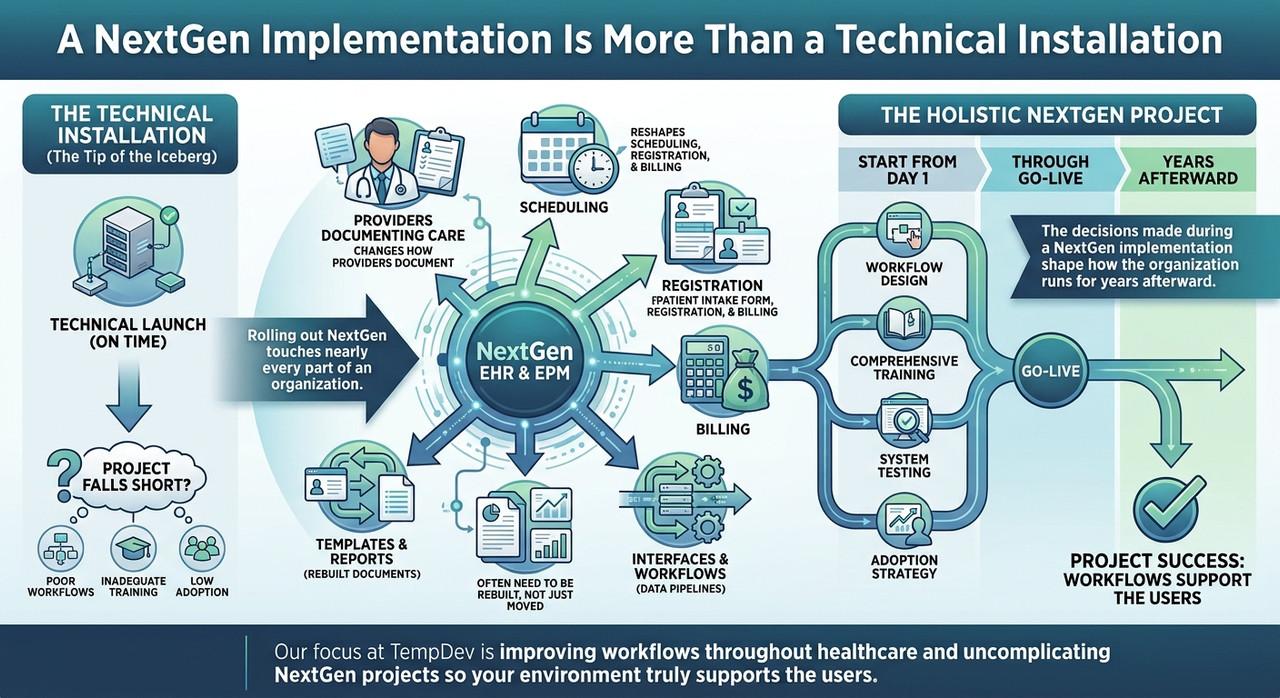
Read ArticleRolling out NextGen touches nearly every part of an organization. A NextGen EHR implementation changes how providers document care, while a NextGen EPM implementation reshapes scheduling, registration, and billing simultaneously. Templates, reports, interfaces, and workflows built for the old system often need to be rebuilt, rather than simply moved over. In addition, different departments bring different priorities, and staff have to learn a new system while still seeing patients.
The decisions made during a NextGen implementation don't disappear at go-live. They shape how the organization runs for years afterward. Because of that, a project can technically launch on time and still fall short if workflows, training, testing, and adoption aren't part of the plan from the start.
Our focus at TempDev is getting NextGen implementations and training right from the start, with thoughtful workflows, configuration, and user education that support how your organization actually works. The goal is to build a strong foundation from day one, so you’re not turning around six months later trying to optimize an implementation that never quite worked in the first place.
What Does a NextGen Implementation Include?
Implementation is the coordinated work of planning, configuring, testing, training, launching, and supporting NextGen EHR or EPM.
First, you must define organizational goals and project requirements. Next, review your current clinical, administrative, and revenue cycle workflows. Then configure NextGen precisely around the organization’s needs.
During a NextGen EHR implementation, teams develop or modify templates, reports, and interfaces. They carefully prepare and validate data. Afterward, they test the system and all connected workflows.
Users receive instruction based entirely on their roles and responsibilities. Finally, teams plan for go-live and post-launch support. Most importantly, implementation decisions should be based on how the organization actually works. You should never simply reproduce an old, inefficient system inside NextGen.
When Does an Organization Need NextGen Implementation Support?
Healthcare organizations need professional implementation support when:
Moving from another EHR or practice management platform to NextGen.
Adding NextGen EHR to an organization already using NextGen EPM.
Starting a NextGen EPM implementation alongside an existing clinical system.
Expanding NextGen into a new location, specialty, or department.
Standardizing separate NextGen environments after a corporate merger.
Implementing a major new module, feature, template package, or interface.
Rebuilding an implementation that did not meet the organization’s true needs.
Supporting an internal team that lacks the time or experience to manage the full process.
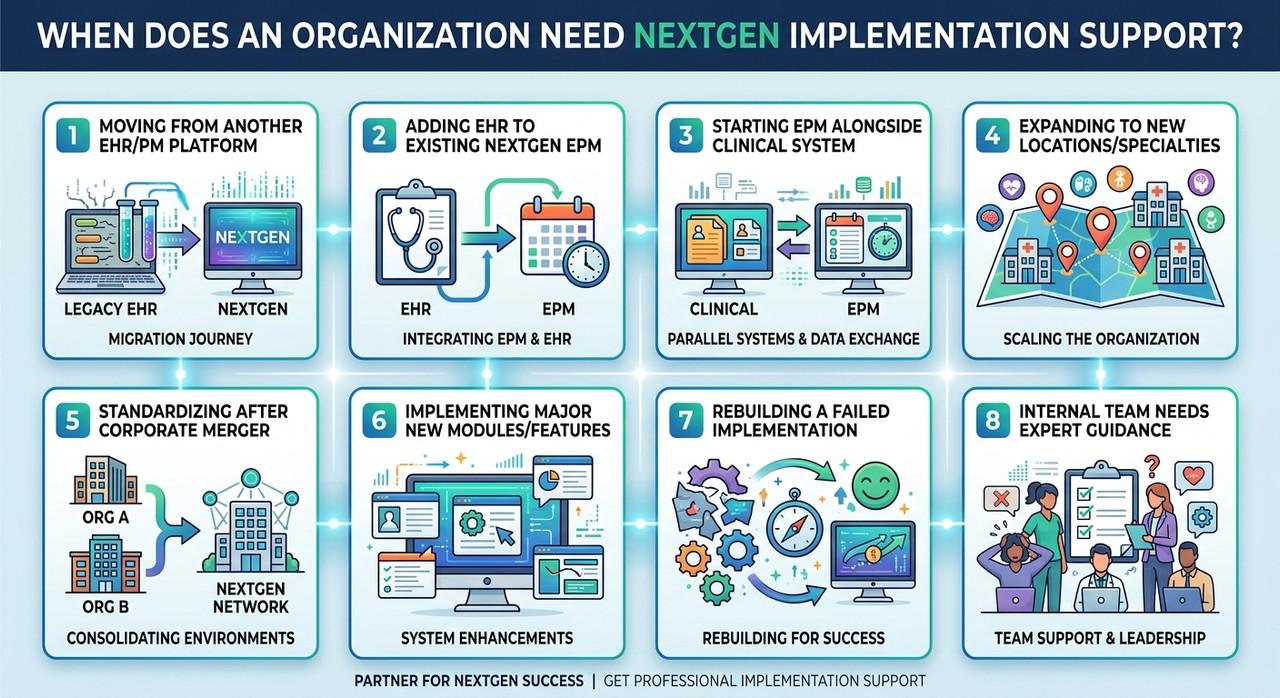
Implementation support can cover the entire project or fill specific areas where the organization needs additional expertise.
What a Strong NextGen Implementation Process Should Include
Discovery and Goal Setting
First, define exactly why you are starting a NextGen EHR implementation or expanding the system. You must identify clear clinical, financial, operational, and technical goals, what success looks like, and which workflows, departments, and stakeholders will be affected.
Workflow Review and Requirements Gathering
Before configuring anything, document how work happens today. Flag inefficient processes that shouldn't carry over into the new system, and gather requirements from providers, staff, billing teams, and leadership, noting differences by specialty and location. Then, translate these organizational needs into clear configuration and development requirements.
NextGen Configuration and Development
This is where approved workflows become real: billing, claims, templates, reports, dashboards, user security and access levels, interfaces, forms, patient letters, tasking, and other supporting tools, all configured to match how the organization needs to operate.
Data Preparation and Conversion
Here, historical clinical and operational data is cleaned, standardized, mapped securely to the correct locations in NextGen, and tested before transfer; validating that converted data is complete and accurate matters as much as moving it.
Testing and Go-Live Preparation
Both individual system components and full workflows need testing. Confirm that interfaces, reports, templates, and security work perfectly before go-live, with a clear plan for downtime and escalation if something goes wrong.
Why NextGen Training Must Be Based on Real Workflows
Generic feature walkthroughs don't prepare anyone for a real day at work. Providers need NextGen EHR training that shows them how to document actual visits. Front-office staff need to practice real scheduling, registration, and check-in scenarios. Billing teams need to see how their work moves into claims and account follow-up, and managers need to know how to monitor work and use reports effectively.
Most importantly, good NextGen training ensures every employee clearly understands how their specific tasks affect other departments and shows them how to complete their responsibilities, not just where the buttons and menus are.
What Effective NextGen Training Should Include
Role-Based Training
Providers, clinical staff, front-office teams, billers, managers, and administrators all need different training, built around what each group actually does. NextGen EHR training for a provider looks nothing like training for a scheduling coordinator, and it shouldn't.
Hands-On Workflow Practice
Realistic scenarios and complete workflows, instead of isolated clicks, give staff room to ask questions and surface configuration problems before go-live, when they're still easy to fix.
Training Materials and Ongoing Resources
Quick-reference guides, recorded sessions, documentation for new hires, and refresher training after launch help the lessons stick past the first week.
To learn more, read how NextGen training can help your practice.
Superuser and Leadership Preparation
Internal experts who can support coworkers, and managers equipped to monitor adoption, give the organization a way to sustain what training started, long after the trainers leave.
Go-Live Is the Beginning, Not the End
Organizations absolutely need support after NextGen launches. Users will inevitably encounter situations that did not appear during testing. Real patient volume quickly exposes hidden workflow bottlenecks. Additional NextGen training needs usually become visible immediately.
Templates, reports, and system settings may require quick adjustments, and workarounds can form fast when questions go unanswered. Comparing performance against the original goals and staying involved after go-live helps stabilize the environment before workarounds become habits.
How Implementation and Training Help Workflow Better
Done well, a NextGen EHR & Practice Management implementation and the training behind it align the system with how the organization actually operates, instead of replicating old inefficiencies inside new software. Staff gets clearer workflows, confusion drops after go-live, and teams become confident faster. Departments and locations stay more consistent, and the whole transition feels manageable instead of disruptive.
For more details, explore the six benefits of EHR implementation and project management.
How TempDev Uncomplicates NextGen Implementation and Training
We bring deep knowledge of NextGen EHR and EPM to every project, along with experience connecting clinical, administrative, financial, and technical workflows. That support runs from early planning through post-go-live stabilization, covering configuration, templates, reporting, interfaces, conversions, and testing along the way.
Our NextGen EHR training and NextGen implementation work are both built around your actual workflows and user roles, not generic feature lists. We can lead a full implementation or fill specific project gaps. Either way, the recommendations come from real experience with how people use NextGen every day.
Explore our NextGen EHR consulting and NextGen EPM consulting services to learn more about our approach.
Build a NextGen Environment Your Team Can Use With Confidence
Long-term success with NextGen comes down to planning, configuration, workflow alignment, testing, training, and support that continues after launch. Skip any one of those, and the system that looked great in the demo can still fall short in daily use.
If your organization is planning a NextGen EPM implementation, EHR rollout, or system upgrade soon, let's talk.
Interested?
Agree with our point of view? Become our client!
Did you enjoy this read? Feel free to share it with your contacts.