


NextGen Data Conversions Done Right: What It Actually Takes

Related articles:
Turn Your NextGen Healthcare Data Into Business Intelligence and Reports That Work
Read ArticleHow TempDev’s NextGen Quality Consulting Can Fix Documentation Gaps and Boost Performance
Read ArticlePerform a NextGen Revenue Cycle Optimization With TempDev For Less Administrative Friction And Stronger Cash Flow
Read ArticleHealthcare Data Cannot Simply Be Moved From One System to Another
Ask any healthcare practice leader who’s lived through a rough clinical or operational data move into their EHR and Practice Management system what went wrong, and you'll rarely hear "the data didn't move." You'll hear that it moved, but nobody could find it, trust it, or use it the way they used to. Whether you're switching from another EHR, consolidating instances, or expanding an existing NextGen environment, a NextGen data conversion should preserve the meaning and usability of your data, not just relocate it.
Because different systems store, organize, and define information differently, similar fields may use different formats, values, or definitions; clinical and operational data may have different retention and access needs, custom fields may not have an obvious home in NextGen, and some information may need to stay accessible even when it isn’t converted. A successful healthcare data conversion protects patient care, billing, reporting, and compliance, which is exactly what we focus on at TempDev.

What Is a NextGen Data Conversion?
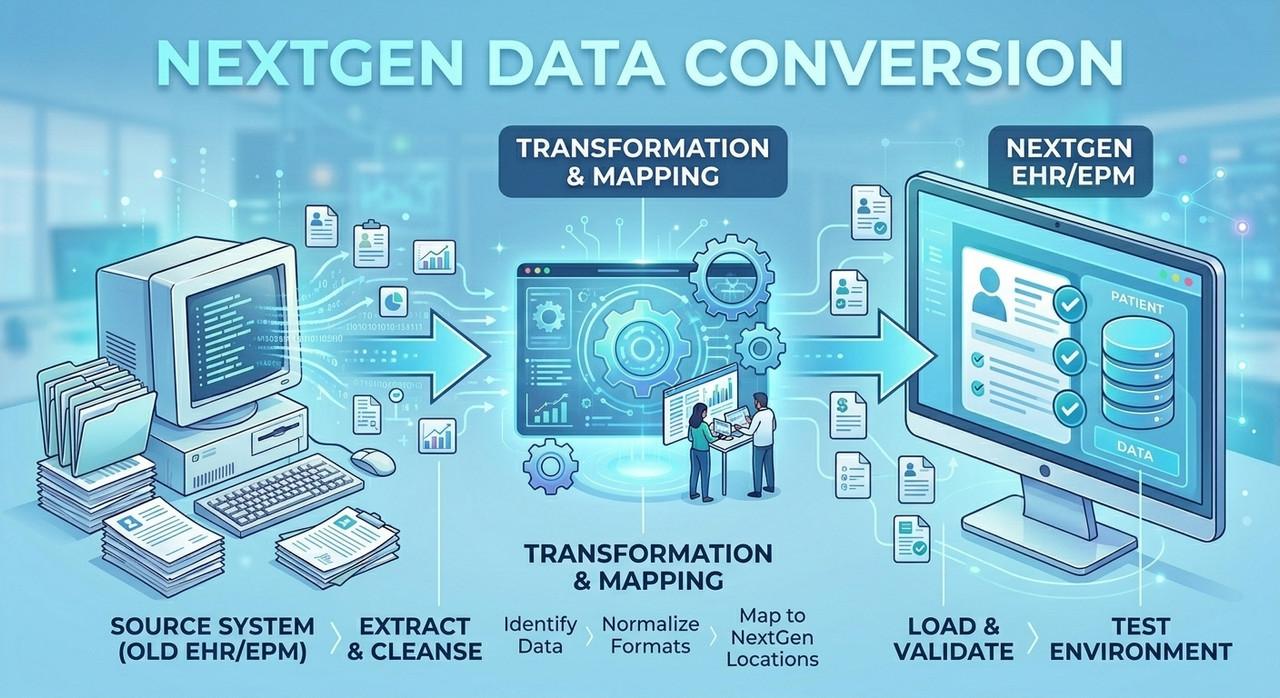
A NextGen data conversion is the process of extracting information from a source system, transforming it into the right format, and loading it into NextGen EHR or EPM. Whether the project is a NextGen EHR data conversion, a NextGen EPM data conversion, or both together, the work generally involves:
Identifying the data that needs to move
Extracting it from the original system
Cleaning, normalizing, de-duplicating, and preparing the information
Mapping source data to the correct NextGen locations
Loading it into a test environment
Validating completeness and accuracy
Correcting issues before the final migration
Production migration
Data conversion can involve clinical records, patient demographics, appointments, documents, providers, and insurance information, among other data types.
When Does a Healthcare Organization Need a NextGen Data Conversion?
A few common situations call for EHR or Practice Management data migration support:
Moving from another EHR or practice management system to NextGen
Moving to another EHR or Practice Management System from NextGen
Adding a new practice to an existing NextGen EHR or NextGen EPM environment
Consolidating multiple NextGen databases or instances
Merging practices, locations, or organizations
Separating a practice from a shared NextGen environment
Acquiring another organization and moving its records
Replacing an older application connected to NextGen
Archiving or retiring a legacy system
Rebuilding an earlier conversion that didn't meet expectations
The right conversion approach depends on the systems involved, the data available, and how the organization plans to use its historical information.
Decide What Data Should Be Converted
Not every piece of historical information belongs in the active NextGen environment. Before conversion begins, we help your organization to:
Determine regulatory and retention requirements
Identify what's needed for patient care and continuity
Determine what billing and collections teams require
Identify data needed for reporting, quality programs, or audits
Separate active information from outdated records
Decide what gets converted, archived, scanned, or left in the legacy system
These decisions work best when clinical, operational, financial, legal, and technical stakeholders weigh in together, since each group depends on the data differently once the healthcare data conversion is complete.
What a NextGen Data Conversion Process Should Include
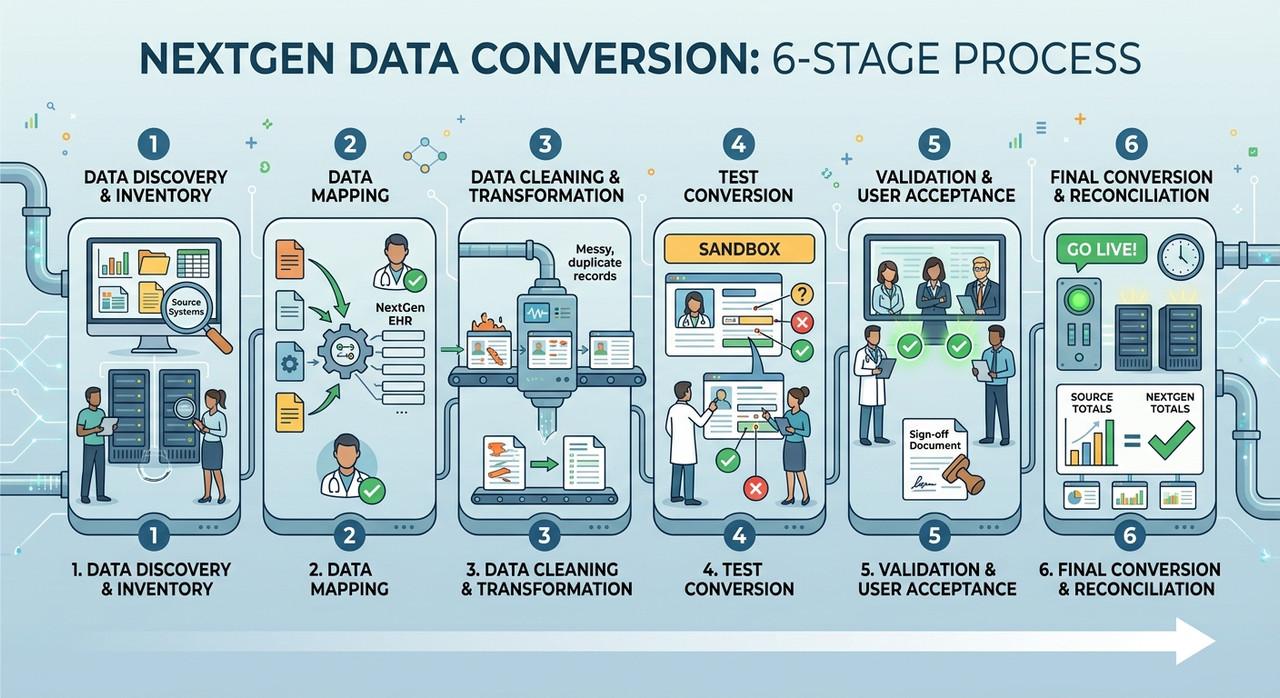
A well-run conversion moves through six connected stages.
Data Discovery and Inventory
Every conversion starts with identifying source systems and documenting available data types, formats, and volumes. This is also when teams determine who owns and understands each data set, flag missing, duplicated, or unreliable information, and review custom fields, codes, and historical configurations before confirming how the data can be extracted. ONC's EHR playbook is a useful reference if you're building this process from scratch.
Data Mapping
Next, source fields get matched to the correct NextGen EHR or EPM fields, requiring teams to determine how historical information should appear to users. Codes, statuses, and categories are translated; provider and payer structures are accounted for; and any fields that can't be converted directly are documented, and clinical and operational approval is obtained for key mapping decisions.
Data Cleaning and Transformation
Dates, names, codes, and formats get standardized, resolving any invalid or incomplete values wherever possible. Duplicate records are addressed, and source data is transformed into the format NextGen or the end point system requires while preserving the relationships between patients, encounters, appointments, payers, orders, and documents. Throughout this process, teams must also carefully document any assumptions or limitations.
Test Conversion
A representative dataset is loaded into a test environment so NextGen users can verify correct record locations and identify mapping, formatting, and usability problems. Teams then compare record counts and totals against the source system, repeating tests after corrections using HealthIT.gov's system testing guidance as a framework.
Validation and User Acceptance
Clinical, billing, operational, and technical reviewers validate both individual records and aggregate totals to ensure users can easily locate and understand the converted information. They also verify that the data supports required workflows and document any discrepancies before signing off on the production conversion.
Final Conversion and Reconciliation
Once approved, the team establishes a cutoff and final extraction schedule, coordinates any downtime or workflow changes, and completes the production conversion. Converted totals are then reconciled against the source system, the environment is monitored for post-conversion issues, and the entire conversion and validation process is fully documented.
Common Risks in a Healthcare Data Conversion
Several recurring issues can derail a conversion or delay a go-live:
Incomplete access to source data
Inconsistent data quality
Undocumented custom fields and values
Requirements that shift late in the project
Limited clinical or operational involvement
Not enough time for testing and validation
Assuming source and destination systems organize data the same way
Retiring the source system before validation is complete
Catching these risks early gives an organization more room to address them before they affect the timeline or accuracy of an EHR data migration.
How Data Conversion Affects Daily Workflows
Converted data only matters if people can use it in the context of everyday work. Providers need to locate relevant clinical history. Staff need to identify existing patients and appointments. Billing teams need accurate balances, charges, and insurance information, and reports need to reflect correct historical values. Users also need to know what was converted and where to find it, since archived information must remain accessible through a defined process. Technically complete data isn't enough if nobody can find, interpret, or trust it.
How a Well-Planned Conversion Helps Workflow Better
A properly executed EHR or PM data migration gives users the information they need within NextGen rather than scattered across disconnected systems. It supports continuity of clinical and financial work, prevents unnecessary manual reentry, and improves confidence in reports and historical records. It also makes mergers, implementations, and system transitions less confusing to manage, because everyone knows where information lives rather than guessing.
How TempDev Uncomplicates NextGen Data Conversions
We bring deep knowledge of NextGen EHR and EPM data structures, along with real experience across clinical, demographic, operational, and financial data. Our team handles data analysis, mapping, transformation, and validation while collaborating with clinical, billing, and technical stakeholders every step of the way. TempDev's project management team ensures that all tasks are accounted, adhered to, and stakeholders are communicated with.
Whether your project is a NextGen EHR data conversion or a NextGen EPM data conversion, our NextGen EHR consulting and NextGen EPM consulting teams support implementations, mergers, acquisitions, splits, and legacy system retirement. We document every decision, limitation, and result so nothing gets lost along the way.
Read more on what an EHR clinical data conversion actually involves and how NextGen data conversions work across EHR and EPM.
Move Your Data Into NextGen Without Losing What Matters
A successful NextGen data conversion comes down to careful decisions, detailed mapping, multiple rounds of testing, and validation from the people who actually understand the information. Get those pieces right, and your data supports the organization instead of slowing it down.
Ready to plan your NextGen EHR or EPM data conversion with TempDev? Let's talk about what it would take to move your information without losing what matters.
Interested?
Agree with our point of view? Become our client!
Did you enjoy this read? Feel free to share it with your contacts.