


Perform a NextGen Revenue Cycle Optimization With TempDev For Less Administrative Friction And Stronger Cash Flow


Revenue cycle performance rarely breaks down in one place. A payment problem that surfaces at the end of the process often started weeks earlier, in scheduling, eligibility, authorization, or a system configuration nobody has reviewed in years. When cash flow slows, or denials climb, it is tempting to focus on the account in front of you. But healthcare revenue cycle optimization works best when it looks at the entire path from patient access to final payment.
That is where NextGen revenue cycle optimization with TempDev comes in.
Revenue Cycle Problems Often Begin Before a Claim Is Submitted
The revenue cycle is not a billing-department function. It is a connected process that starts before a patient ever arrives. Scheduling decisions affect registration and authorization, and incorrect demographic information can create claim problems weeks later. Eligibility and benefits checks shape what a patient ultimately owes, while missing authorizations can delay or prevent payment altogether. Clinical documentation affects coding and charge capture, and claim edits depend on accurate system configuration. Denials often reveal problems that started much earlier in the workflow, and even patient collections are shaped by the original estimate, how clearly it was communicated, and the payment options available.
Because these steps are connected, improving one isolated billing task rarely corrects the broader problem. At TempDev, our goal is to make work flow better throughout the organization by uncomplicating NextGen EPM and the revenue cycle processes built on it.
What Is NextGen Revenue Cycle Optimization?
NextGen revenue cycle optimization is the process of reviewing and improving the people, workflows, technology, data, and reporting involved in getting paid for healthcare services. It can include patient access, registration and scheduling, insurance verification, authorizations and referrals, estimates and pre-visit collections, documentation and charge capture, coding and claim preparation, claim submission and rejection management, denial prevention and resolution, payment posting, patient billing and collections, credit balances and refunds, accounts receivable follow-up, and reporting. Together, these pieces form the foundation of dependable NextGen revenue cycle management.
Optimization is not simply asking staff to work more accounts. It means improving the systems and processes that create the work in the first place, which is the real purpose of NextGen EPM optimization.
When Does an Organization Need Revenue Cycle Optimization?
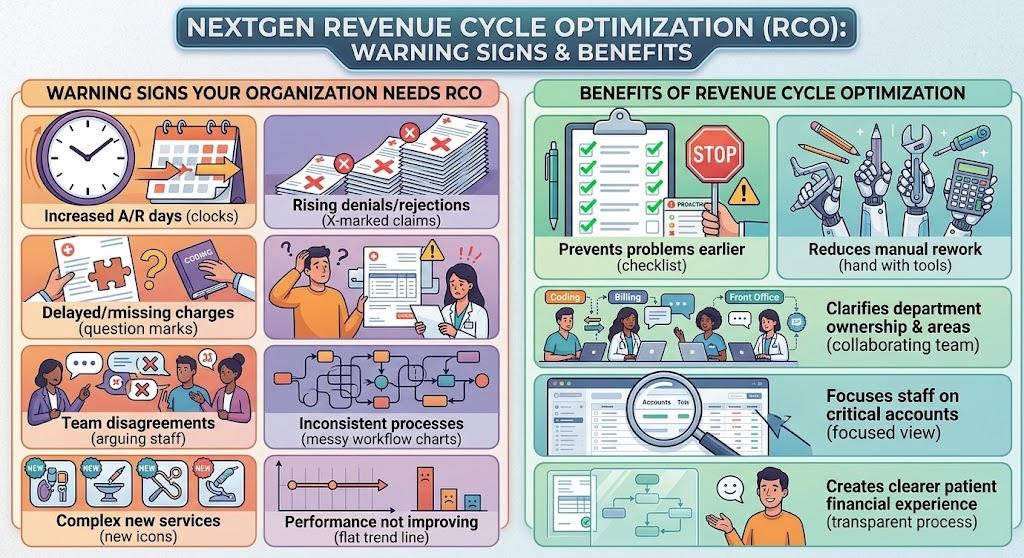
Several warning signs suggest it is time for healthcare revenue cycle optimization:
Days in accounts receivable are increasing, or denials and claim rejections are rising.
Charges are delayed or missing, and staff maintain large manual worklists.
Patient balances are difficult to collect, and employees rely on spreadsheets instead of NextGen.
Revenue cycle teams disagree about ownership, or reports do not match.
Different locations follow inconsistent processes, and staffing shortages create growing backlogs.
Payer rules and system edits are not maintained.
New services, providers, or locations have added complexity that the current setup was not built to handle.
Financial performance does not improve despite increased effort.
Optimization can focus on one process or the full revenue cycle, and a revenue cycle assessment can help pinpoint where to start.
What Areas Should Revenue Cycle Optimization Review?
Patient Access and Registration
Accurate front-end work prevents downstream rework. This means reviewing appointment scheduling, patient demographics, insurance information, eligibility and benefits, authorizations and referrals, estimates, copays, and front-office communication and training.
Documentation, Coding, and Charge Capture
This area covers documentation completeness, coding workflows, charge entry and review, missing-charge processes, provider and staff responsibilities, interfaces and automated charge feeds, timeliness between service and claim submission, and communication between clinical and billing teams.
Claim Preparation and Submission
Strong NextGen billing optimization depends on accurate claim edits, payer-specific requirements, clearinghouse workflows, rejection handling, claim status monitoring, timely filing, ownership of suspended claims, and automation opportunities.
Denial Prevention and Management
Effective denial management reviews categories and trends, root causes, assignment and prioritization, appeal workflows, documentation and authorization issues, payer behavior, upstream correction processes, and reporting on both resolution and prevention.
Payment Posting and Account Resolution
This includes electronic and manual payment posting, remittance reconciliation, underpayments, contractual adjustments, insurance follow-up, patient balances, credit balances and refunds, and consistent account closure standards.
Patient Billing and Collections
Clear estimate communication, pre-visit collections, statement clarity, electronic statements, online payment options, payment plans, and text and email reminders all shape the patient's financial experience. This is where NextGen billing optimization has the most direct, visible impact on patients.
Reporting and Performance Management
Reliable reporting tracks days in accounts receivable, aging distribution, clean-claim and first-pass performance, rejection and denial trends, charge lag, payment and collection performance, and comparisons across payer, provider, location, and service line.

Identify Root Causes Instead of Treating Every Account Separately
Recurring account problems are usually traceable to an earlier step. Registration errors can create eligibility or claim problems, and authorization issues may begin during scheduling. Coding problems often start with documentation, and denials can be caused by outdated configuration or payer rules. Patient balances suffer when estimates are inaccurate, and aging can increase simply because work is not routed clearly. Reports become unreliable when staff use inconsistent statuses, and repeated manual corrections usually point to an automation opportunity. Account resolution recovers individual dollars, but consistent NextGen revenue cycle management depends on fixing the root cause.
Use NextGen EPM to Create Clearer Workflows
NextGen EPM optimization gives organizations the tools to standardize statuses and work queues, route work to the right people, and use reports to flag high-priority exceptions. It also supports automating repetitive steps, maintaining claim edits and payer requirements, and building clear escalation processes. Connecting front-office, clinical, and billing workflows reduces duplicate tracking, gives managers real visibility into volume and performance, and clears out outdated reports, queues, and procedures that no longer serve the organization. When NextGen EPM cannot accommodate your desired workflows, partnering with TempDev for custom NextGen EPM solutions is also an option.
Measure Whether Changes Improve Performance
Before making changes, establish baseline measurements and agree on how each metric is defined. Set realistic operational and financial goals, and monitor both outcomes and leading indicators across payer, provider, location, and service. Validate report calculations, investigate unexpected changes, and give teams regular feedback. The most useful measures depend on each organization's goals, but adjustments should always follow evidence, not isolated complaints.
Support Staff Through Process Changes
Optimization also requires change management. Involve the employees who complete the work, and explain why workflows are changing. Give staff clear responsibilities, provide role-based training, and update written procedures. Prepare managers and superusers to support the transition, monitor adoption, and address new workarounds quickly. Sometimes the data will also reveal staffing or capacity problems that process changes alone cannot solve.
How Revenue Cycle Optimization Helps Work Flow Better
Done well, healthcare revenue cycle optimization prevents problems earlier in the claim lifecycle. It supports stronger NextGen revenue cycle management by reducing manual rework, clarifying ownership across departments, and helping staff focus on accounts that actually need action. It connects clinical, operational, and financial workflows, improves the accuracy of reports, and creates a clearer financial experience for patients. Stronger performance should come from better processes, not more pressure on employees or patients.
How TempDev Uncomplicates NextGen Revenue Cycle Optimization
TempDev brings deep knowledge of NextGen EPM and a clear understanding of the full patient-to-payment workflow, including patient access, billing, denials, collections, and account resolution. Our team supports NextGen configuration and workflow redesign, custom reports and business intelligence dashboards, automation and system integration, staff training, and root-cause analysis. That combination lets us connect system configuration with the operational and financial work happening across the organization, whether a client needs focused NextGen billing optimization or a full NextGen EPM optimization initiative.
Learn more about our NextGen EPM consulting and revenue cycle services, or read our earlier posts on 7 ways to improve your healthcare revenue cycle management and how to optimize your NextGen revenue cycle management.
Build a More Connected NextGen Revenue Cycle
Stronger financial performance requires a complete view of patient access, clinical documentation, billing, claims, collections, reporting, and staff workflows. When those pieces work together, NextGen revenue cycle optimization becomes less about chasing individual accounts and more about running a system that performs consistently.
If your organization is ready to talk about NextGen revenue cycle optimization, reach out to TempDev. We would be glad to discuss where to start.
Interested?
Agree with our point of view? Become our client!
Did you enjoy this read? Feel free to share it with your contacts.