


How TempDev Extends NextGen Custom Interfaces for Complex Data Exchange

Related articles:
Turn Your NextGen Healthcare Data Into Business Intelligence and Reports That Work
Read ArticleHow TempDev’s NextGen Quality Consulting Can Fix Documentation Gaps and Boost Performance
Read ArticlePerform a NextGen Revenue Cycle Optimization With TempDev For Less Administrative Friction And Stronger Cash Flow
Read ArticleNextGen Custom Interfaces
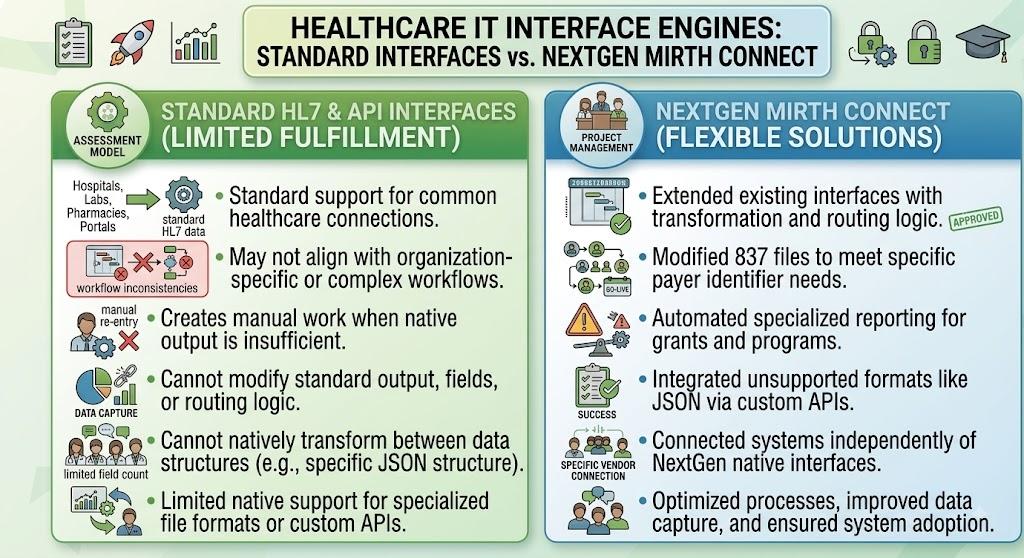
NextGen supports standard HL7 and API interfaces for many common healthcare connections, including hospitals, laboratories, pharmacies, payers, clearinghouses, third party applications, health information exchanges, and patient portals. But healthcare data exchange is rarely one-size-fits-all, and not every workflow or system can be supported by an out-of-the-box interface.
That is where an interface engine becomes especially valuable. Interface engines can connect systems with different data formats, transform and route information, and support more complex integration requirements. To learn more about some of the leading options, read our 5 Best Interface Engines for EHR and PM Systems.
One of our preferred solutions is NextGen Mirth Connect, a highly flexible interface engine that can support custom integrations and complex data exchanges when a standard interface is not available or does not fully meet an organization’s needs. TempDev uses Mirth Connect to extend existing NextGen interfaces or build custom integration workflows when standard options cannot support the required exchange.
What Is Mirth, and How Does It Work With NextGen?
Mirth is a NextGen interface engine that receives, transforms, routes, and delivers healthcare data between systems. It can modify individual data elements, translate between formats, apply routing rules, and deliver information to the appropriate payer, vendor, grant partner, or external application.
It supports JSON, XML, CSV, HL7, X12, databases, APIs, and file-based exchanges. Mirth can extend an existing NextGen interface or operate independently when the required exchange is not supported natively.
When Does an Organization Need Mirth Interface Development?
There are many scenarios where Mirth interface development is needed.
A payer requires additional information in an 837 file that the standard output does not include. A grant program requires a highly structured report to be generated automatically. An external organization expects HL7 fields that are not included in the standard message. Certain fields need to be removed before data is delivered. A vendor uses different codes, formats, or naming conventions. Data must be routed differently depending on the provider, location, program, payer, or patient population.
Staff members manually edit files before sending them. Employees repeatedly export, reformat, and upload data through spreadsheets. An outside system sends JSON that NextGen cannot ingest directly. A vendor requires NextGen information to be exported as JSON. A grant or payer requires a file format that NextGen does not support natively.
When a standard NextGen interface does not exist for the required exchange, Mirth Connect is a popular choice. Some examples are when data must move directly between NextGen and an external API, database, or file source or Information must be transformed between JSON, HL7, X12, XML, CSV, or another required structure.
Common Ways TempDev Uses Mirth With NextGen Custom Interfaces
Modifying 837 Files for Payers
Payers do not always accept an 837 exactly as it comes from a standard NextGen workflow. One may require an additional identifier or segment, while another may have specific formatting or provider information requirements. Mirth can make those adjustments before the file is sent, including adding data elements, reformatting fields, applying payer-specific rules, and routing the completed file to the right destination. Staff does not have to open and modify the file manually.
Supporting Grant and Specialized Program Reporting
Grant-funded programs can have their own reporting requirements, particularly when the information must be submitted in a specific structure. Mirth can pull the required data from NextGen, organize it according to the program's specifications, and create the submission on a defined schedule. It can also handle transmission and provide a way to identify successful or failed submissions. That makes recurring reporting less dependent on staff rebuilding the same file each time.
Adding or Removing HL7 Fields
Supporting HL7 does not necessarily mean two systems expect the same message. One system may need information that the other does not normally include. Custom HL7 interface development can address these differences by adding or removing fields, translating codes, changing field placement, or filtering messages based on defined criteria. Mirth can make these changes before the message reaches the receiving system, while the underlying NextGen interface remains in place.
Ingesting and Exporting JSON
JSON creates another common integration challenge. An outside application may send information in JSON even though the required exchange is not available through a standard NextGen interface. Mirth can receive the data, validate the structure, and transform it into a format that NextGen can use. The same process can work in the other direction when another application needs NextGen information in a specific JSON structure. Field mapping and business rules can be applied as part of the exchange.
Transforming Data Between Systems
Data does not always line up neatly between healthcare systems. A field name, code, format, or status used by one application may mean something different to another. Mirth can map the source information to the appropriate destination fields and translate data between formats such as JSON, HL7, X12, XML, and CSV. Rules can also be applied to missing, duplicate, or invalid information before the data moves forward.
Automating Specialized Data Exchanges
Some organizations still rely on a familiar manual process: export the data, open the file, make changes, save it, and send it to another system. That process takes staff time and creates opportunities for mistakes. Mirth Connect healthcare integration can automate much of this exchange. Scheduled files can be generated, transformed, routed, and delivered without requiring someone to repeat the same steps each time. The workflow can also include error handling and monitoring when a transmission does not go as expected.
Start With the Data Exchange Requirement
Before Mirth development begins, clearly define the intended process.
What information needs to move?
Does a standard NextGen interface already support the exchange?
Does Mirth need to modify data moving through an existing interface or operate independently?
What format does the source system provide?
What format does the destination system require?
Which fields, segments, or codes must be added, removed, or transformed?
Where should the information appear in the receiving system?
Who owns monitoring and resolving errors?
Mirth Connect interfaces should solve a clearly defined data-exchange gap.
What Mirth Interface Development Should Include
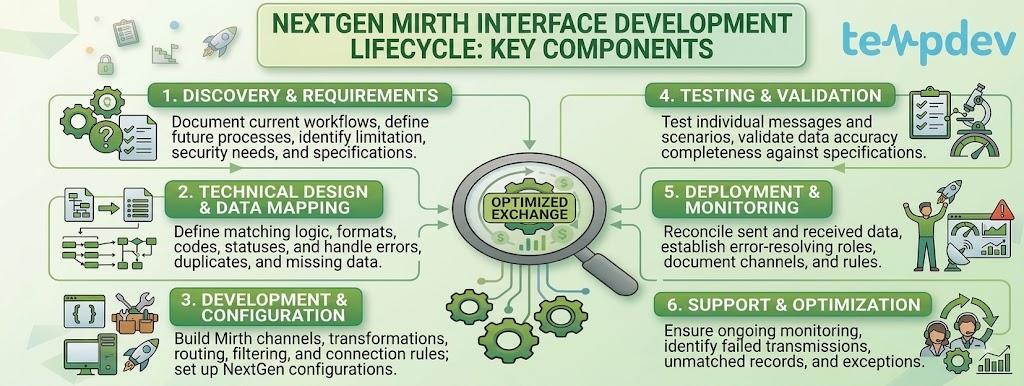
Discovery and Requirements. Document the current workflow and its problems. Define the desired future process. Identify systems, vendors, stakeholders, and data owners. Specify required data elements and exchange frequency. Gather payer, grant, vendor, or partner specifications. Document security, privacy, and access requirements. Assess the organization’s NextGen interoperability needs and identify limitations that standard functionality cannot address. Determine whether Mirth will extend an existing interface or operate independently.
Technical Design and Data Mapping. Map data between source and destination systems. Define matching logic, field formats, codes, statuses, and required values. Document which fields or segments must be added, removed, transformed, or routed. Establish how errors, duplicates, and missing information will be handled. Define how and which formats will be ingested, transformed, generated, and delivered.
Development and Configuration. Build the required Mirth channels and transformations. Configure NextGen to send or receive information correctly. Establish secure connectivity and create routing, filtering, and transformation rules. Add payer-, grant-, vendor-, or program-specific logic.
Testing and Validation. Test individual messages or transactions. Compare transformed output with receiving-organization specifications. Validate data accuracy and completeness. Confirm that information reaches the correct patient and workflow. Test normal and failure scenarios, including payer-, program-, location-, or vendor-specific rules.
Deployment and Monitoring. Plan the production launch and closely monitor early transmissions. Reconcile sent and received information and establish responsibilities for resolving interface errors. Document the Mirth channels, transformation rules, dependencies, and support process.
Why Mirth Monitoring and Integration Strategy Matter
Mirth interfaces require ongoing monitoring because vendors, payers, and connected systems can change over time. Organizations need a clear process for identifying failed transmissions, unmatched records, and other exceptions before they affect operations.
The role Mirth plays also depends on the integration. Mirth can extend an existing NextGen interface when data needs to be modified, translated, filtered, or routed differently. NextGen custom interfaces can provide a solution when no standard interface exists or when the exchange requires a custom API, JSON workflow, database connection, or specialized file format.
Understanding that distinction helps organizations determine whether Mirth should supplement an existing NextGen interface or serve as the primary integration layer.
How TempDev Uncomplicates Mirth Interface Development
TempDev designs, develops, tests, and supports Mirth interfaces for NextGen EHR and EPM. The team helps healthcare organizations extend standard interfaces, integrate JSON and APIs, modify HL7 and X12 transactions, and automate specialized data exchanges that standard interoperability cannot support.
Learn more about our NextGen EHR consulting, NextGen EPM consulting, and interface engine expertise.
Build the Data Exchange NextGen's Standard Options Cannot Support
Mirth fills the gaps where standard NextGen interfaces end. Whether the requirement involves modifying an existing transaction or building a custom integration, the right approach depends on the organization's workflow, systems, and data requirements.
Ready to build your NextGen custom interface? Contact TempDev to work with our Mirth Connect Certified developers on a custom integration designed for your organization.
Interested?
Agree with our point of view? Become our client!
Did you enjoy this read? Feel free to share it with your contacts.