


Turn Your NextGen Healthcare Data Into Business Intelligence and Reports That Work

Related articles:
How TempDev’s NextGen Quality Consulting Can Fix Documentation Gaps and Boost Performance
Read ArticlePerform a NextGen Revenue Cycle Optimization With TempDev For Less Administrative Friction And Stronger Cash Flow
Read ArticleHow a NextGen Revenue Cycle Assessment with TempDev Reveals Hidden Financial Gaps
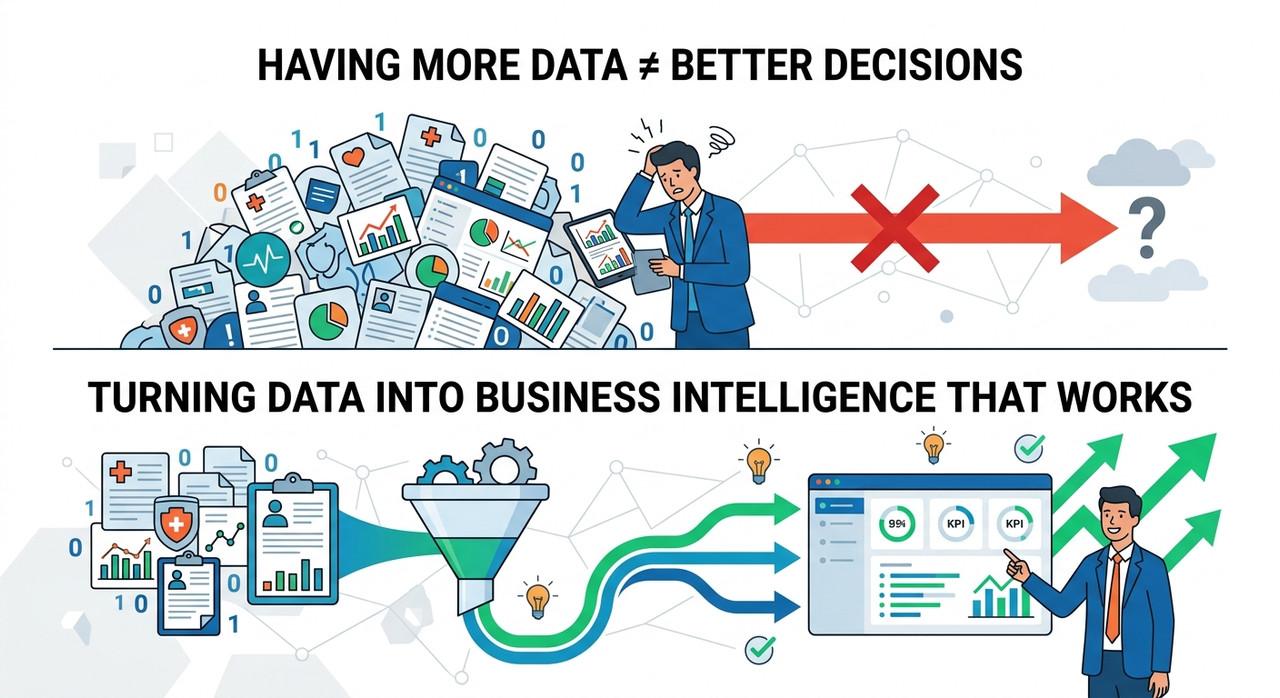
Read ArticleHaving More Data Does Not Automatically Create Better Decisions
Healthcare teams often work with more information than they can realistically act on. Important details may be spread across the EHR and EPM. Standard reports may not answer organization-specific questions, and teams may calculate the same metric differently. Reports may also require time-consuming manual manipulation. Leaders may receive information after the opportunity to act has passed. Because of this, staff often fall back on spreadsheets that quickly become outdated. Data quality problems make users question the results, and different roles need different levels of detail. Effective reporting should give each user the right information, at the right time, in a format they understand. That is the goal behind every NextGen report and NextGen Business Intelligence project TempDev builds. The aim is to make healthcare data easier to use, not just easier to collect.
What Are NextGen Reports and Business Intelligence?
NextGen reports and Healthcare Business Intelligence serve related but different purposes.
NextGen reports help organizations retrieve specific clinical, financial, and operational information, monitor required activities and exceptions, and support daily worklists. They also meet recurring reporting requirements and help teams analyze historical performance.
NextGen Business Intelligence takes that work further. It combines data from multiple sources and visualizes trends that a static report can't show. Dashboards let leaders monitor KPIs and compare locations, departments, providers, or time periods, moving the organization toward interactive analysis.
Reports and dashboards should be built around business and clinical questions, not around every available data point.
When Does an Organization Need Custom NextGen Reporting?
Several signs point to a need for custom NextGen EHR reporting or NextGen EPM reporting.
Often the first clue is that standard reports don't answer the question being asked, so employees spend hours building spreadsheets by hand. Because teams calculate the same metric differently, leaders get different answers to the same question. Staff can't easily spot incomplete or overdue work, reports take too long to prepare, and teams can't drill into the reasons behind a result. Clinical, operational, and financial data often gets reviewed separately, making the full picture harder to see.
Growth adds its own pressure. An organization that is expanding, adding new programs, or facing changed quality or revenue cycle requirements often finds its reports no longer reflect current workflows or configuration. When leadership needs more timely visibility, that gap becomes hard to ignore.
Many organizations also participate in grant, payer, government, or public health programs that require very specific reports that need to be custom built to meet the requirements.
Start With the Decision the Report Must Support
Before development begins, a few questions should guide the work.
Who will use the report, and what decision or action should it support? How often is the information needed, and at what level of detail? It also helps to identify which NextGen fields hold the data and how the metric should be defined.
Practical details matter too: what filters or drill-down capabilities are needed, and what should happen once the report finds a problem? Finally, decide in advance how the organization will know the report is useful.
A report without a clear user or action can add information without improving performance.
What Can NextGen Reports and BI Dashboards Measure?
Clinical Operations
On the clinical side, NextGen reports and dashboards track patient volumes and appointment flow alongside provider productivity and documentation completion. They can also surface orders, results, and referral activity, along with the workflow bottlenecks that slow clinical teams down.
Revenue Cycle Performance
Revenue cycle reporting typically covers charges, payments, and days in accounts receivable, along with claim submission, rejections, and denial trends. Payer and service-line performance round out the picture, together with patient balances, collections, and credit balances that need follow-up.
Quality and Population Health
For quality and population health, reporting focuses on gaps in care and quality measure performance, along with patient outreach and follow-up. Program enrollment, documentation completeness, and preventive and chronic care measures all fall under this same umbrella.
Operational and Leadership Reporting
At the leadership level, reporting shifts toward staffing, workload, and location comparisons. It also covers service growth, system adoption, and project performance, rounded out by backlogs and organizational scorecards.
What Effective NextGen Report Development Should Include
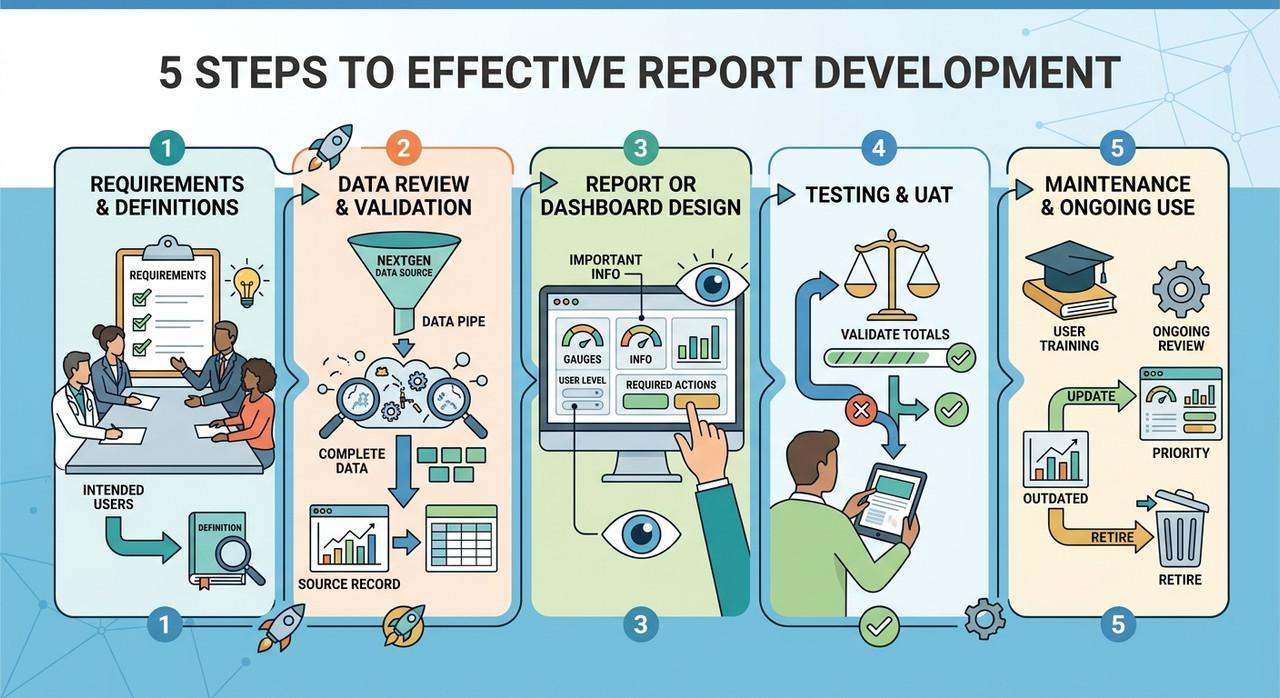
Requirements and metric definitions. We identify intended users and decisions, agree on definitions, required formats and fields, document filters and calculations, and set acceptance criteria before development begins.
Data review and validation. Next is to confirm where information is stored and evaluate data completeness. Then we review how workflows affect data capture, and compare results with known source records.
Report or dashboard design. We then visualize the most important information clearly, match detail to the intended user, and make required actions easy to identify.
Testing and user acceptance. After, we test calculations and record-level results, validate totals, confirm filters and comparisons work correctly, ask intended users to complete realistic tasks using the report and resolve discrepancies before release.
Implementation and ongoing maintenance. Finally we train users on definitions and intended use, establish ownership, review reports when workflows change, retire reports that are outdated and update dashboards as organizational priorities change.
Reporting Problems May Begin With Workflow Problems
Reporting cannot always be fixed through report development alone. Required information may not be captured. Users may enter the same value inconsistently, or important data may exist only in free text. Departments may follow different workflows, and interface problems may prevent information from reaching NextGen.
Ambient documentation tools make this tension especially clear. They are designed to produce free-text notes, which is exactly what makes them useful at the point of care. But that same free text can be difficult for reports to structure later. When reporting gaps begin upstream, a clinical audit can help. From there, TempDev may recommend template, configuration, training, interface, or workflow changes rather than a new report.
How Better Reporting Helps Work Flow Better
Reliable NextGen EHR reporting and NextGen EPM reporting give staff clearer worklists and priorities. They help managers spot problems before they grow, reduce time spent assembling information, and create shared definitions across departments. They connect clinical, operational, and financial performance so teams can focus on the exceptions that need action.
The goal is not more reports. It is making complex NextGen data easier to understand and helps them do their jobs better. It also gives leaders greater confidence in the decisions those reports support. The AHRQ Workflow Assessment Toolkit makes a similar point about health IT generally. Successful adoption depends on understanding its impact on clinical and administrative workflow, and reporting is no exception.
How TempDev Uncomplicates NextGen Reports and Business Intelligence
TempDev brings deep knowledge of NextGen EHR and EPM data. We build custom operational, clinical, financial, and quality reporting. We also design NextGen Business Intelligence dashboards that connect reporting requirements to real workflows.
Our team supports metric definition, data validation, and user acceptance testing. We also help identify upstream data or configuration problems before they undermine a new report. Our solutions are designed for frontline users, managers, and executives alike, with ongoing refinement as needs change.
Put Your NextGen Data to Work
Effective NextGen reports and Healthcare Business Intelligence give healthcare organizations a clearer view of performance. They also offer a practical way to turn information into action. The goal is not collecting more data. It is using the data already available effectively.
Ready to put your NextGen EHR reporting and NextGen EPM reporting to work? Talk with TempDev about your next reporting or Business Intelligence project, or explore our NextGen EPM consulting services.
Interested?
Agree with our point of view? Become our client!
Did you enjoy this read? Feel free to share it with your contacts.