


How NextGen EHR Analysis Uncovers the Problems Holding Your Practice Back

Related articles:
Turn Your NextGen Healthcare Data Into Business Intelligence and Reports That Work
Read ArticleHow TempDev’s NextGen Quality Consulting Can Fix Documentation Gaps and Boost Performance
Read ArticlePerform a NextGen Revenue Cycle Optimization With TempDev For Less Administrative Friction And Stronger Cash Flow
Read ArticleYour NextGen EHR may already have more potential than your current workflows, configuration, and templates are allowing you to realize. Maybe providers are spending more time documenting than they should. Staff may be entering the same information in multiple places, important clinical details can be difficult to find, or reporting may not give leadership the visibility they need. These challenges do not always mean the technology itself is the problem. Often, they are signs that there is an opportunity to improve how the system is configured, used, and supported. That is where NextGen EHR analysis can make a difference.
Before replacing technology or making major changes, it helps to understand how your current NextGen environment is actually working. A thoughtful analysis can uncover opportunities to simplify workflows, improve configuration, strengthen user adoption, address training gaps, and take better advantage of functionality already available within the EHR.
At TempDev, our goal is to make healthcare workflows work better. We help organizations understand what is happening today, identify where the greatest opportunities exist, and determine the right changes to create a more efficient and effective NextGen EHR.
What Is NextGen EHR Analysis?
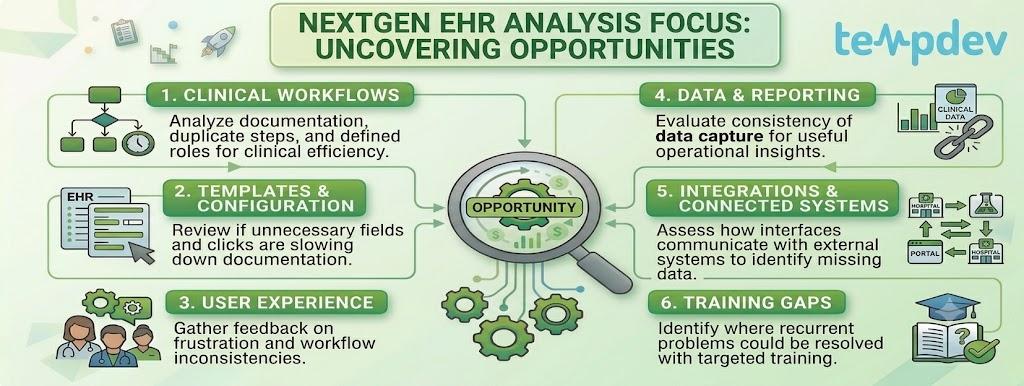
A NextGen EHR analysis is a structured review of how the system is configured, how people use it, and how information moves through clinical workflows.
The process includes:
Reviewing the organization's goals and concerns
Observing or documenting current workflows
Examining NextGen EHR configuration and templates
Gathering feedback from providers, clinical staff, administrators, and technical teams
Reviewing available reports, metrics, and system data
Identifying gaps between the current environment and desired results
Documenting findings and recommending potential improvements
The analysis is not simply a technical system review. It considers the technology, people, processes, and information involved in completing the work. The analyst's role is to investigate, evaluate, and document. The analyst then partners with the the project manager who is responsible for project plans, schedules, resources, or implementation.
When Should a Healthcare Organization Conduct an EHR Assessment?
Several situations may indicate the need for a structured EHR system assessment.
Providers are frustrated with documentation requirements or excessive clicks.
A new specialty or practice needs to be implemented and leadership is unsure of next steps.
Staff members use workarounds outside NextGen.
Different locations or departments follow inconsistent processes.
The organization is preparing for an upgrade, an implementation, a merger, or a major change.
Leaders lack confidence in the accuracy or usefulness of system reports.
Training has not resolved recurring workflow problems.
Productivity, user satisfaction, or data quality has declined.
Leadership needs a clearer understanding before deciding whether to begin a larger project.
An analysis can be useful before a major project or as a standalone step to determine what problems exist.
What a NextGen EHR Analysis Should Evaluate
Clinical Workflows
Clinical workflow analysis examines how information moves from scheduling through documentation and follow-up. It looks at where providers and staff experience delays or duplicated work. It considers whether roles are clearly defined and where manual processes or outside spreadsheets have been introduced.
Templates and System Configuration
NextGen EHR assessment evaluates whether users see the information they need at the right point in the process, as unnecessary fields or clicks can slow documentation. The analysis also checks whether configuration is consistent across departments.
For a practical guide on reviewing your current system configuration and workflows, see our Spring Clean NextGen PM & EHR blog.
User Experience and Adoption
The analysis evaluates how different roles use NextGen in daily work. It identifies where staff may need additional training or support.
Data and Reporting
The analysis evaluates whether required information is captured consistently. It checks whether reports provide useful operational and clinical insight and examines whether data quality issues are limiting reporting or quality programs.
Integrations and Connected Systems
The analysis examines how NextGen communicates with laboratories, hospitals, payers, portals, and other systems. It evaluates whether interface problems are creating manual work or missing information.
How Analysis Prevents the Wrong Solution
Organizations should identify the cause of a problem before deciding what to build, buy, or change.
A training issue should not automatically lead to a system rebuild. A workflow issue may not require a new template. A configuration problem may be mistaken for a limitation of NextGen. A reporting problem may begin with inconsistent data collection.
NextGen workflow analysis helps distinguish urgent risks from general inefficiencies. It separates confirmed findings from assumptions. It identifies where additional discovery may be needed.
The analysis gives leadership a clearer understanding of the current environment and the evidence needed to decide what should happen next.
NextGen EHR Analysis and Project Management Serve Different Purposes
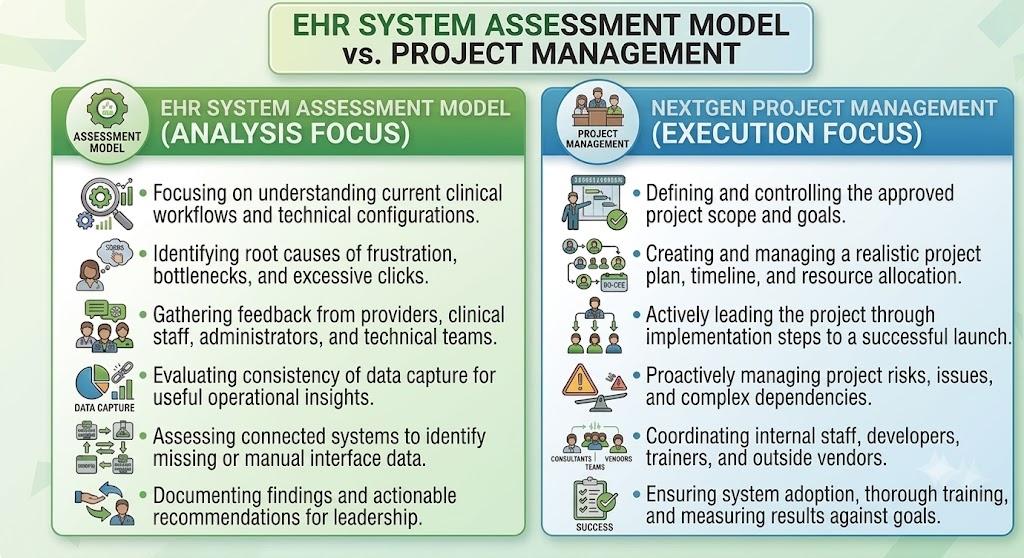
NextGen EHR analysis focuses on understanding before changing. It looks closely at how the current environment is configured and used, including workflows, templates, system settings, user feedback, and operational challenges. The goal is to identify root causes, uncover opportunities for improvement, and give leadership clear findings and recommendations to guide what comes next.
Project management focuses on turning those decisions into action. Once priorities and requirements are defined, a project manager helps organize the work by establishing scope, building a realistic timeline, coordinating responsibilities, managing risks, and keeping stakeholders aligned. They also help guide activities such as testing, training, implementation, and go-live.
Together, analysis helps determine what should change and why, while project management helps ensure those changes are carried out successfully.
How a Better Understanding Helps Work Flow Better
A thorough EHR system assessment identifies unnecessary steps and duplicated effort. Users gain clearer responsibilities, documentation becomes more consistent, and data capture improves. Leadership can therefore focus resources where they matter most.
The purpose of analysis is not to create a long report that sits unused. The deliverable should be practical findings and recommendations that help the organization decide how to move forward.
How TempDev Uncomplicates NextGen EHR Analysis
TempDev brings deep knowledge of NextGen EHR configuration and functionality. Our team has experience with clinical workflows across different specialties and organizations.
We review both system configuration and day-to-day use to identify short-term improvements and larger strategic needs. Our recommendations can guide workflow redesign, template development, training, or reporting.
TempDev helps organizations separate symptoms from root causes so they can make changes with greater confidence.
Once your analysis is complete, our NextGen Workflow Optimization Pros & Cons blog can help you evaluate the benefits and risks of making changes.
Learn more about our NextGen EHR consulting.
What Deliverables Come From a NextGen EHR Assessment?
A NextGen EHR assessment produces:
A clear summary of the current state
Documented root causes
Findings supported by observations and feedback
Recommendations grouped by issue type
Quick wins for immediate attention
Longer-term initiatives for redesign or investment
Known risks and areas requiring further investigation
A documented handoff for leadership or a project manager
Understand the Problem Before Making the Change
Healthcare organizations cannot improve their NextGen environment effectively until they understand how the system and workflows are performing today.
Analysis provides the understanding and recommendations. Project management provides the structure and coordination to implement approved changes.
For a practical roadmap on implementing changes after your analysis, check out our First-90-Day Playbook.
Contact TempDev today to discuss a NextGen EHR assessment.
Interested?
Agree with our point of view? Become our client!
Did you enjoy this read? Feel free to share it with your contacts.