


The Hidden Cost of EHR Click Burden: Designing More Efficient Clinical Workflows in NextGen

Related articles:
Utilize NextGen EHR Operations BI Dashboard to Improve Clinical Workflows
Read ArticleFirst-90-Day Playbook: Accelerating Your NextGen Workflow Redesign
Read ArticleWhat Is Workflow Redesign? Why Is It Important?
Read ArticleHow to Master Your NextGen EHR Workflow
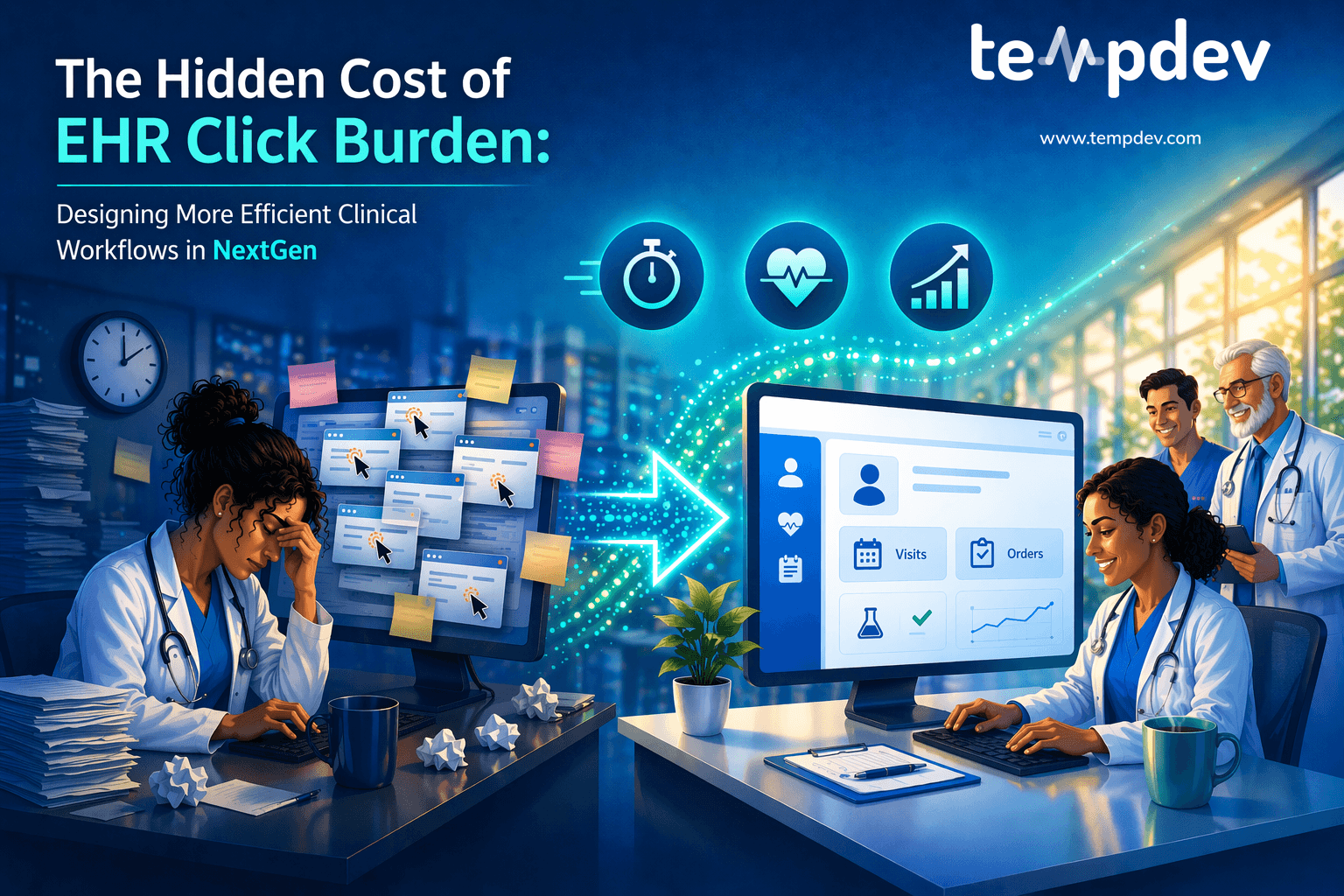
Read ArticleThe initial promise of Electronic Health Records (EHR) was a simple one. At its core, technology would streamline documentation, improve patient safety, and make clinical data more accessible for everyone involved in the continuum of care. In turn, it promised to end illegible handwriting and lost folders by replacing them with a seamless digital experience that empowered providers. However, this vision has given way to a growing challenge known as EHR click burden. Instead of a streamlined experience, clinicians now spend hours navigating complex menus, clicking through endless dialogue boxes, and struggling with templates that do not match their actual clinical process.
As a result, this issue is widely known as EHR click burden, and it is much more than a minor annoyance or a technical glitch. In fact, excessive clicking represents a significant and measurable drain on healthcare resources. Not only does it cause immense provider fatigue, but it also reduces the amount of quality face-to-face time spent with patients. Perhaps most importantly, it can compromise the actual quality of the data captured. After all, when a system is hard to use, the data inevitably suffers.
Given these challenges, organizations using NextGen must treat usability as a critical operational priority. Importantly, the issue often stems from workflow configuration rather than the platform itself. While NextGen is an incredibly powerful and flexible tool, if it is not specifically tailored to your unique clinical needs, the burden on the user grows. Therefore, by focusing on deep workflow optimization, practices can reclaim lost time, improve documentation accuracy, and support a more sustainable clinical environment for their staff.
Why EHR Complexity Continues to Challenge Healthcare Teams
Usability remains a top concern for healthcare leaders across the country. Even with advanced systems like NextGen, teams often feel bogged down by the sheer volume of digital tasks. While the NextGen platform provides the necessary tools to reduce clicks, poor configuration or "out of the box" settings can still lead to a heavy burden.
Documentation Complexity and Regulatory Pressure
Clinical documentation requirements have grown significantly over the last decade. Providers must capture specific data for billing and satisfy complex requirements for quality programs like MIPS. They must also ensure total legal compliance for every encounter. This complexity often translates into more fields, more tabs, and more clicks.
When a template is poorly designed, it forces the provider to "hunt" for information. They may have to jump between five different screens just to complete a single, routine note. This fragmentation breaks the clinical flow and ruins the story of the patient encounter. It makes documentation feel like an administrative chore rather than a vital part of patient care.
Cognitive Load for Clinicians
Every click requires a decision, and every decision consumes mental energy. This creates a high cognitive load that contributes directly to provider burnout. According to research and reports from HealthIT.gov, usability issues and high cognitive loads contribute directly to provider burnout and professional dissatisfaction.
When the EHR is difficult to navigate, the clinician must focus their mental energy on the software instead of the patient sitting right in front of them. Over time, this constant mental tax leads to exhaustion. It also increases the risk of medical errors. A tired provider who is frustrated with a screen is simply more likely to miss a detail or select the wrong option in a drop-down menu.
Operational Impact on Patient Throughput
Efficiency at the keyboard directly impacts the efficiency of the exam room. If a provider spends ten extra minutes on documentation per patient due to poor template design, they see fewer patients per day. This significantly reduces the revenue potential of the entire practice.
Click burden also creates organizational bottlenecks. If providers fall behind on their charts, the entire clinic slows down. Medical assistants may wait for orders that have not been clicked through yet. Patients may experience longer wait times in the lobby. Improving EHR usability is therefore not just a provider satisfaction goal; it is a critical operational and financial goal for the business.
Where Click Burden Hides in Daily Workflows
To solve the problem, you must identify where the workflow bakes in unnecessary clicks. Staff often overlook click burden because they’ve grown accustomed to the inefficiency.
Over-Engineered Templates: Many templates are built to include every possible clinical scenario in a single view. This forces the user to scroll through dozens of irrelevant sections to find the one they need.
Task Navigation and Order Entry: Ordering a simple lab test should be fast. However, in some configurations, it requires navigating through several layers of the system. A report from the GAO explains that improving the layout of these tasks is essential. Streamlined order entry reduces the time a provider spends looking at the screen and searching for codes or selecting facilities.
The "Key Miss" in Design: Many inefficient setups fail to utilize Quick Saves and Charting by Exception. This is a major concept in modern clinical design. If your system does not allow you to document the normal or expected findings instantly so you can focus only on the outliers, you are clicking far too much.
Reporting-Driven Requirements: Quality measures often require structured data points. To capture these, administrators often add dozens of checkboxes to templates. If these fields are not integrated naturally into the clinical flow, they feel like extra work. This often leads to providers ignoring the fields entirely, which causes poor reporting accuracy despite the extra effort.
The Solution: Designing for Clinical Flow
Successful clinical workflow redesign starts with the clinician's thought process. It does not force the provider to follow the logic of the software. Instead, it makes the software follow the human.
The "One-Click" Approach to Data
You do not need a checkbox for every single item. Modern designers look for ways to map data behind the scenes. For example, if a provider documents a specific diagnosis, the system should be smart enough to automatically suggest or fill in the relevant quality fields. This one-click approach satisfies reporting needs without slowing down the clinician. It ensures that the organization gets the high-quality data it needs for performance tracking without taxing the provider.
Balancing Documentation Requirements With Usability
The challenge for many practices is finding the balance between strict requirements and a usable system. This requires a strategic approach to how data is handled. The goal is to make quality documentation invisible to the user.
Through smart back-end configuration and the use of triggers, you can capture data in the background. This allows the clinician to document naturally in the way they were trained. The system then translates that narrative or basic documentation into the specific format needed for MIPS, billing, or legal compliance.
Why TempDev is the Obvious Choice for Optimization
Many consultants can point out that a problem exists. TempDev is the partner that actually eliminates the problem. We do not just offer generic advice or best practice PDFs. We re-engineer your NextGen environment from the ground up to be the high-performance tool it was always meant to be.
While other firms focus on generic consulting language, we focus on high-impact technical execution and measurable results. We understand that in a busy clinic, every second counts.
True <5 Click Workflows: We do not just improve templates; we transform them. Our team specializes in creating workflows that are radically efficient. For example, we have optimized flu and COVID shot clinics to operate at under 5 clicks per patient. This is achieved without even needing to open the patient chart, which saves a massive amount of navigation time.
Charting by Exception & Quick Saves: We implement advanced logic that allows providers to utilize Quick Saves. This means a provider can document a standard, healthy encounter with a single action. This allows them to spend their time focusing on the patient's unique symptoms and needs rather than clicking Normal over and over again.
System-Wide Visibility: We deploy custom dashboards that display all of your organization's required measures in one place. Practitioners no longer have to guess what they missed. They can see exactly what each task requires in terms of clicks, eliminating guesswork and reducing the stress of quality reporting.
Optimization of the Total Environment: Sometimes the click burden feels worse because the system is slow. We take a holistic view of your NextGen environment. This includes performance tuning and deep SQL optimization. A faster system makes every click feel lighter and every transition smoother.
Strategic Workflow Redesign: We observe how your team actually uses the software in the real world. We then suggest improvements that distribute the documentation load. This might include training medical assistants to take on more data entry tasks or optimizing how the practice routes tasks.
With over 18 years of experience specifically in the NextGen ecosystem, TempDev has seen every possible workflow challenge. We know how to bridge the gap between what the administrators need for data and what the providers need for speed.
To Sum it Up
EHR click burden is a serious issue that impacts provider well-being and practice profitability every single day. However, it is not an unsolvable problem. Through thoughtful EHR usability improvement and strategic design, healthcare organizations can completely transform their NextGen experience.
When you optimize your EHR with TempDev, you do much more than just save time. You improve the quality of care and create a better, more professional environment for your staff. Most importantly, you allow your providers to focus on what they do best: caring for their patients and improving health outcomes.
Interested?
Agree with our point of view? Become our client!
Did you enjoy this read? Feel free to share it with your contacts.