


How NextGen Workflow Redesign Helps Healthcare Teams Work Without Friction

Related articles:
Is Your Practice Ready for MVP Reporting? A NextGen Readiness Audit for the MIPS Transition
Read ArticleTraditional MIPS Is on the Way Out: What the MVP Transition Means for NextGen Practices
Read Article2027 Healthcare Compliance Readiness: HIPAA Security, Digital Accessibility, and Electronic Prior Authorization
Read ArticleHealthcare workflows rarely stay simple for long. New requirements get added, technology changes, and staff build workarounds to keep the day moving. Locations grow, services expand, and templates that once fit the practice no longer match how work happens. Over time, these small adjustments stack up into real friction. That is exactly where NextGen workflow redesign comes in.
At TempDev, we believe work should flow, not fight the system meant to support it. NextGen workflow redesign gives healthcare organizations a structured way to understand why a process became complicated and to build something better in its place.
Why Healthcare Workflows Get Complicated Over Time
Most inefficient processes did not start that way. They grew complicated one small decision at a time.
New requirements are added without removing outdated steps.
Locations or departments build their own version of the same process.
Staff creates workarounds when NextGen does not clearly support a task.
Templates and configurations don’t match how the practice actually operates.
Manual spreadsheets, email, fax, and paper fill the gaps around the system.
Responsibilities blur as teams and services change.
Upgrades introduce functionality the organization never fully adopts.
A process built for a smaller practice may not scale.
These issues can look like isolated user complaints. In reality, they point to a broader disconnect among people, processes, and technology. Closing that disconnect is exactly what EHR and practice management workflow redesign is meant to do.
What Is NextGen Workflow Redesign?
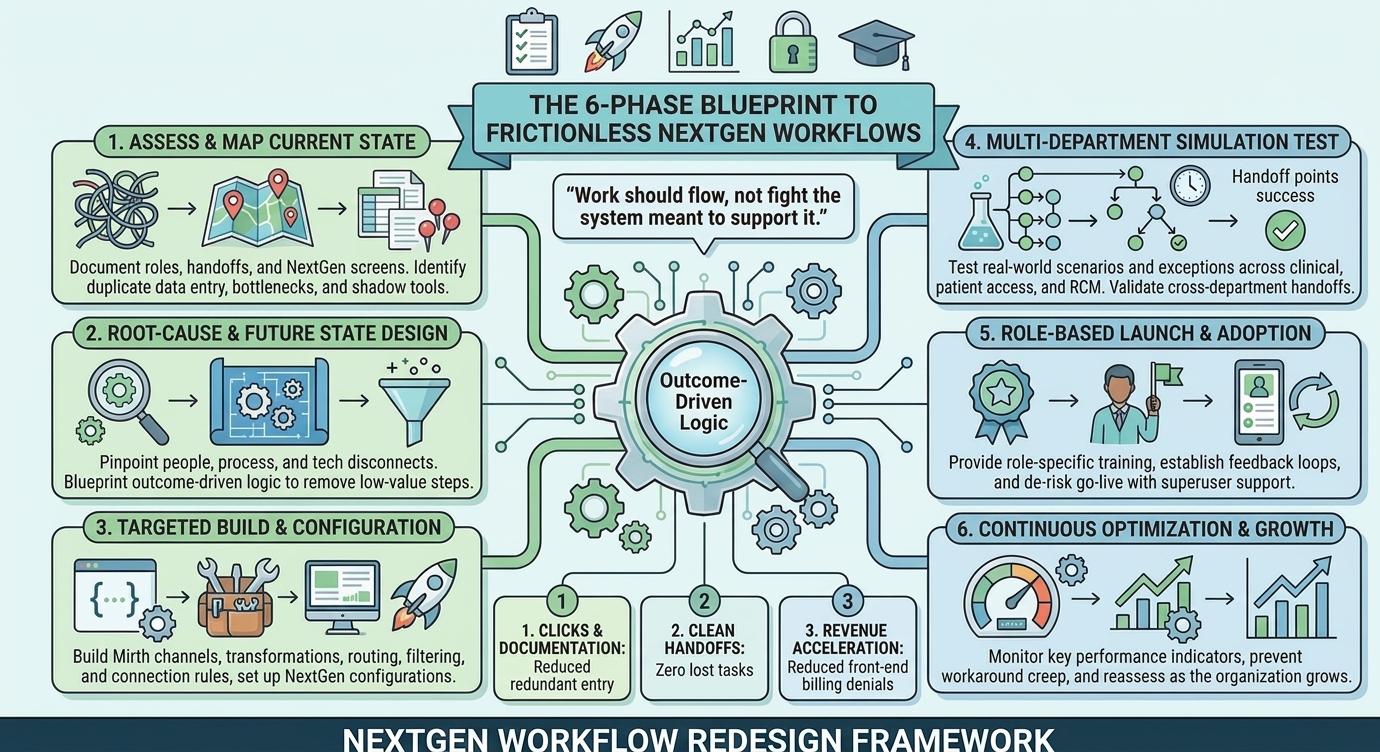
NextGen workflow redesign is a structured process for understanding how work gets done today and designing a better version supported by the system. It is not the same as changing one template or adding more training. Instead, it examines the entire process from start to finish.
A typical project involves:
Defining the workflow and the outcome it should produce
Mapping every step, role, decision, handoff, and system interaction
Identifying delays, duplication, bottlenecks, and workarounds
Deciding what to remove, standardize, or automate
Configuring NextGen to support the redesigned process
Testing the workflow with real users and scenarios
Training staff and monitoring performance after go-live
Because the goal is a better outcome, not just a different screen, NextGen EPM & EHR workflow redesign always starts with the people who do the work.
Signs Your Organization Needs NextGen Workflow Optimization
Certain patterns repeat across organizations that could benefit from NextGen workflow optimization:
Providers or staff complete excessive clicks or duplicate documentation.
Departments follow inconsistent processes for the same task.
Work is regularly delayed between teams, and patient wait times or backlogs are increasing.
Employees rely on spreadsheets, paper, email, or fax outside NextGen, even after training.
Staff is unsure who owns the next step, and reports show incomplete or inconsistent information.
Billing errors or denials trace back to front-end or clinical steps.
The system gets called “difficult” even though the functionality already exists.
The organization is preparing for an upgrade, an implementation, a merger, or an expansion.
Redesign may focus on a single high-friction process or several connected workflows across departments. Either way, NextGen workflow optimization means finding where the friction starts, not where it surfaces. For more background, see TempDev's earlier piece on NextGen EHR workflow optimization.
Where EHR Workflow Redesign Makes the Biggest Difference
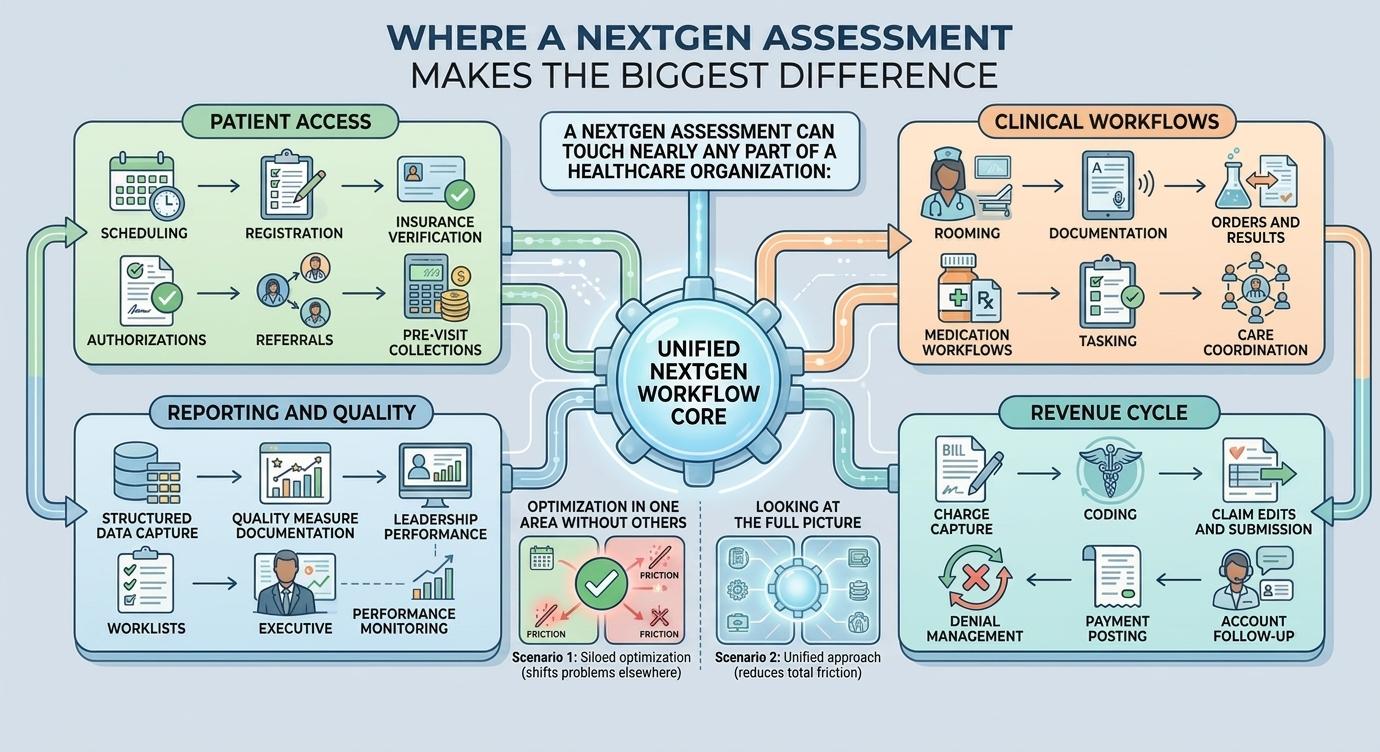
EHR workflow redesign can touch nearly any part of a healthcare organization:
Patient access: scheduling, registration, insurance verification, authorizations, referrals, and pre-collections
Clinical workflows: rooming, documentation, orders and results, medication workflows, tasking, and care coordination
Revenue cycle: charge capture, coding, claim edits and submission, denial management, payment posting, and account follow-up
Reporting and quality: structured data capture, quality measure documentation, worklists, and leadership performance monitoring
Optimizing one area without considering the rest often just shifts friction elsewhere. By looking at the full picture, your NextGen EHR & Practice Management workflow remains unified, ensuring that solving one problem doesn’t quietly create another.
Mapping the Current State Before Designing the New One
An effective NextGen workflow assessment always starts with mapping the current process, not the future one. That means documenting:
Every step, the role responsible for it, and the information it needs and produces
The NextGen screens, templates, and reports actually in use, plus any outside tools filling the gaps
Decisions, exceptions, approval points, delays, and handoffs between teams
Duplicate entry, user frustrations, any safety concerns, and measures currently used to evaluate performance.
AHRQ's workflow assessment toolkit offers a useful framework for this kind of current-state mapping, including real-world examples of how it plays out. Involving the people who actually do the work matters more than leadership assumptions alone.
Finding the Root Cause, Then Designing What's Next
From there, the team identifies root causes: unclear responsibilities, poor handoffs, NextGen configuration that no longer matches the process, templates that collect too much or too little, or simply staffing and capacity limits. Not every workflow problem needs new development, and not every user complaint can be solved with training.
Once causes are clear, TempDev designs a future-state process around the outcome the organization needs: removing low-value steps, clarifying ownership, capturing information once and reusing it, standardizing while still allowing justified specialty differences, and building clear exception paths. This mirrors the approach outlined in HealthIT.gov's practice transformation toolkit, which similarly ties technology change to workflow and outcome.
Configuring, Testing, and Rolling Out the New Workflow
Configuration follows design, not the other way around. The outcome of the workflow assessment may mean template changes, EPM and EHR configuration, work queues, reports and dashboards, interfaces, security and access, or automation are necessary.
Before anything goes live broadly, we test the redesigned NextGen workflow with real scenarios and representative staff, normal cases and exceptions, across every department the process touches, to confirm handoffs are clear and information reaches the right people. A smaller pilot often surfaces issues before the organization-wide launch. TempDev's First 90-Day Playbook walks through what that path from design to go-live actually looks like.
How Workflow Redesign Drives Healthcare Workflow Improvement
Healthcare workflow improvement is not about making people move faster. It is about removing what gets in their way. NextGen workflow redesign cuts duplicate work, clarifies ownership, and helps information reach the right person at the right time. It also reduces reliance on disconnected manual tools, makes training and reporting more effective, and eases frustration for providers and staff.
Because friction rarely comes from a single source, improving healthcare workflows usually means examining more than one workflow at once. Not every redesign project makes sense right away, though: TempDev's breakdown of NextGen workflow optimization pros and cons is a useful gut check before committing resources.
Redesign Does Not End at Go-Live
A new process only works if people actually follow it. That means explaining why the change is happening, training staff by role, and preparing superusers to answer questions on day one. It also means giving employees a clear way to flag problems and reviewing performance data regularly, since workarounds tend to creep back in when nobody is watching. NextGen workflow redesign should be reassessed periodically, with targeted adjustments made as evidence supports them.
How TempDev Uncomplicates NextGen Workflow Redesign
TempDev brings deep knowledge of NextGen EHR and EPM, plus hands-on experience across clinical, patient access, revenue cycle, and reporting workflows. We handle current-state mapping and root-cause analysis, then carry the work through template, configuration, report, interface, and automation support, testing, training, and post-launch monitoring, connecting the effects of each change across departments. Recommendations are grounded in both NextGen functionality and how healthcare actually operates day to day.
Learn more about our NextGen EHR consulting and NextGen EPM consulting services.
Create NextGen Workflows That Support the People Doing the Work
Effective NextGen workflow redesign begins with understanding the current process, and lasting healthcare workflow improvement does not end when new configuration goes live. It continues as staff adopts the change. Contact TempDev today to talk about NextGen workflow redesign for your organization.
Interested?
Agree with our point of view? Become our client!
Did you enjoy this read? Feel free to share it with your contacts.