


The AI Layer Is Demanding More Than Today’s EHR Workflows Can Handle

Related articles:
Ambient AI Didn’t Fix Documentation. Here’s What Healthcare Leaders Should Do Instead:
Read ArticleFirst-90-Day Playbook: Accelerating Your NextGen Workflow Redesign
Read ArticleWhy Your Healthcare Dashboard Isn’t Working And What to Do
Read ArticleImproving Patient Care & Reducing Physician Burnout with AI
Read ArticleExploring the Benefits of AI Implementation in Transforming Clinical and Business Operations
Read ArticleDon’t Replace Your EHR. Fix It: A More Practical Approach to AI in Healthcare
Read Article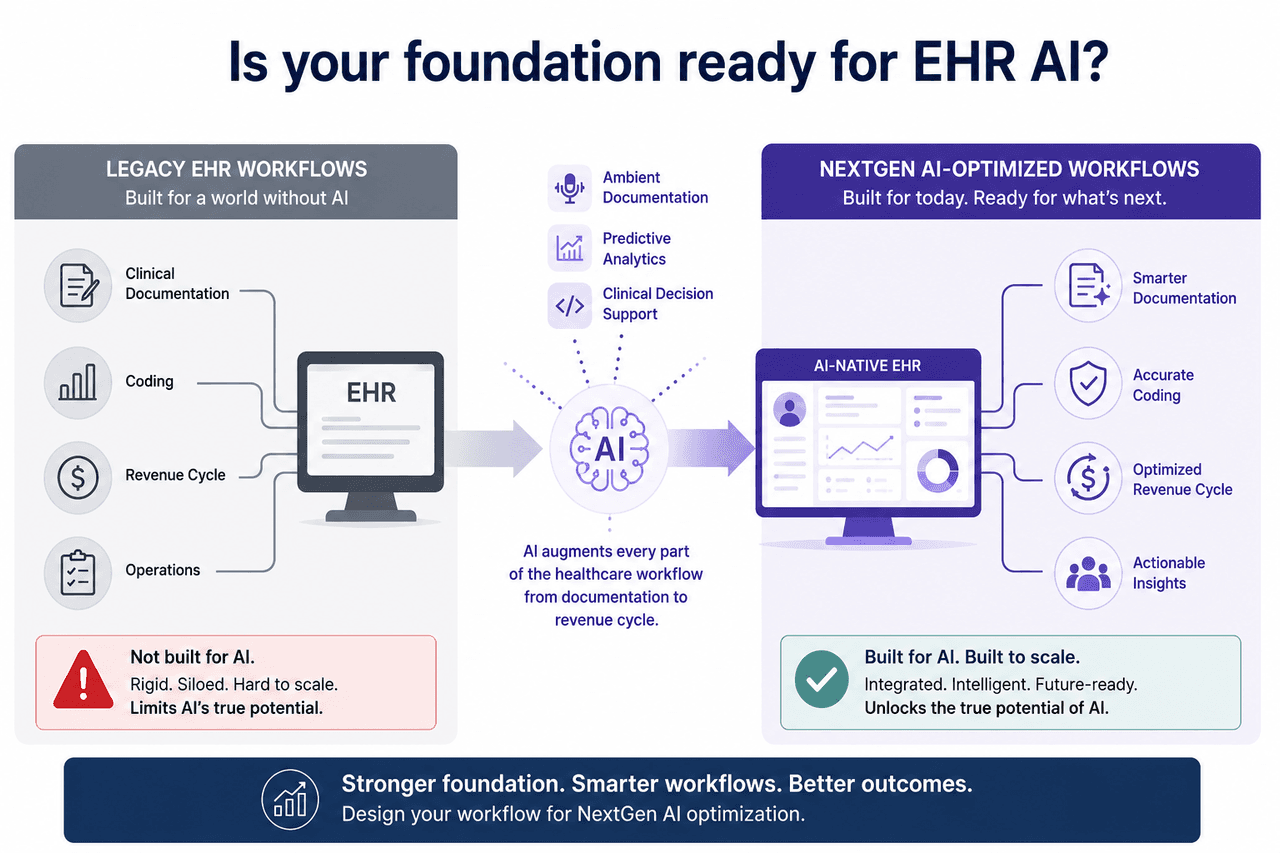
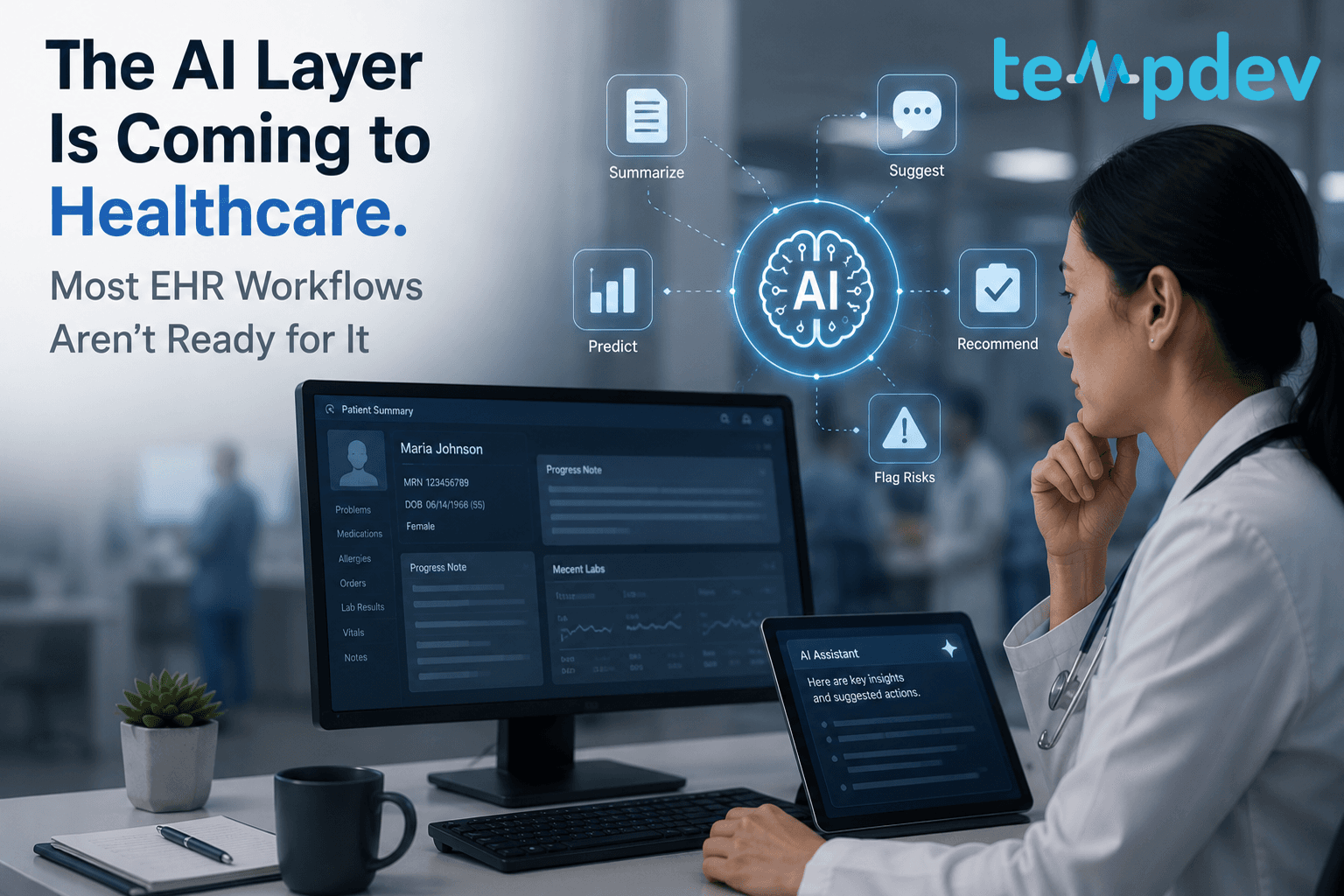
We're at a point where almost every organization in healthcare has some sort of artificial intelligence (AI) integrated into its operations, whether that's ambient documentation, predictive coding, or clinical decision support. And it doesn't look like it'll slow down anytime soon. AI is quickly becoming essential to every facet of healthcare, from clinical documentation to revenue cycle automation.
The trouble is, most EHR workflows were built years ago for processes that didn't involve AI at all. The tools that were once used to document care and bill for that care are now being augmented by machine learning to help with things like predicting denial trends and recommending documentation changes. The result is that many organizations are building AI healthcare workflow integration on a foundation that won't support its true potential, especially without healthcare workflow design and scalable NextGen AI optimization.
What it Means to "Layer AI" On Top of Healthcare Organizations
When we talk about integrating AI into healthcare, we're referring to the practice of using AI tools to augment existing processes through an EHR AI integration. An EHR is still present. It's simply extended with additional AI capabilities such as predictive modeling, natural language processing, etc.
In theory, this process of adding AI to existing workflows is seamless. However, in practice, the process is anything but smooth. In many cases, the workflow layer, that is, the underlying structure that defines the EHR's role in clinical documentation and revenue cycle management, remains the same while AI is added to it as an overlay. This is a fundamental problem for many organizations trying to layer AI on top of their existing workflows without rethinking their healthcare workflow design or preparing for proper EHR AI integration.
How Existing Workflows Break AI Healthcare Integration
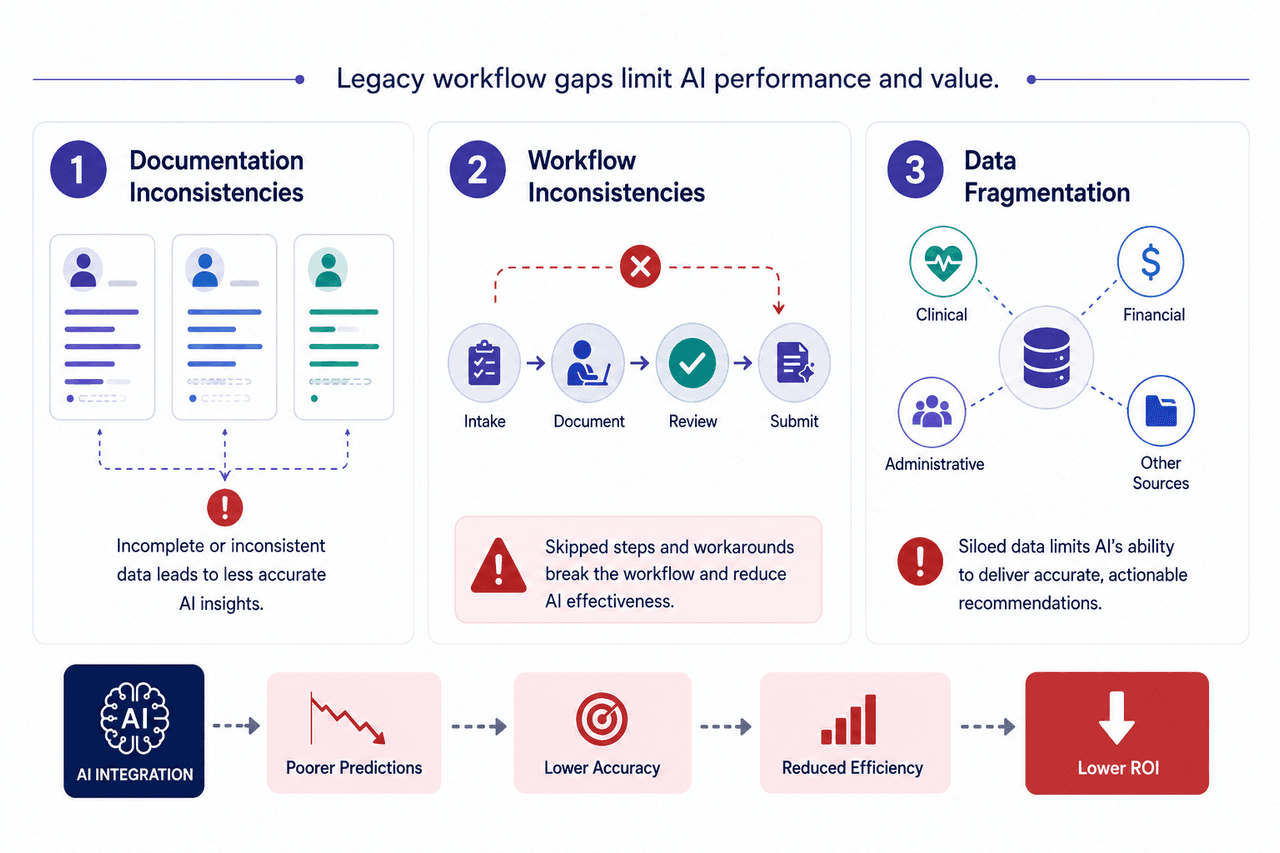
As mentioned earlier, most EHR workflows were built years ago to support processes that didn't involve AI. However, the problem goes beyond that. There are several critical issues in most EHR workflows that prevent organizations from fully benefiting from AI integrations and NextGen AI optimization. Let's get into three of them:
Documentation Inconsistencies
One of the primary reasons EHR AI integration fails is inconsistent documentation across specialties, practices, and even individual clinicians. While most EHRs allow for customization, the result is often documentation templates that are inconsistent or incomplete. This leads to inaccurate data inputs, which, in turn, causes the AI algorithm to produce less accurate recommendations or predictions.
Workflow Inconsistencies
Another challenge for many EHR workflows is inconsistent execution of workflows. While most EHR systems are designed to be intuitive, they require specific user actions to operate efficiently. As organizations implement new features and update existing ones, users may start skipping certain steps or relying on manual workarounds. This breaks the original EHR workflow design and limits the effectiveness of AI-related healthcare workflow design improvements.
Data Fragmentation
Finally, EHR workflows often involve the use of multiple data sources. However, data may be stored in different modules depending on its type (clinical, financial, administrative, etc.).
The challenge is that most AI tools rely on the availability of certain data inputs to generate accurate recommendations. Inconsistent access to these data inputs, therefore, prevents AI algorithms from performing their functions.
Why AI Reveals Flaws in Your Health Care System
There’s a simple rule from engineering: automation makes bad processes worse. AI is no exception in healthcare.
If your workflows are inefficient, adding AI will only make those inefficiencies more visible and faster, especially in environments attempting EHR AI integration without fixing healthcare workflow design first.
Inconsistencies Inputs Give Inaccurate Outputs
Data inputs play a huge role in getting accurate AI outputs. When an EHR system produces inaccurate recommendations, the issue may come down to incorrect data inputs. An EHR system can be perfect, but still fail to produce accurate recommendations because of data inconsistencies.
Incomplete or inconsistent data inputs yield incomplete or inconsistent outputs. For instance, an ambient documentation tool will generate unnecessary recommendations due to data inconsistencies. Similarly, the coding recommendation engine may provide incorrect code recommendations based on an inconsistent E&M template.
Planning Matters More Than the Tool
McKinsey found that most healthcare leaders agree that AI and digital transformation are top priorities. But far fewer feel ready to execute. That’s not a technology problem, but a planning and workflow problem.
Without clear, consistent workflows, organizations are forced to rework their systems before AI can deliver value. And that delays ROI.
Preparing Your Workflows for AI Integration
Now that we understand the importance of preparing EHR workflows for AI tool integration, let's discuss how to go about it.
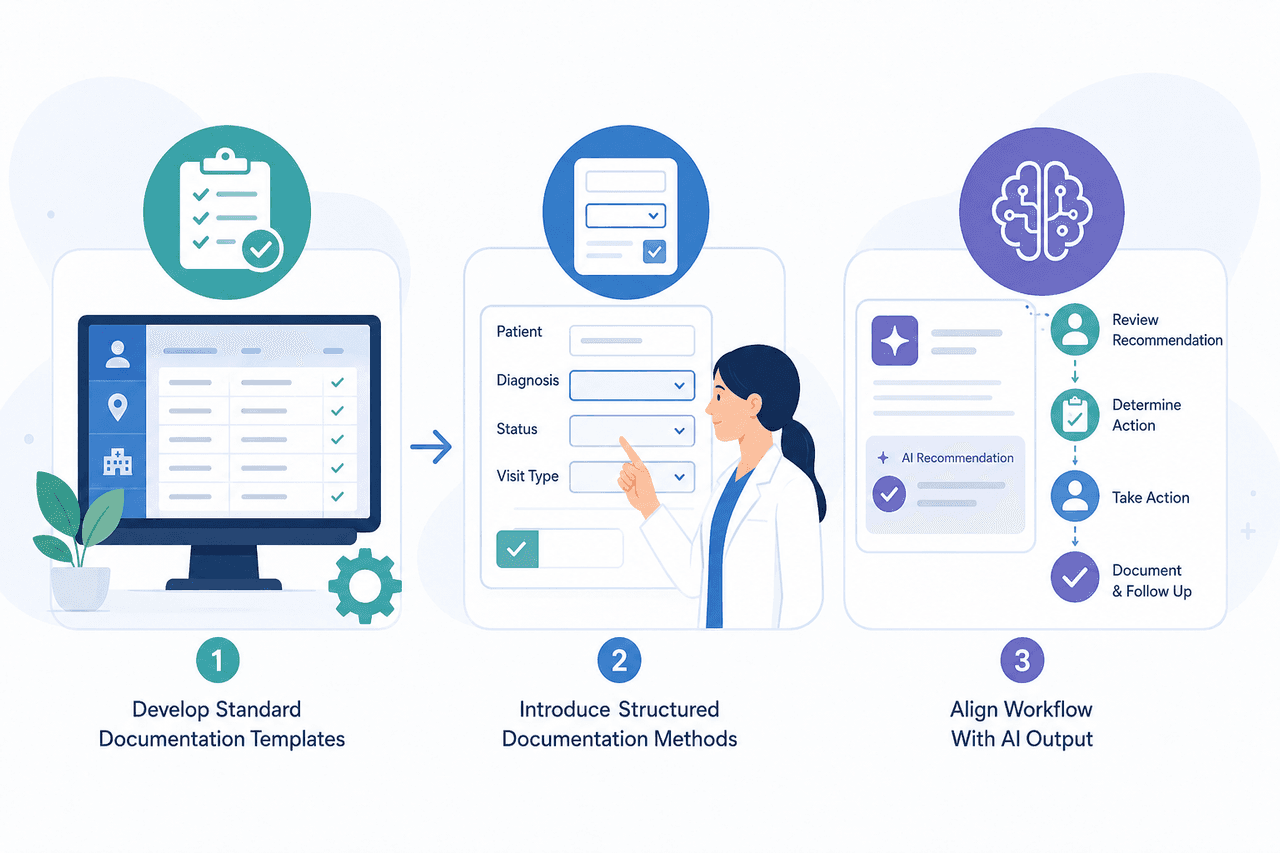
Develop Standard Documentation Templates
First, organizations need to audit and standardize their documentation templates for all specialties and all organizational locations. This step eliminates any inconsistencies that may negatively impact the data integrity of the EHR system and supports stronger NextGen AI optimization.
Of course, removing all data inconsistencies from an EHR system is an impossible mission, but that process will guarantee that everyone uses similar workflows and enters consistent information into the EHR system.
Introduce Structured Documentation Methods
The next step in preparing workflows for AI integration is structuring documentation processes to reduce free-text field usage. Using free-text fields is easy because of unlimited user freedom.
However, free-text fields are by definition inconsistent since each entry can be unique, and inconsistent data is an obstacle for effective EHR AI integration.
We’d recommend organizations use structured documentation methods wherever possible. Structured fields feature free-form entries but with predefined options or drop-down menus. Such documentation is useful not only for eliminating data inconsistencies but also for entering only relevant information.
Align Workflow With AI Output
Lastly, organizations need to align their EHR workflows with the output of AI tools. While AI tool recommendations and outputs can be helpful, without appropriate workflow design, they will never benefit anyone.
Specifically, figure out whose responsibility it will be to follow up on AI tool recommendations, which actions should they take, and at what moments of the workflow they should do it.
Practical Approach to AI Tool Integration Into EHR Workflows
Before trying to integrate AI tools into EHR workflows, healthcare organizations should first audit and optimize their workflows. Afterward, they'll be ready to use AI healthcare workflow integration.
Audit and Optimize Your Workflows First
First, healthcare organizations should audit their current workflow. This allows them to assess how efficient their workflows are in terms of generating consistent data entries and how users are performing their tasks.
Next, organizations should optimize workflows based on the audit results. Doing so will guarantee that users are executing workflows properly.
Layer AI on Top of Optimized Workflows
Only after workflow optimization should organizations integrate AI tools into them. This approach guarantees that AI will get accurate and consistent data inputs and will generate accurate recommendations.
Conclusion
AI tools are essential for maximizing the potential of modern health care systems. However, they require organizations to optimize their workflows to enable proper operation. Otherwise, AI healthcare workflow design won't bring the expected benefits.
TempDev helps healthcare organizations with AI healthcare workflow integration and NextGen AI optimization. Let us audit and optimize your workflow so you can stay ready for the future of healthcare.
Learn more about our solutions and services.
Interested?
Agree with our point of view? Become our client!
Did you enjoy this read? Feel free to share it with your contacts.