


Don’t Replace Your EHR. Fix It: A More Practical Approach to AI in Healthcare

Related articles:
Partnering With TempDev: Your Trusted Advisor in AI-Driven Healthcare Transformation
Read ArticleThe Role of AI in Healthcare Transformation: Healthcare AI for C-Suite Executives
Read ArticleExploring the Benefits of AI Implementation in Transforming Clinical and Business Operations
Read ArticleEnhancing Data Security and Privacy: Addressing Concerns in AI-Enabled Healthcare Systems
Read ArticleImproving Patient Care & Reducing Physician Burnout with AI
Read ArticleHow AI is Revolutionizing Healthcare: Key Insights for CTOs
Read ArticleHealthcare organizations are under increasing pressure to modernize. Artificial intelligence is moving quickly, and it is tempting to believe that layering new tools on top of old systems or bypassing them entirely will solve long-standing frustrations. But replacing your EHR is rarely the answer. In most cases, the real opportunity is much more practical. Fix what is already there, then introduce AI in a way that supports how your organization actually operates. This is a core idea in NextGen EHR optimization: improving the system you already rely on before adding anything new.
Why There’s Growing Frustration With EHR Systems
The frustration with EHR systems is real, and it is justified. But the root causes are often misunderstood.
Clinician Burnout Tied To EHR Usability
Most clinicians are not frustrated with the idea of digital records. What frustrates them is how those systems are configured. Excess clicks, poorly structured templates, and cluttered interfaces can create cognitive load that compounds throughout the day. Over time, they become major contributors to burnout.
Workflow Inefficiencies
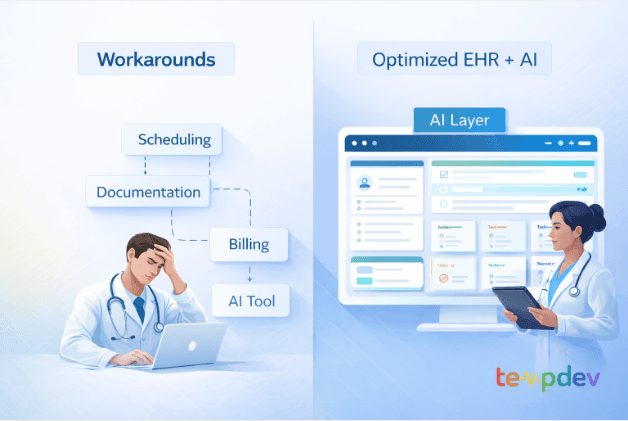
In many organizations, workflows evolve faster than the system that supports them. New services are added. Reporting requirements expand. Staffing models change. But the EHR configuration often stays the same. The result is workarounds, duplicate data entry, and inconsistent processes across teams.
Overreliance On Manual Processes
When the system does not support the workflow, people fill the gaps manually. Spreadsheets, side notes, and disconnected tools start to take over. This creates risk, reduces visibility, and makes it harder for leadership to trust the data.
The frustration is not just about technology. It is also about misalignment between system design and real-world operations.
The Temptation to “Work Around” the EHR With AI
As AI tools become more accessible, many organizations are exploring ways to bypass their EHR rather than improve it.
Ambient Scribes As A Workaround
Ambient documentation tools promise to reduce documentation burden by capturing conversations and generating notes. In the right context, they can be helpful. But when used as a workaround for poorly designed templates or workflows, they mask the underlying problem instead of solving it.
External Tools Replacing Core Workflows
Some organizations are shifting scheduling, intake, or care coordination tasks into external platforms. These tools can feel easier to use in isolation, especially when compared to a poorly configured EHR.
But this shift often happens without rethinking how data flows across the organization. Instead of improving the system, it moves key workflows outside of it, creating parallel processes that are harder to manage over time.
Risks Of Fragmented Systems
When core workflows live across multiple systems, fragmentation becomes unavoidable. Data is captured in different places, definitions start to vary, and reconciliation becomes a manual effort.
Over time, the EHR stops functioning as a reliable system of record. Reporting loses consistency, compliance risk increases, and operational visibility declines. What initially felt like a usability improvement turns into a coordination problem.
AI should not be used to avoid fixing the system. It should be used to strengthen it.
What The Research Is Telling Us
Recent research reinforces a point many operators already understand. Technology alone does not resolve workflow challenges.
For example, a study published in JAMA shows that AI scribe adoption is associated with only "modest decreases in total EHR time and documentation time and with a modest increase in weekly visit volume."
While these are meaningful improvements, they are not transformative. They rather reflect incremental efficiency gains rather than a fundamental shift in how work gets done.
That distinction matters.
If the underlying workflows were fully optimized, the impact would likely be more substantial. Instead, the moderate results suggest that these tools are improving isolated tasks within a larger system that remains unchanged.
These tools also do not replace the need for structured data within the EHR. Documentation still needs to be reviewed, standardized, and used for billing, reporting, and compliance. In practice, this means AI scribes can reduce parts of the workload, but they do not eliminate the broader system requirements around data capture and workflow coordination.
Why Optimization Comes Before Innovation

Before introducing new tools, organizations need to ensure their existing systems are working as intended.
Cleaning Up Workflows Before Adding Tools
Start by mapping how work actually happens. Not how it was designed years ago, but how staff are using the system today. Identify where steps are duplicated, where information is re-entered, and where delays occur
Aligning System Configuration With Real Operations
EHR systems like NextGen are highly configurable. But many organizations operate on default setups or outdated configurations. Templates, order sets, and task flows should reflect current clinical and operational needs.
Eliminating Unnecessary Steps
Every extra click matters. Reducing friction is not just about convenience. It directly impacts productivity, accuracy, and staff satisfaction. Small improvements at the workflow level can create significant gains at scale.
This is what a strong EHR optimization strategy looks like. It focuses on alignment, clarity, and efficiency before introducing additional layers of technology.
How AI Should Actually Be Used in Healthcare Systems
AI has a role to play, but it needs to be applied intentionally.
Supporting Structured Workflows
AI works best when it operates within a well-defined process. For example, it can assist with summarizing structured encounters, flagging gaps in care, or guiding next steps based on established protocols.
Enhancing Data Capture And Reporting
Instead of replacing documentation workflows, AI can improve how data is captured and organized. This makes reporting more reliable and transforms static reports into actionable insights.
Improving Efficiency Without Adding Complexity
The goal is not to introduce another system that staff need to learn. The goal is to reduce effort within the methods they already use. AI should feel like an extension of the workflow, not an additional workflow on top of it.
When applied this way, AI in healthcare workflow becomes a practical tool for improving operations rather than a workaround for system limitations.
What A Well-Designed System Looks Like
A well-functioning healthcare system is not defined by how many tools it uses. It is defined by how clearly those tools support the work.
EHR As The System Of Record
The EHR should remain the central source of record-keeping. All core clinical, financial, and operational data should flow through it in a structured and consistent way.
AI As An Operational Layer
AI should sit on top of that foundation, enhancing specific parts of the workflow without disrupting the whole. It should support decision-making, reduce manual effort, and improve visibility, among other benefits.
Clear, Usable Workflows For Staff
At the end of the day, the system has to work for the people using it. That means intuitive navigation, logical task flows, and minimal redundancy. When workflows are clear, adoption improves. When adoption improves, outcomes follow.
Conclusion
There is a lot of excitement around AI right now, and much of it is warranted. But replacing your EHR or working around it is not a sustainable strategy.
The organizations seeing the best results are taking a more disciplined approach. They are fixing what is broken, aligning their systems with real workflows, and then introducing AI in a way that supports that foundation.
Healthcare system integration is not about adding more tools. It is about making the system you already have work better.
When you start there, AI becomes an accelerator, not a crutch.
Interested?
Agree with our point of view? Become our client!
Did you enjoy this read? Feel free to share it with your contacts.