

How a NextGen Revenue Cycle Assessment with TempDev Reveals Hidden Financial Gaps

Revenue cycle reports can show that collections are slipping or denials are climbing. What they rarely show is why. A NextGen revenue cycle assessment looks past the numbers. It examines the workflows, configuration, staffing, and data behind them.The result is a practical improvement plan instead of another dashboard nobody acts on.
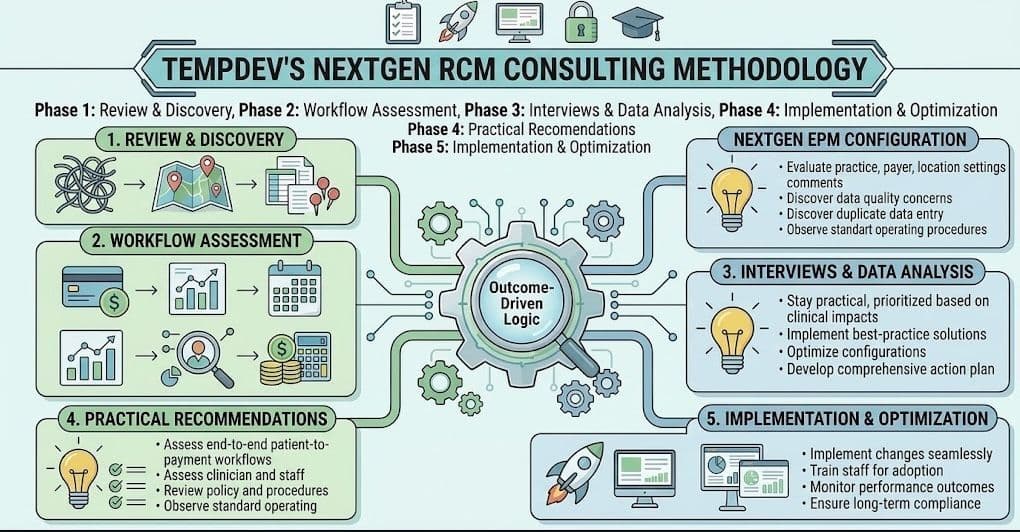
Revenue Cycle Metrics Show the Result, Not Always the Cause
Most finance teams recognize the warning signs. Accounts receivable keeps growing, denials keep rising, and collections slow down even though staff works harder. Patient balances sit unresolved, and there are conflicting reports from different departments. Performance may vary across locations or providers, and leadership gets explanations based on anecdotes instead of data.
These outcomes usually trace back to connected issues across patient access, documentation, NextGen configuration, billing workflows, staffing, and payer behavior. Simply running another report won't reveal the root cause; instead, it requires a comprehensive healthcare revenue cycle analysis. Effective revenue cycle consulting must begin with this objective evaluation. At TempDev, making this connection is what we do best: we are here to streamline your workflows and uncomplicate revenue cycle performance.
What Is a NextGen Revenue Cycle Assessment?
A revenue cycle assessment is a structured evaluation of the processes and technology your organization uses to get paid for patient services. Instead of guessing what's wrong, a NextGen revenue cycle assessment maps the full path from patient access to final payment. That path spans registration, eligibility, documentation, coding, claims, denials, payment posting, insurance follow-up, patient billing, and NextGen EPM configuration.
Because these steps depend on each other, an accurate NextGen EPM assessment looks at the whole system, not one department. HFMA's revenue cycle management resource is a useful reference point for industry standards. Most importantly, the goal isn't a list of every possible improvement. It's identifying root causes and priorities, so you know what to fix first.
When Should an Organization Conduct a Revenue Cycle Assessment?
Several situations point to the need for a revenue cycle assessment. Financial performance may have declined, days in accounts receivable may be climbing, or denials may be rising without a clear explanation.
Staffing or leadership changes, mergers, acquisitions, and expansions can also disrupt established workflows. In addition, organizations that recently implemented or upgraded NextGen, or moved billing in-house or to a vendor, often benefit from a fresh look. Whether the goal is a full healthcare revenue cycle analysis or a narrow review, timing matters. If reports no longer feel reliable, or teams lean on spreadsheets, that's a signal too. The same is true after a stalled improvement effort; an assessment can set a baseline before problems grow.
What Information Should Be Reviewed Before the Assessment?
Before work begins, gather a clear picture of the current environment. This includes organizational structure, provider and location details, payer mix, and team structure. It also includes written procedures, NextGen EPM configuration, and clearinghouse or vendor relationships.
Recent performance reports, accounts receivable aging, denial data, and charge and payment trends provide useful context. Existing work queues and known concerns from staff and leadership add more. However, report data should always be validated before conclusions are drawn from it.
What a NextGen Revenue Cycle Assessment Should Evaluate
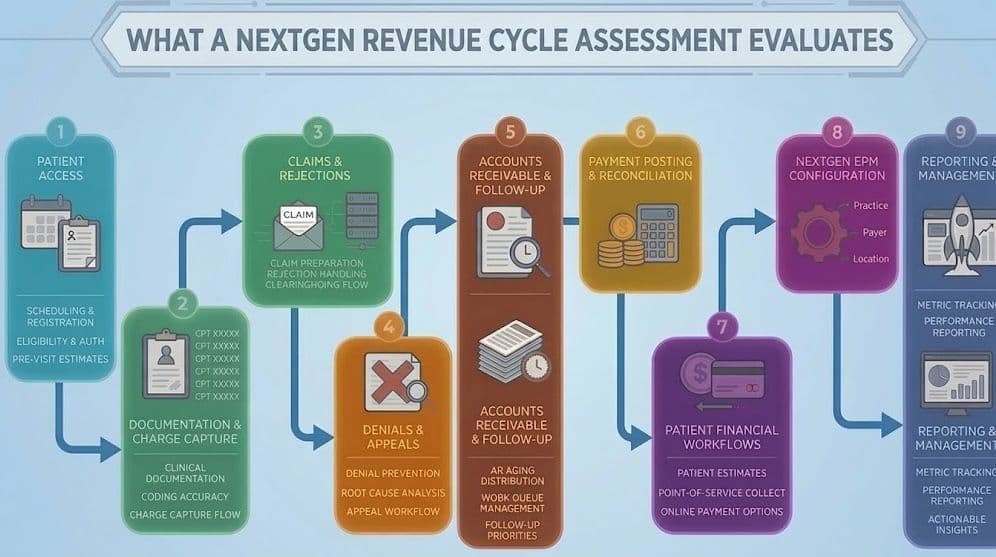
A thorough NextGen revenue cycle assessment examines every stage of the patient-to-payment process. Each area below supports overall healthcare revenue cycle analysis and financial performance.
Patient Access
Patient access sets the tone for the entire revenue cycle. It covers scheduling, registration accuracy, eligibility, authorizations, referrals, estimates, pre-collections, copay collection, staff training, and handoffs to clinical and billing teams.
Documentation and Charge Capture
Documentation timing and coding accuracy directly affect charges. This includes missing or delayed charges, manual versus automated entry, staff responsibilities, claim holds, and clinical-to-billing communication.
Claims and Rejections
Claim-edit configuration and clearinghouse processes matter next: payer-specific requirements, rejection causes, suspended claims, timely-filing risk, ownership, and escalation.
Denials and Appeals
Denials deserve close attention because of their financial impact. The review covers denial categories, root causes, prioritization, appeal processes, payer trends, and preventable versus unavoidable denials.
Accounts Receivable and Follow-Up
Follow-up shows how well the backlog gets managed: aging distribution, work-queue assignment, high-dollar and timely-filing prioritization, underpayment identification, and staffing capacity.
Payment Posting and Reconciliation
Payment posting affects accuracy and speed, from electronic and manual posting to deposit reconciliation, adjustment codes, unapplied payments, credit balances, and refund timeliness.
Patient Financial Workflows
Patient financial workflows shape the collections experience: estimate accuracy, pre-visit and point-of-service collections, statement clarity, online payments, payment plans, and financial assistance.
NextGen EPM Configuration
Because configuration underlies everything else, a NextGen EPM assessment reviews practice, location, provider, and payer setup. It also covers claim edits, work queues, security access, reports, and automated processes.
Reporting and Management
Finally, reporting and management review metric definitions, data accuracy, and reporting frequency. They also track performance by payer, provider, and location, and whether reports actually lead to action.
Include the People Who Perform the Work
Reports rarely show how work actually gets completed. Written procedures may not reflect current practice, and staff know the workarounds that never make it into a report. Because of this, workflow observation and interviews are essential; resources like AHRQ's workflow assessment toolkit reflect the same principle. This approach helps distinguish training gaps from system limitations, so recommendations stay realistic.
Validate the Data Before Drawing Conclusions
Report accuracy has to be confirmed before conclusions are drawn. Metrics may use inconsistent definitions, reports may exclude certain locations or date ranges, and historical configuration changes or duplicate data can distort results. Reviewing a sample of actual accounts helps confirm what the aggregate data appears to show.
Turn Assessment Findings Into a Prioritized Plan
A useful NextGen revenue cycle assessment produces more than a summary. It identifies strengths, high-risk gaps, and root causes, alongside quick wins and longer-term projects. Most importantly, recommendations should be organized by impact, risk, effort, and dependency, with clear owners assigned, rather than presented as one undifferentiated list.
A Revenue Cycle Assessment Is Different From Optimization
A revenue cycle assessment evaluates the current environment, identifies gaps and root causes, establishes a baseline, and recommends prioritized changes. See HFMA's revenue cycle topic page for additional context on how the industry frames this work.
Revenue cycle optimization implements those approved improvements: changing workflows and configuration, building reports and automation, training staff, and measuring results. Some organizations need only a focused assessment; others continue into a broader optimization project.
How an Assessment Helps Work Flow Better
A well-run assessment gives leadership a clearer picture of the full revenue cycle. It shows where work stalls or duplicates and separates symptoms from root causes. It also clarifies responsibilities across departments and surfaces reporting problems that limit performance. Most importantly, it reduces reliance on assumptions and creates a shared improvement plan.
How TempDev Uncomplicates NextGen Revenue Cycle Assessments
TempDev brings deep knowledge of NextGen EPM and experience across the entire patient-to-payment process. Our approach to revenue cycle consulting means reviewing workflows, configuration, reports, and staffing. We pair that with data analysis, account review, and interviews with leadership and frontline teams.
Because we understand how clinical and front-office work affects financial outcomes, our recommendations stay practical and prioritized. From there, our revenue cycle and NextGen EPM consulting teams support the configuration, reporting, training, and workflow improvements.
Find the Problems Behind the Revenue Cycle Metrics
A useful NextGen revenue cycle assessment should explain what's happening, why it's happening, and what to address first. If your reports raise more questions than answers, that's a sign it's time for a closer look.
TempDev offers practice management assessments and revenue cycle consulting built around your actual workflows, not just your dashboards. For a related read, see our guide on seasonal NextGen PM and EHR maintenance. Contact TempDev today to talk about a NextGen EPM assessment or a broader revenue cycle consulting engagement.
Ready to get more of your NextGen system?
Help your organization achieve measurable improvements in efficiency, compliance, and performance.