
How to Manage NextGen Practice Splits and Mergers Without Disrupting Patient Care

Practice Changes Create More Than an Organizational Challenge
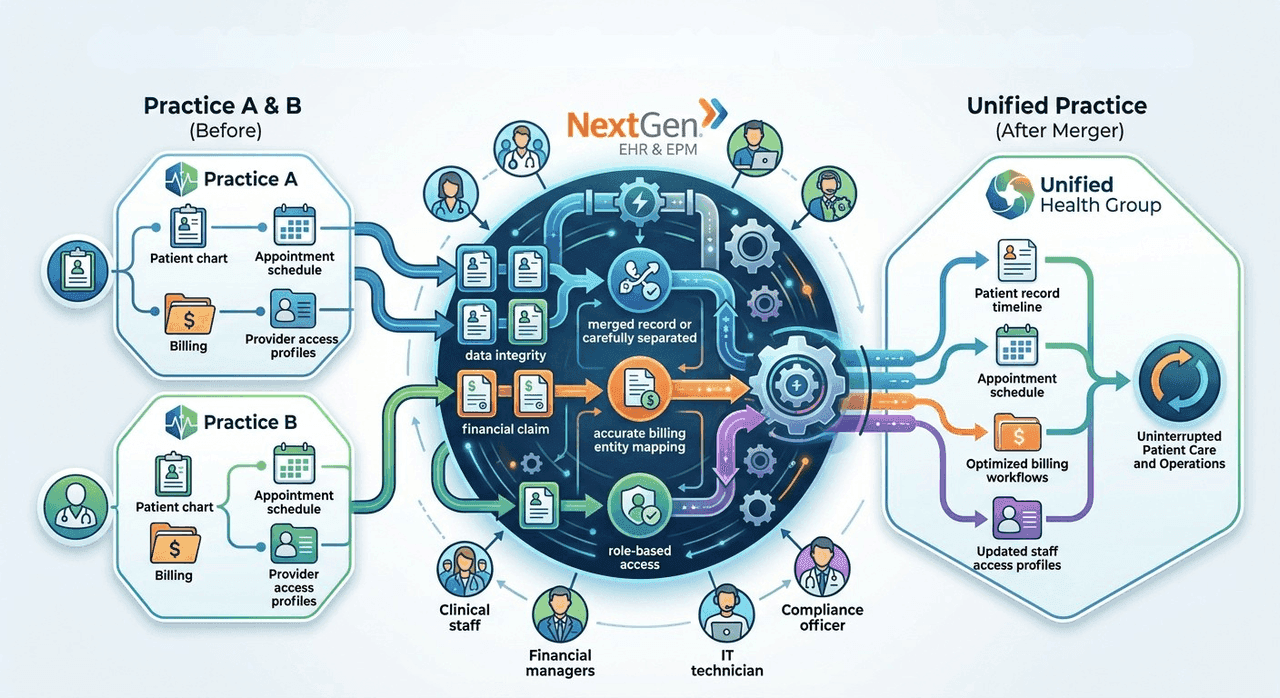
A practice merger or split transforms far more than an organizational chart; it fundamentally alters how information flows through NextGen EHR and NextGen EPM. Patient records might need to be combined, transferred, or cleanly separated, while providers and staff will likely require updated security profiles and system access. Additionally, organizational elements like locations, departments, practices, and billing entities often change, requiring insurance, claims, patient balances, and financial histories to remain accurately tethered to the correct entity. Uninterrupted patient and staff access to care and information relies on carefully updated templates, reports, interfaces, and tasking systems.
These projects require coordination among clinical, financial, operational, technical, compliance, and leadership teams, not just IT. A NextGen practice merger or NextGen practice split can disrupt operations without a coordinated plan. TempDev's goal is to optimize healthcare workflows and protect continuity of care and daily operations by simplifying major organizational transitions like these.
What Is a NextGen Practice Merger or Split?
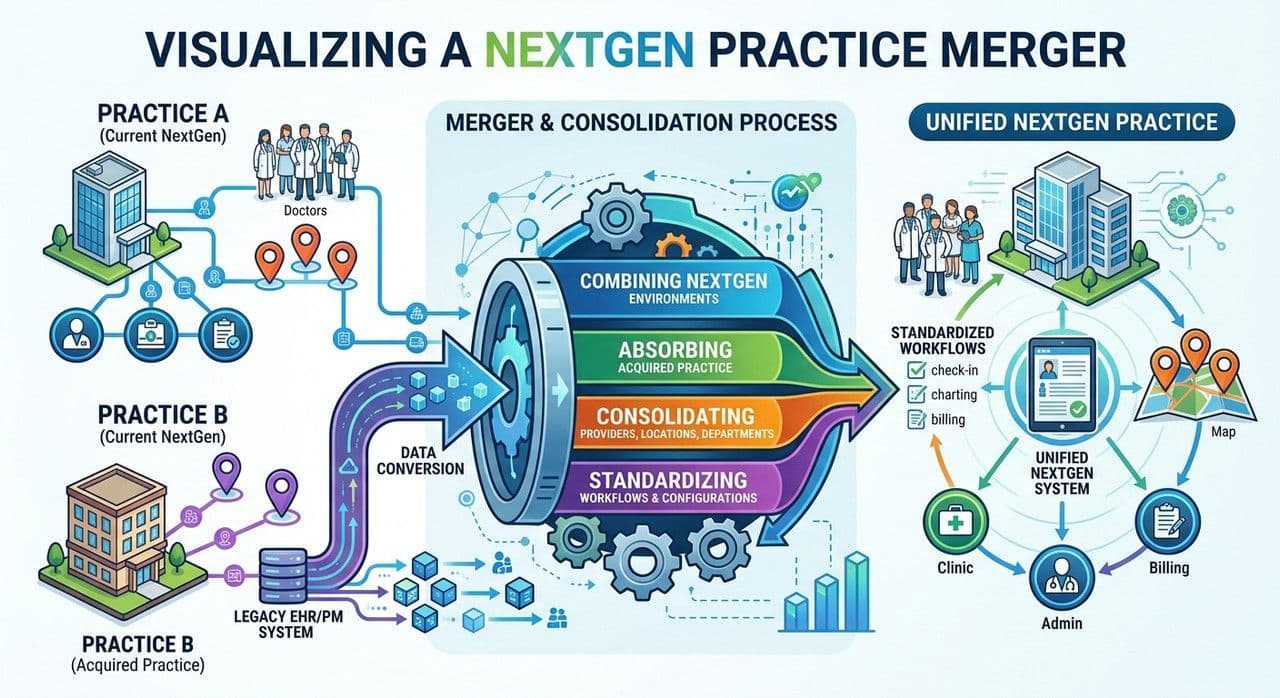
A NextGen practice merger typically involves combining separate NextGen environments, absorbing an acquired practice into an existing system, and consolidating providers, locations, and departments. This process standardizes workflows and system configurations, often requiring data conversions from a different NextGen EHR or practice management platform.
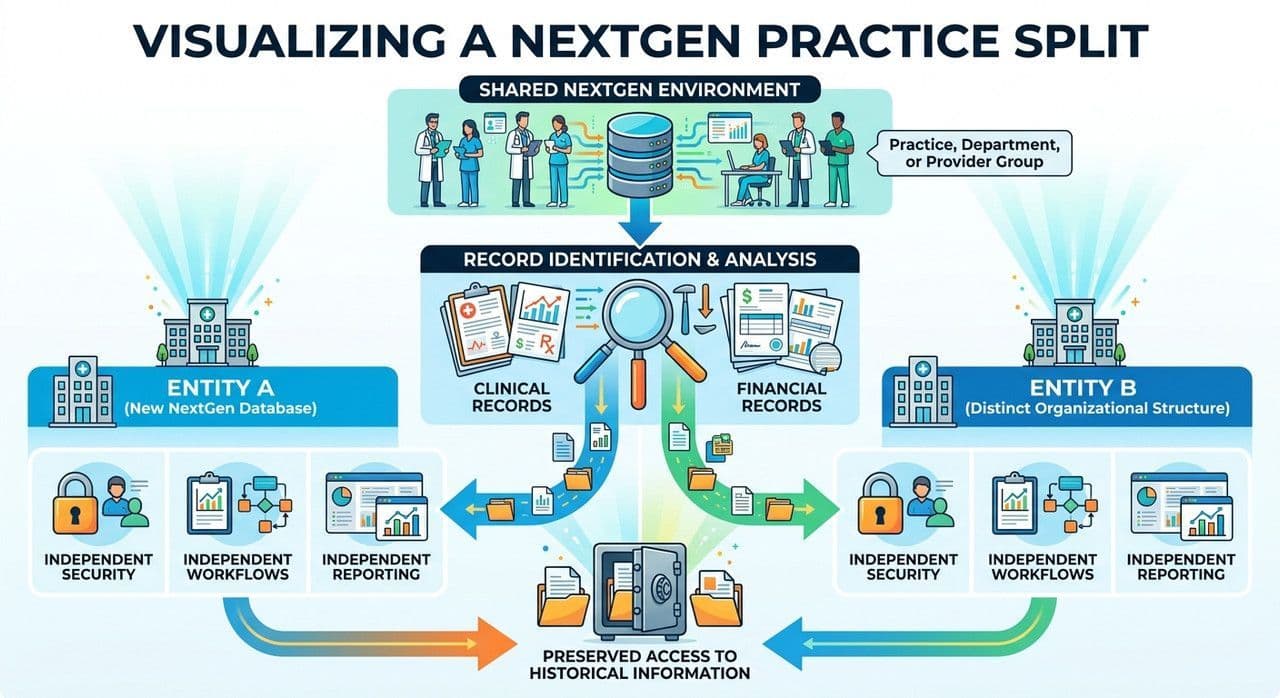
A NextGen practice split separates a practice, department, or provider group from a shared environment to create a new NextGen database or distinct organizational structure. This separation involves identifying the clinical and financial records belonging to each entity, establishing independent security, workflows, and reporting, and preserving access to historical information.
Every healthcare practice merger or split is different because it depends on the organizations, systems, contracts, and data involved. For general guidance, see ONC's EHR playbook.
When Does an Organization Need NextGen Split or Merger Support?
Practices need specialized split or merger support in these situations:
A healthcare organization acquires another practice.
Two practices or health systems combine.
A provider group leaves a larger organization.
A practice changes ownership.
Several NextGen databases need to be consolidated.
An acquired practice must move from another system into NextGen, necessitating a NextGen data conversion.
Locations or service lines are reorganized under new entities.
A hospital or management organization adds or separates affiliated practices.
Internal teams lack the capacity or experience to manage the technical transition.
Planning for these triggers must begin early, as contracts, data access, staffing, compliance, and operational deadlines all heavily affect a NextGen practice merger or NextGen practice split.
Start With Clear Ownership and Project Scope
Before initiating system changes, participating organizations must document clear project scope and ownership to prevent costly gaps later on. This involves agreeing on which organizations, practices, providers, and locations are included, alongside determining the legal and operational effective dates. Leadership must define who owns the clinical and financial records, which organization will maintain the active NextGen environment, and exactly what information must be transferred, copied, separated, or archived.
Furthermore, organizations need to document which party assumes responsibility for open claims and patient balances, who possesses approval authority for clinical, financial, and technical decisions, which vendors must participate, and what systems must remain operational during the transition.
The Four Stages of a NextGen Practice Merger
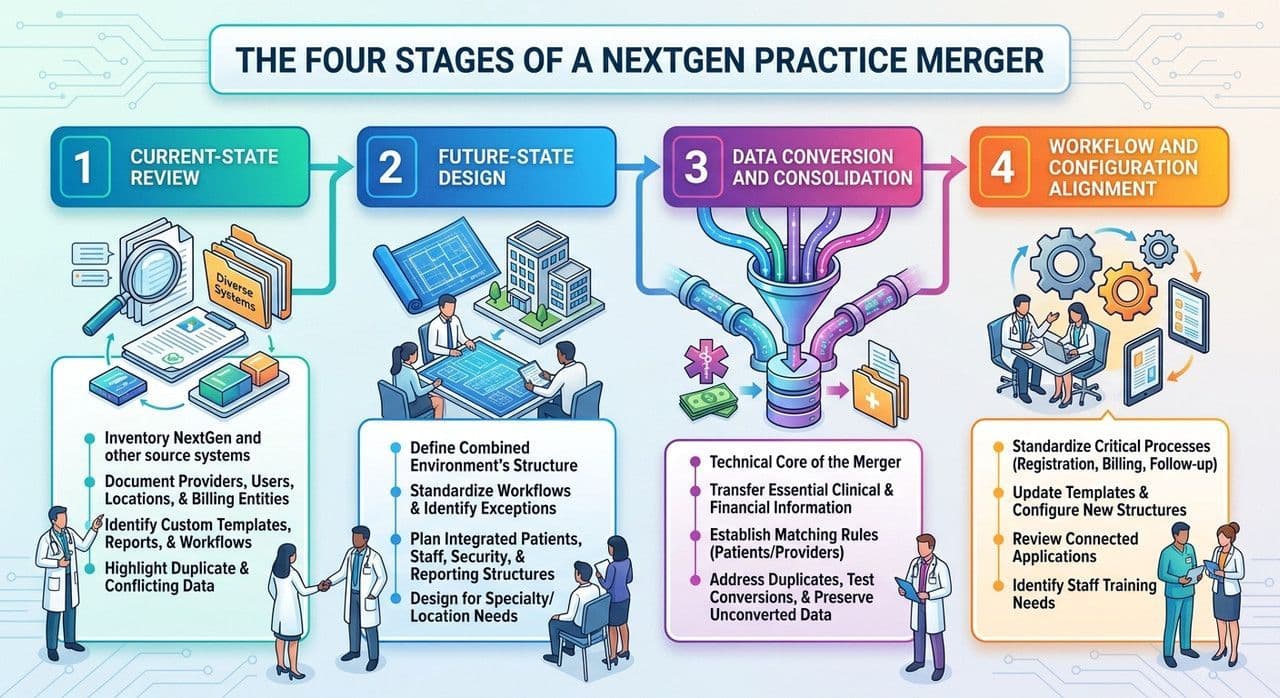
A NextGen EHR merger progresses through four connected stages.
Current-State Review
The current-state review involves inventorying NextGen environments alongside other source systems to document providers, users, locations, and billing entities. This stage identifies custom templates, reports, configurations, and workflows while highlighting duplicate or conflicting data.
Future-State Design
During future-state design, organizations define the combined environment's structure, standardizing workflows while identifying necessary specialty or location-specific exceptions. This phase also maps out how patients, staff, security, and reporting structures will integrate.
Data Conversion and Consolidation
Data conversion and consolidation form the technical core of the merger. It requires identifying essential clinical and financial information to move, establishing strict matching rules for patients and providers, and mapping source data to correct NextGen locations. Teams must address duplicate records, complete test conversions, and preserve access to unconverted historical data.
Workflow and Configuration Alignment
Finally, workflow and configuration alignment standardizes critical processes like registration, documentation, billing, and follow-up. Teams update templates, configure new organizational structures, review connected applications, and identify training needs to ensure a clean merger free of lingering issues.
What a NextGen Practice Split Should Include
Data Ownership and Separation Rules
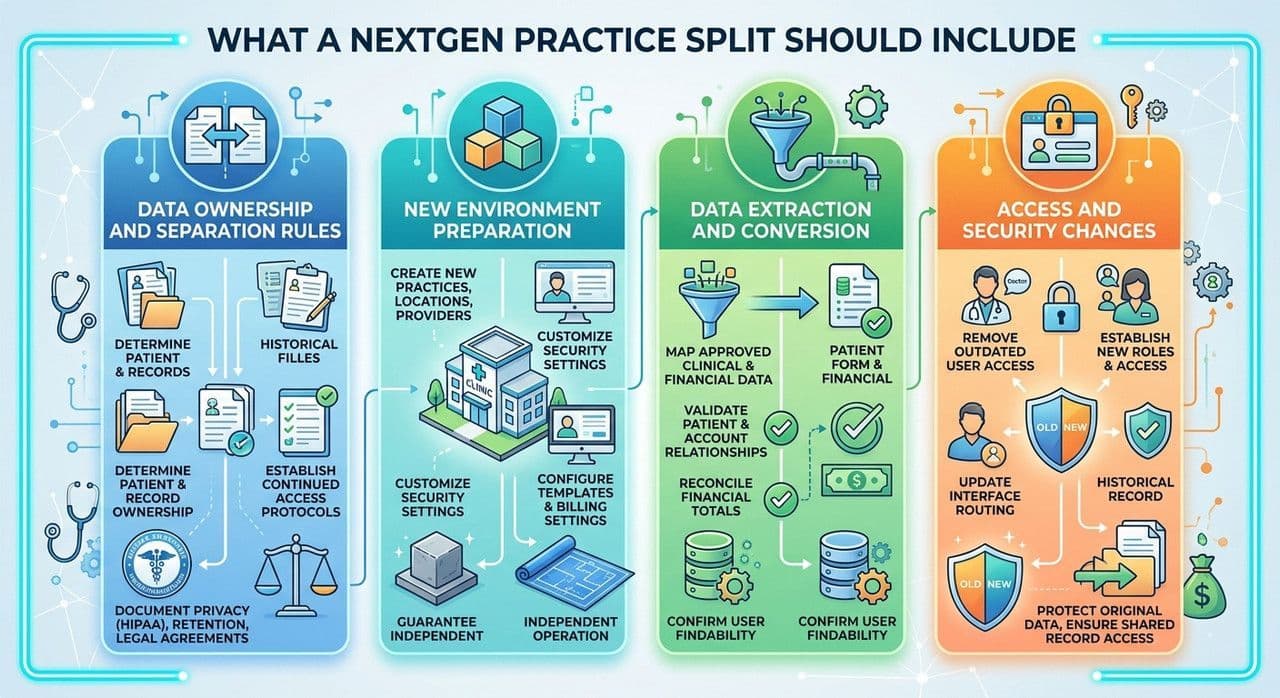
A successful split relies on strict data ownership and separation rules. Organizations must determine exactly which patients, historical records, open encounters, claims, and tasks belong to each entity, establishing protocols for continued access or data extracts. These agreements must document privacy, retention, and legal considerations under HIPAA for the participating organizations.
New Environment Preparation
New environment preparation follows, requiring the creation of new practices, locations, providers, and customized security settings. Technical teams configure templates, billing settings, and infrastructure to guarantee the separated organization can operate independently.
Data Extraction and Conversion
During data extraction and conversion, approved clinical and financial data is mapped into the new NextGen structure. Teams validate patient and account relationships, reconcile data, and confirm users can easily locate transferred information.
Access and Security Changes
Finally, access and security changes involve removing outdated user access, establishing new roles, updating interface routing, and protecting data that must remain with the original organization while ensuring proper access procedures for shared historical records.
Protect Revenue Cycle Continuity During the Transition
During a transition, financial work rarely stops cleanly on the effective date, so a healthcare practice merger or split needs a clear plan for handling everything still in motion: open claims and accounts receivable, unposted charges and payments, patient balances and credit balances, payer enrollments and billing identifiers, clearinghouse and remittance connections, authorizations and referrals, financial reporting responsibilities, statements and patient communications, and ownership of denials and follow-up work all require deliberate coordination to protect revenue cycle continuity and prevent gaps that could delay payment or confuse patients.
Test Complete NextGen Workflows Before the Transition
End-to-end testing is essential before going live with NextGen, since the system needs to be validated as a complete, connected workflow rather than a collection of isolated functions, covering patient search and registration, scheduling and check-in, clinical documentation and orders, tasking and communication, charge capture and claims, payments and account follow-up, interfaces and external data exchange, reports and dashboards, security and user access, and historical record retrieval.
This validation should include clinical, operational, billing, and technical users working through their real day-to-day tasks rather than relying on technical testing alone, since issues that seem minor in isolation can disrupt care delivery or revenue flow once the system is live.
Prepare Staff and Patients for the Change
To successfully execute the transition and support continuity requires preparing both staff and patients for the impending changes. Organizations must inform employees about the timeline and provide role-based training on new workflows, including clear instructions for accessing historical data and reporting technical issues. Establishing superusers offers essential support during the critical early transition period. Patient-facing changes such as new portals, statements, or contact information must be communicated clearly, keeping in mind that patients retain HIPAA rights to access their health information throughout the transition.
How Careful Planning Helps Work Flow Better
Careful NextGen project planning ultimately transforms a stressful healthcare practice merger or split into a controlled, well-documented transition. It protects access to patient and financial data, reduces confusion about organizational responsibilities, keeps clinical and billing work moving, and prevents incompatible workflows from merging unchecked. By clarifying responsibilities and user roles, organizations reduce their dependence on manual fixes post-transition, achieving the ultimate goal: creating a NextGen environment fully equipped to support the new organization from day one.
How TempDev Uncomplicates NextGen Practice Splits and Mergers
TempDev simplifies these transitions through deep expertise in NextGen EHR and NextGen EPM structures, alongside extensive experience managing practice mergers, acquisitions, and consolidations. Instead of treating a transition as a standalone data task, TempDev coordinates project planning across organizations and vendors, handling clinical and financial data conversion, workflow configuration, testing, and comprehensive training.
Build the Right NextGen Environment for the Organization's Next Chapter
A successful NextGen EHR merger or NextGen practice split demands clear ownership, coordinated system changes, and dedicated support.
If your organization is approaching a transition, consulting with TempDev can help build a plan that fully protects continuity of care.
Ready to get more of your NextGen system?
Help your organization achieve measurable improvements in efficiency, compliance, and performance.