


How NextGen Business Analysis Bridges Operational Needs and Project Requirements


Related articles:
Turn Your NextGen Healthcare Data Into Business Intelligence and Reports That Work
Read ArticleHow TempDev’s NextGen Quality Consulting Can Fix Documentation Gaps and Boost Performance
Read ArticlePerform a NextGen Revenue Cycle Optimization With TempDev For Less Administrative Friction And Stronger Cash Flow
Read ArticleWhen cash flow slows, teams become overwhelmed, or workflows stop supporting the people who rely on them, it is often a sign that your NextGen environment is ready for improvement. However, before you can configure, build, or optimize anything, you need a shared understanding of the operational need and the requirements that will move the organization forward. Through structured analysis, TempDev’s practice management business analyst uncovers root causes and aligns your entire team around actionable project scope. We turn operational friction into efficient, seamless practice management.
What Is NextGen Practice Management Business Analysis?
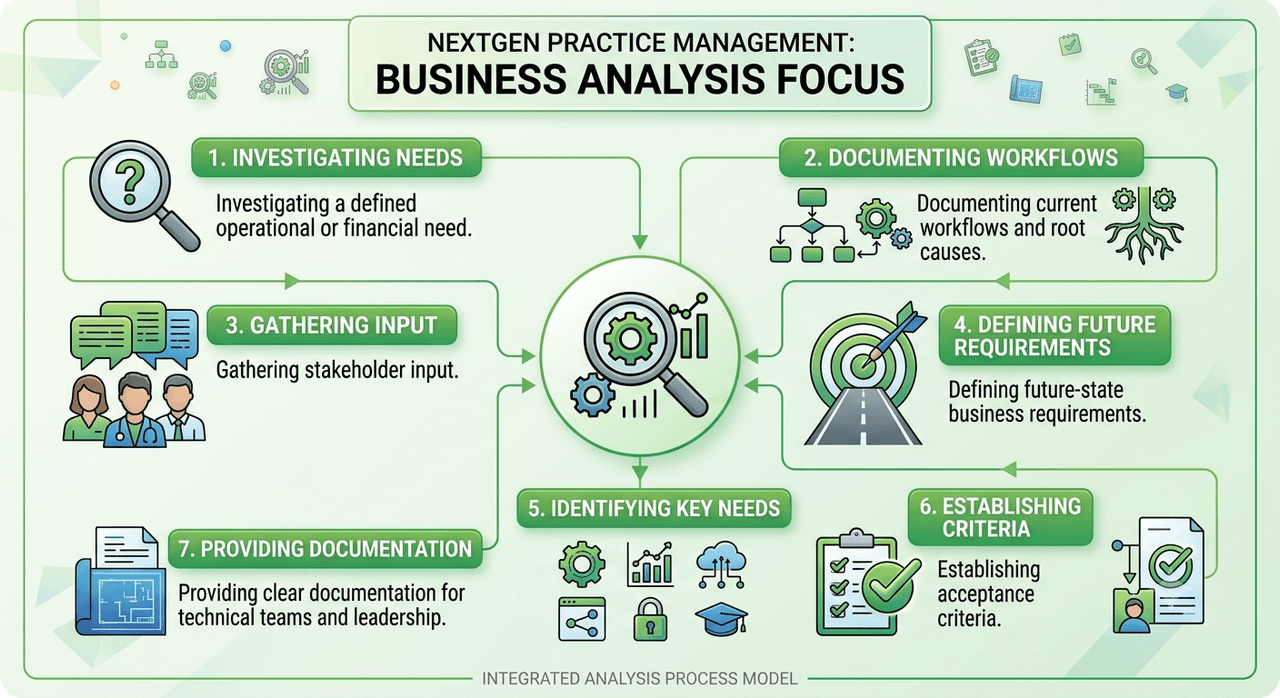
At its core, NextGen EPM business analysis takes an operational or financial need and turns it into requirements clear enough for the people who will configure, develop, report on, or change NextGen Practice Management.
That means a practice management business analyst has to:
Define the specific PM problem and the outcome you're after.
Identify which departments and roles it touches.
Document how the process works today across scheduling, registration, claims, and follow-up.
Gather and organize business, workflow, reporting, data, and technical requirements.
Define what the solution must accomplish, with real acceptance criteria.
Analysts focus on investigating, documenting, and defining what a solution needs to do. By providing clear, actionable requirements, they complement project managers, giving them the exact blueprint needed to guide execution, manage scope, and keep the team on track.
When Do You Need Healthcare Business Analysis?
A few signs you need dedicated healthcare business analysis support:
You're considering a new scheduling, billing, reporting, or automation workflow.
Departments disagree about how a process should actually work.
The project has a goal, but no real detail behind it.
Requirements keep shifting after configuration has already started.
Staff is working around NextGen instead of working with it.
Leadership needs help defining the business need, expected outcome, and functional requirements.
A project manager needs documented workflows and requirements before developing the formal project plan.
Leadership needs to understand what should be built or changed before assigning timelines, resources, and ownership.
NextGen business analysis gets a project ready to build or brings clarity back to a complex existing one by defining key tasks. Working in tandem with the project manager, the analyst helps structure and organize the work for smooth delivery.
Start With the Business Problem
Before anyone configures anything, ask the basic questions: What problem are we actually solving? Who's affected by how things work today? What outcome are we after? What information will a technical team or project manager need before the work can be scoped and planned?
And don't skip this one: is the requested feature even the right fix? "Build a report" “Automate this step” rarely explains the need behind it. Figuring out the real problem is the analyst's job.
What NextGen Practice Management Business Analysis Should Include
Stakeholder Identification and Input
A practice management business analyst starts by identifying decision-makers, subject-matter experts, users, and technical teams, and who actually signs off on requirements. Surfacing conflicting priorities early saves you a lot of pain later.
The goal here is a shared understanding of the business problem and the outcome everyone is working toward, documented without the analyst taking on responsibility for managing how those stakeholders participate for the rest of the project
Current-State Workflow Documentation
Next, they document how the process works today. You can't redesign a process you haven't mapped, so identify:
Each role, step, decision, handoff, exception, and system interaction.
What NextGen functions and outside tools are in play.
Manual workarounds and duplicated effort.
Exactly where the process breaks down and what effect that has on operations or revenue cycle performance.
AHRQ's workflow tools are a solid framework if you want a starting point for these assessments.
Root-Cause and Gap Analysis
This is where the analyst separates the visible problem from what's actually causing it: workflow, configuration, data, reporting, training, ownership, or system limitation, and separate individual user preferences from requirements that reflect a real business need. From there, they lay out the risks, constraints, dependencies, and whatever Is still unresolved.
The practice management business analyst's role here is to provide evidence and findings. Deciding how to schedule and implement the resulting work is a leadership and project management decision, not an analyst one.
Future-State Process Definition
Once they know the root cause, the analyst can define what the process should look like. Cut the steps that no longer make sense. Decide exactly where NextGen should carry the load without creating the implementation plan or assigning project resources.
NextGen Requirements Gathering and Documentation
This is where business and operational requirements get documented alongside functional and technical ones, including data, reporting, security, interface, and training needs. Required functionality are separated from nice-to-haves, requirements are prioritized based on business value, risk, and operational need, and everything is written in language that both business users and technical teams can actually understand and act on.
Done well, NextGen requirements gathering becomes traceable inputs that later support configuration, development, testing, and project planning.
Acceptance Criteria and Business Validation
NextGen requirements gathering only means something if you can measure whether they were met. Define what success looks like, including exceptions, and tie every acceptance criterion back to a documented requirement.
Analysts help define how the organization will recognize a successful solution. The project manager coordinates the actual testing and approval process within the larger project.
Turning Operational Needs Into Clear NextGen Requirements
Solid NextGen healthcare business analysis translates general concerns into actionable solution requirements. For instance, a concern like “our claim follow-up process is too slow” may need to be translated into requirements covering:
Which users review and manage outstanding claims.
How claims should be prioritized.
Which statuses, worklogs, or queues should be used.
What payer, location, provider, or balance information users need.
Which tasks or notifications should be triggered.
What reports managers need.
How exceptions and escalations should be handled.
What roles should have access to update or review the work.
How improvement will be measured.
Clear requirements like these help developers, consultants, vendors, and internal teams work toward the same result instead of four different interpretations of “faster.” These requirements often become the inputs for a project to correct the issue. For more information, take a look at our NextGen EPM consulting and NextGen EHR consulting work.
Business Analysis vs. Revenue Cycle Assessments
The two are closely related, but they serve different purposes.
NextGen EPM business analysis is typically tied to a specific operational need, system change, or proposed project. It focuses on understanding current workflows, stakeholder requirements, pain points, dependencies, and desired outcomes so the organization can determine what should change and what the solution needs to accomplish.
A revenue cycle assessment applies those same business analysis principles across a broader portion of the revenue cycle. Rather than evaluating a single project, the assessment brings together analysts, project managers, operational leaders, and other subject matter experts to examine workflows, system use, performance, and opportunities for improvement.
Business analysis is a key part of that team effort. The findings help the organization prioritize opportunities, define potential projects, and create a clearer path for the work that follows.
Business Analysis vs. Project Management
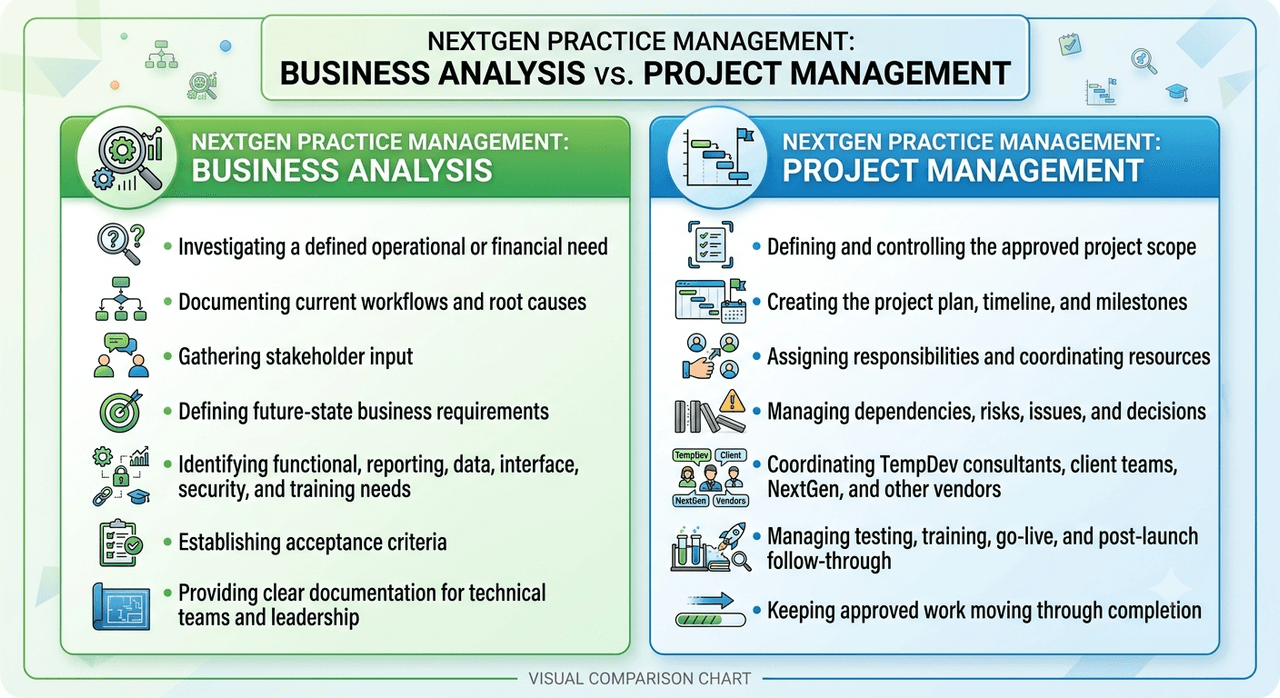
As we’ve already seen, Nextgen business analysis investigates, gathers input, and defines what the future state should look like. Project management defines scope, builds timelines, and coordinates resources, manages risks, and oversees testing and go-live. One supports the other; a business analyst isn't a replacement for a project manager.
Here's more on why IT projects need a project manager before the work begins.
How Business Analysis Helps Work Flow Better
Done correctly, NextGen Healthcare business analysis directly improves operations. It gives stakeholders a shared understanding of the problem and creates clearer handoffs between business and technical teams. It reduces rework caused by incomplete requirements and helps changes in NextGen support actual user workflows.
Furthermore, it provides a clear standard for testing, documents necessary information for project managers, and reduces the risk of starting a project based on assumptions. Business analysis brings clarity before configuration, development, or workflow changes begin.
How TempDev Uncomplicates NextGen EPM Business Analysis
We've spent almost two decades inside NextGen Practice Management working across scheduling, registration, eligibility, billing, claims, payment, reporting, and account follow-up. That depth is what lets us move between operational users and technical teams without losing anything in translation.
Our approach to business analysis includes:
Defining how the system needs to be built, including specific features, functionality, and configuration
Designing targeted workflows based on those technical and operational decisions
Current-state and future-state workflow documentation
Business, functional, reporting, interface, and data specifications
Root-cause and gap analysis
Acceptance-criteria development
Support for implementations, upgrades, reports, interfaces, automations, and workflow projects
TempDev business analysts translate your operational needs into actionable blueprints. They work in tandem with our project managers, handing off clear system requirements and documentation so the Project Management team can seamlessly plan, coordinate, and oversee the successful delivery of the project.
What Deliverables Come From NextGen Practice Management Business Analysis?
Here's what you actually walk away with:
A clear statement of the business problem and desired outcome
Current-state workflow documentation
Documented root causes and process gaps
Stakeholder and user requirements
Functional, reporting, data, interface, security, and training requirements
Normal and exception workflow scenarios
Known risks, dependencies, assumptions, and unresolved questions
Future-state process recommendations
Acceptance criteria for validating a potential solution
A requirements package that can support technical scoping and project planning
Understand the Need Before Defining the Solution
Improving NextGen Practice Management starts with actually understanding the operational problem, not the feature request sitting on top of it. Business analysis is how organizations document current workflows, uncover root causes, define what a solution has to accomplish, and get every stakeholder looking at the same outcome.
NextGen business analysis defines the need and the requirements. Project management takes over once the organization is ready to plan, coordinate, and implement the approved solution.
If you're sitting on a Practice Management problem that hasn't turned into a clear plan yet, or a project that's already underway and could use a clearer set of requirements, let's talk.
Interested?
Agree with our point of view? Become our client!
Did you enjoy this read? Feel free to share it with your contacts.