


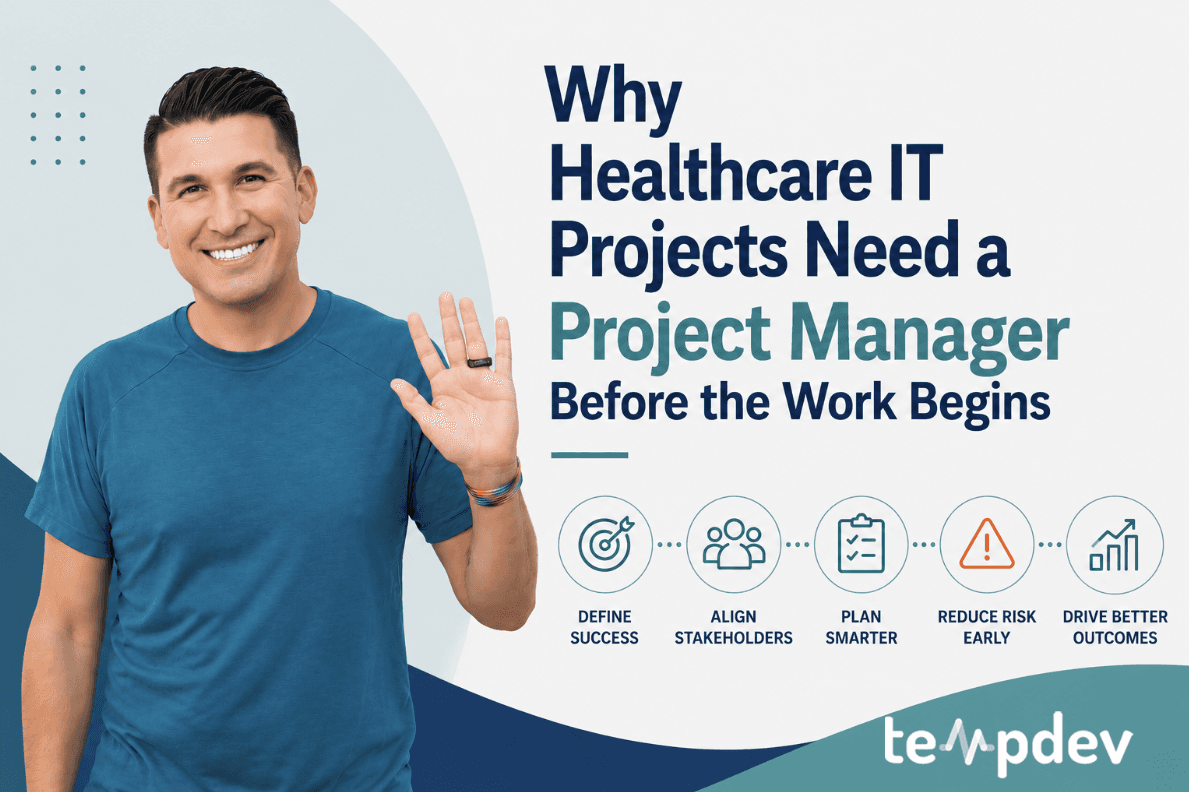
Why Healthcare IT Projects Need a Project Manager Before the Work Begins

Related articles:
From Go-Live to Adoption: Why Launch Day Is Not Enough
Read ArticleHealthcare Project Management: Challenges and Benefits
Read ArticleThe Hidden Cost of Scope Creep in NextGen Projects
Read ArticleBeyond Compliance: Maximizing the Strategic Value of Your NextGen Enterprise 8.3.1 Upgrade
Read Article
When a healthcare organization buys a new piece of technology, everyone focuses on the finish line. Leadership wants the clinical efficiency, the IT team wants to tinker with the new system, and the vendor wants the software live. But if you launch into the project without a real foundation, that excitement disappears fast. Budgets vanish into unexpected consulting hours, timelines slide by months, and clinical staff gets frustrated before the system even goes live.
This breakdown happens because organizations treat a healthcare IT project manager as a construction foreman rather than an architect. They assume a project manager is only useful once the technical build starts, there to track tasks, manage timelines, and check boxes.
In reality, the most critical work happens during discovery and design. If you wait until implementation to bring in a project manager, you are playing catch up from day one. You are trying to steer a heavy ship that has already left the dock without a map.
Most Project Problems Start Before Implementation
The failures on complex technology projects almost always trace back to the exact same few gaps. The wildest part is that these gaps happen long before anyone writes a line of code or flips a server switch. If you skip early, deliberate EHR project planning, these hidden issues turn into incredibly expensive hurdles down the road.
Unclear Ownership Of Decisions
In a busy clinic or a multi-facility health system, it is remarkably hard to pin down who is actually in control of project governance. If you do not define who is responsible for ensuring that things are in line with your project charter, it will eventually stall. You cannot wait for a massive committee to reach a unanimous agreement on every single workflow detail.
A skilled healthcare IT project manager identifies your actual operational leaders immediately during the pre-planning stage. This stops your team from getting trapped in an endless loop of meetings where everyone talks, but nobody signs off on the final blueprint.
Undefined And Creeping Scope
Scope creep is the absolute silent killer of a healthcare technology implementation. It always starts small. A department head asks for one minor custom field or a special alert. Then another manager wants unique reporting tools for their specific team.
Before you know it, the project looks nothing like your original plan or your initial budget. Because there is nobody dedicated to guarding the project boundaries early on, your timeline suffers a slow death by a thousand cuts. A project manager keeps the entire team focused on the primary clinical goals so the work stays manageable and transparent.
Missing Workflow Details
Technical build teams are great at configuring software, but they rarely know how your medical assistants, nurses, or front desk staff actually operate on a hectic Tuesday morning. If you skip a detailed workflow assessment before the software build starts, you will build a rigid system that your people absolutely hate using.
Clinical success depends entirely on these minor operational details. You have to map the human process completely before you apply the new technology. A proactive project manager ensures these real-world workflows are documented during design, not discovered as a painful surprise during user testing.
Underestimated Resource Needs
Your internal staff already has a demanding, full-time job taking care of patients and running daily operations. You cannot simply expect them to lead a massive healthcare technology implementation without dedicated help.
Many tech projects fail because leadership severely underestimates the hours required for database validation, template testing, and end-user training. An early project manager's presence ensures you calculate these resource needs accurately before day one. This allows you to arrange for clinical backfills so you have the right people in the room at the right time without burning out your core team.
Arbitrary Timelines and Unrealistic Go-Live Dates
Many healthcare IT projects launch with a go live date based on corporate wishful thinking or the software vendor's aggressive sales cycle instead of the actual operational bandwidth. When an organization inherits such a timeline, the IT team cuts corners to meet the arbitrary milestone, skipping important steps like testing and training.
When you bring in a PM, they build a realistic project plan backed by data and your true capacity. This sets an expectation across the leadership from the start. Everyone agrees on a timeline that protects clinical operations instead of one that creates chaos as the team scrambles to get to the finish line.
What A Project Manager Should Clarify Before Work Starts
Before any software configuration happens, a strategic healthcare IT project manager acts as an operational architect. They dig into the actual purpose behind the technology investment, ensuring everyone is on the exact same page before the financial clock starts ticking on your implementation vendor.
First, they define what clinical or operational success actually looks like for your specific organization. Is the main goal to reduce patient wait times in the clinic? Is it to improve billing accuracy and drive down your days in accounts receivable? Having a clear, unmovable target allows the implementation team to make faster, better decisions when technical tradeoffs happen.
On top of that, the project manager clarifies exactly which cross-functional teams need to be involved from the start. They ensure that billing offices, clinical directors, and IT infrastructure teams are all talking to each other rather than working in isolated siloes.
The project manager also looks ahead to identify roadblocks before they manifest. They anticipate bottlenecks based on past project performance across the industry. By mapping out these technical and operational risks early, they build a practical safety net for the project. This proactive approach saves an immense amount of time, capital, and organizational sanity.
Why Early Project Manager Involvement Matters In NextGen Project Management
Navigating a complex NextGen project management cycle requires a highly specific set of skills. NextGen is an incredibly powerful, deeply customizable platform, but it can be highly complex to set up correctly from scratch or upgrade smoothly. You cannot rely on a generic IT project manager who does not understand clinical operations. You need someone who understands the technical side of the software and the operational reality of a clinic equally well.
Consider a practical example involving NextGen template customization. A clinical director might request a completely custom intake screen to document a specific visit type more quickly. A generic project manager might just hand that request over to a developer without a second thought.
But a project manager experienced in NextGen project management will pause and look at the broader picture. They know that heavy customization in the template editor can completely break standard reporting metrics or create massive headaches during the next major software upgrade. They will work with the clinical and technical teams early in the design phase to find a solution that leverages standard NextGen functionality while still keeping the clinic efficient.
Early project management involvement is also the secret to successful change management during a healthcare technology implementation. The technical configuration of the database is rarely the hardest part of a rollout. The people are the most difficult part of any technology shift. A seasoned project manager prepares your staff for the cultural shift long before training manuals are printed. They manage user expectations, address staff anxieties, and provide the structured support needed to make the transition highly successful.
At TempDev, our project managers aren't just generic coordinators reading from a generic playbook. They are true NextGen subject matter experts who all rose through the ranks as NextGen analysts. Because they have spent years actually building templates, configuring databases, and solving system bottlenecks, their strategic advice is unparalleled.
How TempDev Builds Execution Into The Project From Day One

At TempDev, we do not view project management as an administrative add-on service or a luxury line item. It is the absolute core of everything we do. We build practical execution into your process from the very first discovery meeting because we know that big healthcare IT projects fail when they lack early, rigorous planning.
We start by learning your specific operational pain points and strategic goals instead of using a generic checklist. Because our team has deep experience across thousands of clinical environments, we spot red flags early. Our discovery process finds the gaps in your data and workflows before they turn into costly implementation emergencies.
Nobody likes surprises or hidden bad news in a high-stakes IT project. We prioritize clear, direct, and frequent communication. You will always know exactly what milestones have been achieved and what critical decisions are coming next. This level of transparency builds real trust and keeps your entire leadership team moving in the exact same direction.
We provide honest, unvarnished timelines based on real-world data, not best-case scenarios. Most importantly, we identify the exact resource and data risks that could derail your progress. We help you plan realistically for staffing shortages, technical interface hurdles, and comprehensive staff training needs. This ensures your healthcare technology implementation stays on schedule and within budget. If you are looking to optimize your financial outcomes alongside your technical systems, you may find our strategies highly valuable.
Conclusion And Next Steps
Your healthcare IT project is far too important and far too expensive to leave to chance. By bringing in an experienced healthcare IT project manager before the configuration work starts, you set your entire organization up for a predictable victory. You clarify your operational goals, protect your financial resources, and ensure your clinical staff feels completely supported through the change.
At TempDev, we specialize in making complex NextGen project management cycles feel simple, predictable, and manageable. We focus heavily on the technical and operational details so your leadership team can focus entirely on patient care. If you want to maximize the return on your software investment, explore our comprehensive NextGen Consulting Services to find the right fit for your organization.
Talk to us today to start your next project with a solid, battle-tested plan.
Interested?
Agree with our point of view? Become our client!
Did you enjoy this read? Feel free to share it with your contacts.