


Related articles:
Referral Management Package for NextGen EHR
Read ArticleOperationalizing Principal Care Management (PCM): Building Sustainable Workflows in NextGen
Read ArticleEnhanced Care Management is a critical program for Medi-Cal members with complex needs. But managing it manually? That is a different story.
Teams struggle to keep up when ECM workflows live outside the EHR. Gaps appear, visibility drops, and billing gets complicated.
TempDev built the Enhanced Care Management package to solve this. It brings ECM documentation, outreach tracking, care planning, assessments, billing support, and payer communication directly into NextGen EHR.
Here is how it works and why it matters.
Why ECM Workflows Are Hard to Manage Manually
Medi-Cal ECM is not a simple documentation exercise. It is a coordinated care model.
Care managers need to track referrals, complete adult and youth assessments, build care plans, document interventions, track outreach attempts, communicate with payers, and submit billing.
Doing all of this manually creates problems.
Paper forms go missing. Spreadsheets become outdated. Documentation lives in different places. No one has a complete view of the patient's ECM record.
The operational pain is real. Teams spend more time hunting for information than delivering care.
The Risk of Documentation Gaps in Enhanced Care Management
CalAIM ECM depends on a complete record.
Payers need to see outreach activity, and care teams need to see assessments and care plans. Billers, too, need to see service documentation, and regulators may request proof of coordination.
When key documentation lives outside the EHR, gaps appear.
Such gaps include an outreach attempt that is logged in a spreadsheet but never makes it into the chart, or a payer communication that happens over email and disappears into an inbox.
These gaps create risks. Hence, billing gets delayed, audits become stressful, and care coordination suffers.
Keeping the full ECM record inside the EHR is an operational necessity.
What Enhanced Care Management Requires From the EHR Workflow
ECM workflows are not simple. They need to support multiple steps.
Intake. Referrals come in. Patients need to be identified and enrolled.
Assessment. Adult and youth assessments capture the member's needs, risks, and goals.
Care planning. Care plans outline interventions, timelines, and responsible parties.
Outreach tracking. Teams need to log every communication attempt. Phone calls. Letters. Home visits. Each one matters.
Intervention tracking. What services were delivered? When? By whom?
Payer communication. Payers such as HealthNet and Anthem Blue Cross need regular data exchange.
Billing. Services need to be documented and submitted for reimbursement.
The EHR should help teams manage these steps in one place. Not across spreadsheets, paper forms, and email threads.
How TempDev's ECM Package Supports NextGen Users
TempDev built the Enhanced Care Management package specifically for NextGen ECM users.
It is a set of templates designed to support Medi-Cal's ECM program. The package brings documentation, tracking, payer information, and workflow activity directly into NextGen EHR.
No more paper forms, scattered spreadsheets, or manual payer file handling.
The package helps healthcare facilities move away from disconnected manual processes. Everything lives inside the EHR, connected and visible.
ECM Templates Included in the Package
The package includes several core components. Each one addresses a specific part of the ECM workflow.
Referral Form. Capture referral information directly in NextGen. Track where the referral came from and what actions are needed.
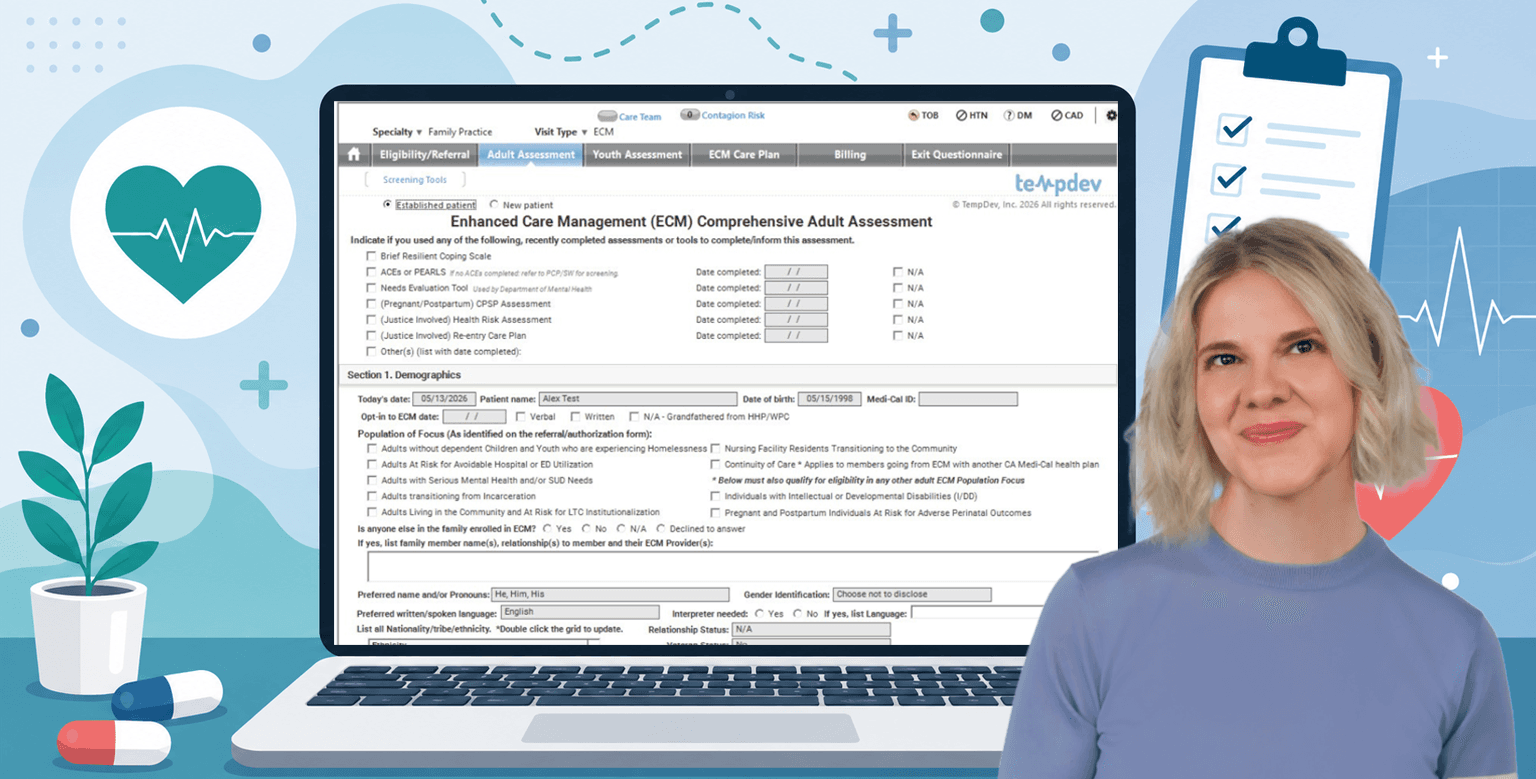
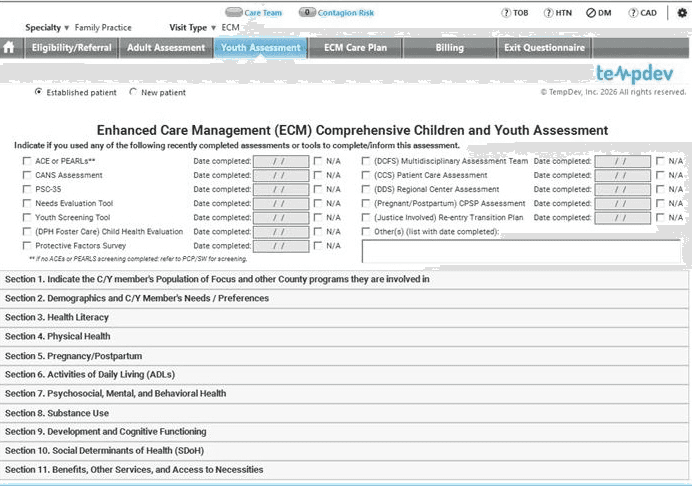
Adult Assessment. Comprehensive assessment for adult ECM members. Captures medical, behavioral, and social needs.
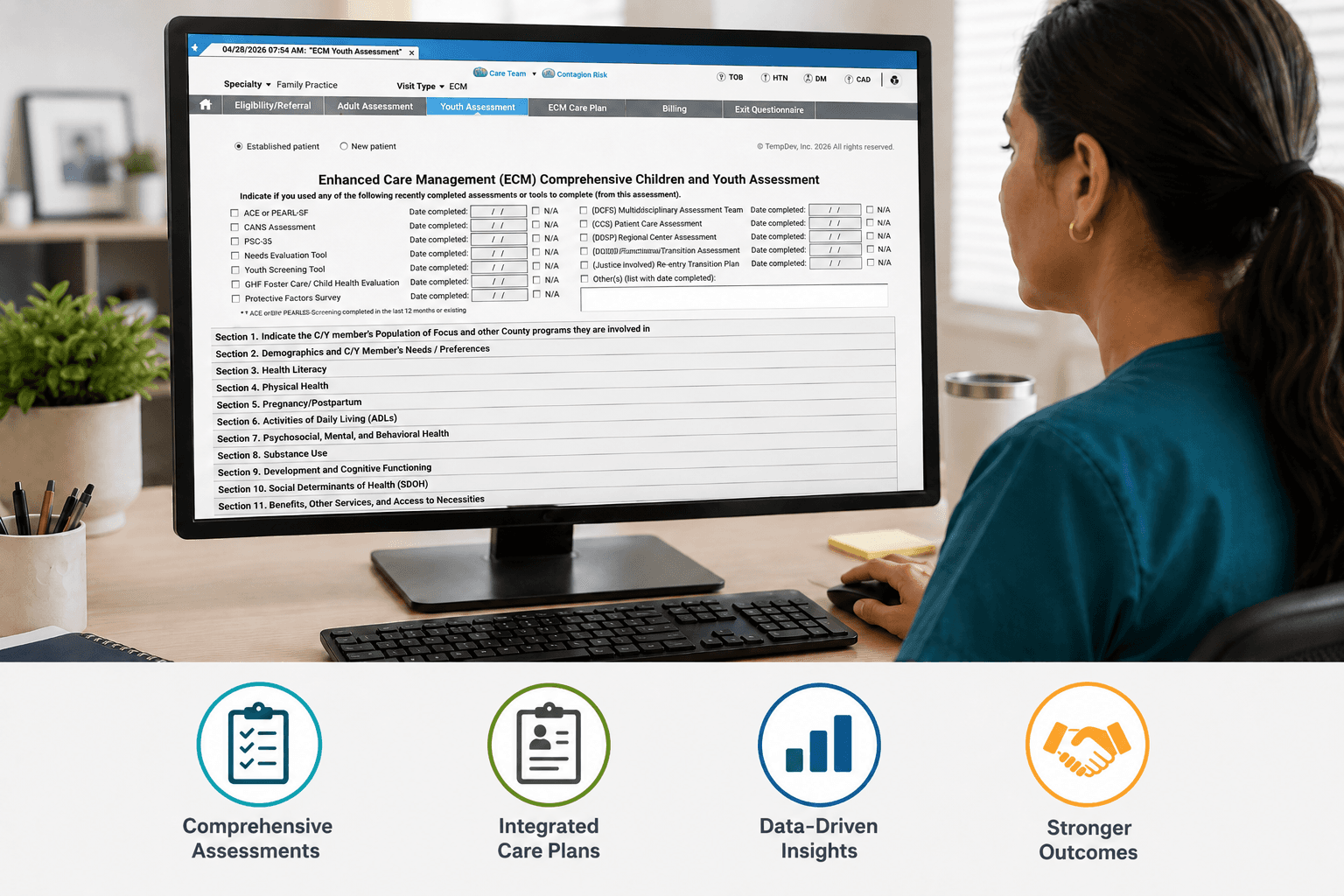
Youth Assessment. Similar to the adult assessment but tailored for younger members.
Completion Questionnaire. Document when a member completes the ECM program or transitions to other services.
Billing. Structured workflow for ECM billing. Supports accurate claim submission and reduces denials.
Brief Resilient Coping Scale. Standardized tool for assessing member coping skills and resilience.
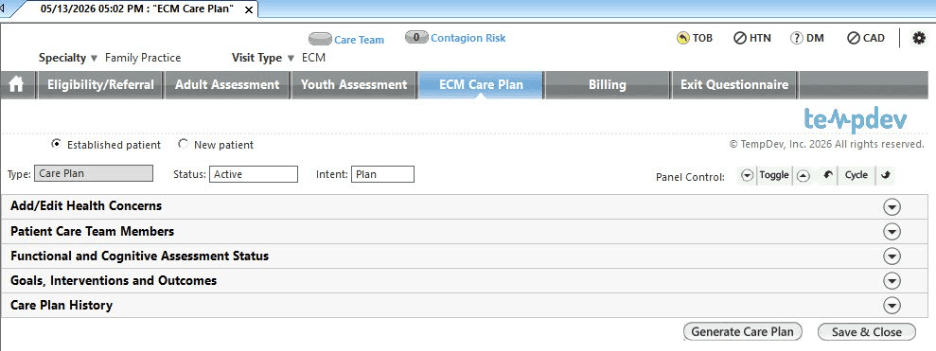
Care Plans, Problems & Intervention Tracking. Build care plans, track problems, and document every intervention. Keep the full record in one place.
Outreach Tracking Practice Template. Log every outreach attempt. Phone calls, letters, home visits, and more.
These ECM templates turn fragmented manual work into structured EHR workflows.
Outreach Tracking for Potential ECM Patients
One of the hardest parts of ECM is finding eligible patients.
Healthcare facilities need to identify potential ECM members and reach out to them. They also need to track every communication attempt and follow up consistently.
Doing this manually is nearly impossible at scale.
The Outreach Tracking Practice Template solves this. Teams can log every outreach attempt, from phone calls, letters, emails, and home visits, directly in NextGen.
The template tracks:
Who was contacted?
When the contact happened?
What method was used?
What was the outcome?
What follow-up is needed?
This visibility changes how teams work. No more guessing who has been contacted, no more duplicate outreach, and no more lost follow-ups.
Automated Payer Communication Through Mirth
CalAIM ECM requires regular communication with participating payers (HealthNet, Anthem Blue Cross, and Other Medi-Cal managed care plans).
Manual file handling is slow and error-prone. Someone exports data. Formats it incorrectly. Sends it to the payer. Waits for a response, then imports the return data.
TempDev's ECM package automates this through Mirth.
Mirth extractions pull the required data from NextGen. The package generates the necessary files:
Return Transmission File for payer responses
Outreach Tracker File for tracking communication attempts
Member Information File for member data exchange
CalAIM Rx Prescription File for prescription information
Mirth ingestion brings payer information back into NextGen: member updates, eligibility changes, and referral statuses.
The result is less manual work, fewer errors, and faster communication with payers.
For more on how TempDev approaches interoperability, check out our blog on interface engines and our interface engine glossary.
How ECM Supports Better Care Coordination
At its core, Enhanced Care Management is about coordinated care.
Medi-Cal members with complex needs often see multiple providers. They may need help with housing, transportation, food access, or medication adherence. They need someone who connects the dots.
ECM provides a single point of contact. A care manager who knows the member coordinates with providers, community resources, and payers.
Coordination only works when everyone has the same information.
When ECM documentation is integrated into NextGen, the care team sees the full picture: referrals, assessments, care plans, interventions, and outreach history, all in one place.
That visibility enables better communication, stronger alignment, and more effective care.
Supporting Social Determinants of Health and Preventive Care
ECM goes beyond clinical documentation.
Factors such as housing instability, food insecurity, and transportation barriers all drive health outcomes.
The ECM package helps care teams document and coordinate around these needs. A member needs help with housing. The care manager logs it, creates a care plan, tracks interventions, and coordinates with community resources.
The package supports the full scope of ECM work, not just clinical data entry.
Final Takeaway
Enhanced Care Management is easier when documentation, outreach, care planning, payer communication, and patient information are connected inside the EHR.
TempDev's Enhanced Care Management package helps NextGen ECM users reduce manual work, close documentation gaps, and support a more coordinated workflow.
The package includes templates for referrals, assessments, care plans, intervention tracking, outreach tracking, and billing. Mirth extractions and ingestion automate payer communication. Everything lives inside NextGen.
Learn more about TempDev's ECM package and other templates. Or explore our interface services for deeper interoperability support.
Stop managing ECM on spreadsheets and paper forms. Bring it into NextGen. Contact TempDev today.
Interested?
Agree with our point of view? Become our client!
Did you enjoy this read? Feel free to share it with your contacts.