

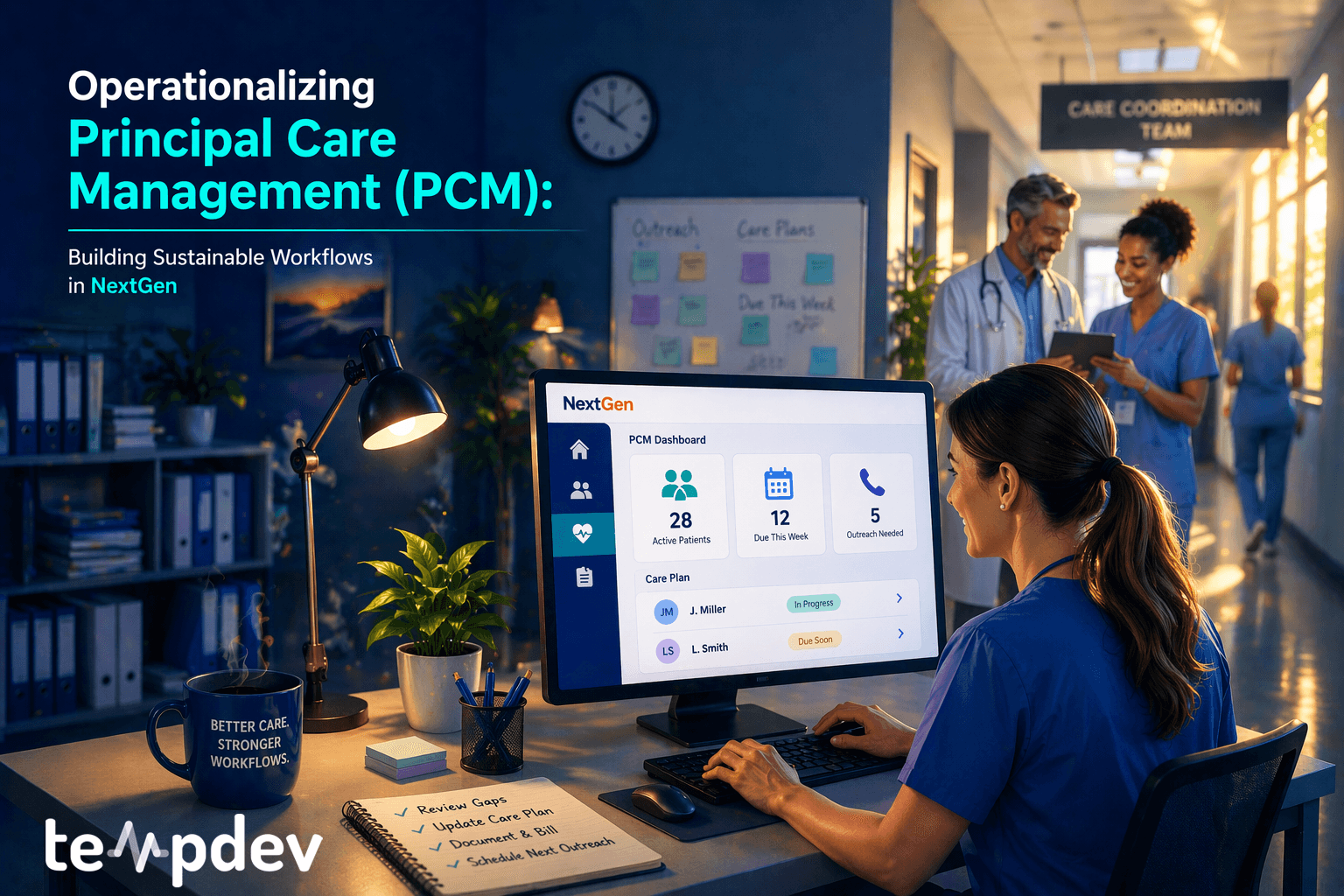
Operationalizing Principal Care Management (PCM): Building Sustainable Workflows in NextGen

Related articles:
Preparing Your NextGen Environment for Population Health Growth
Read ArticleBenefits of Custom NextGen EHR Templates
Read ArticleHow to Custom Develop NextGen EHR Templates
Read ArticleNextGen EHR Orders Management Practice Template
Read ArticleNextGen EHR Quality Measures Dashboard Template
Read ArticleNextGen EHR Operations Advisor Template
Read Article
Getting a Principal Care Management (PCM) program off the ground is a major move for specialty practices. While most groups are familiar with Chronic Care Management (CCM), it is important to understand the professional distinction. Generally speaking, primary care teams utilize CCM for patients with multiple conditions. PCM is specifically designed for specialists to manage patients with a single, high-risk condition. It allows for a deeper level of clinical intervention that can actually change a patient's life.
The real trick is not just knowing the clinical side. It is about having a system that is ready to go from day one. Without a structured workflow in NextGen, PCM can quickly become a massive administrative headache. It might even fail to meet compliance standards or financial goals. For many organizations, the difference between a thriving program and a stalled project is the technical execution. You need a partner that helps you surface the right data at the right time.
What Principal Care Management Is and Why It Matters for Specialists
Principal Care Management offers dedicated and proactive management for patients struggling with one complex chronic condition. Unlike CCM, which requires two or more conditions and is the staple of primary care, PCM focuses specialist resources on one high-intensity issue. This might be congestive heart failure, severe asthma, or end-stage renal disease. These are conditions that put the patient at a high risk for hospitalization or functional decline.
This program matters because it prevents disease from getting worse. It also reduces emergency department visits. By providing a higher level of care coordination, specialists help patients navigate complex treatment plans that require frequent adjustments. For the healthcare system, PCM helps avoid expensive hospital readmissions. This lowers overall costs while improving the patient's quality of life. Because these patients often need frequent medication changes and close monitoring, the intensive nature of PCM ensures they do not fall through the cracks of a busy specialty clinic.
Identifying Eligible Patients with the TempDev PCM Template
A successful PCM program starts with accurate identification. You need a system that flags qualifying patients before they are lost in the shuffle. By using the TempDev PCM template, the work of identifying these patients is already done for you. Eligibility usually requires a condition expected to last between three months and a year. These conditions must be complex enough to require frequent changes to the care plan. Rather than asking staff to manually hunt through charts or build their own queries, our template automatically surfaces patients who meet the criteria. This turns patient identification from a manual research project into a streamlined, automated process that populates your worklists immediately.
Designing PCM Workflows That Actually Work
A program is only as good as the workflow supporting it. To make PCM sustainable, you need structured documentation and clear task management. This ensures that everyone knows their role in the monthly care cycle. If the workflow is clunky, clinical adoption will suffer, and the program will lose its momentum.
With TempDev’s PCM template, you are not building tools from scratch. You are plugging in a proven solution. Our package includes the specific structures needed to handle the heavy lifting.
Structured Documentation
The template captures specific PCM requirements instantly. This includes the initial care plan and any necessary updates. It ensures you document medical necessity and specific risks without hunting for fields.
Monthly Touchpoints
We have built in automated reminders for monthly care management. This ensures you meet minimum time requirements and prevents the end-of-month scramble to hit billing targets.
Team Communication
The system uses NextGen tasking to keep the whole team on the same page. Clear handoffs are vital when you are managing complex medication changes in a specialty setting.
Reducing the number of clicks and providing a pre-built path ensures that your staff can spend more time on the patient and less on the screen. The goal is to make PCM a seamless, plug-and-play part of the day.
Supporting PCM Billing and Compliance Requirements
Billing for PCM services requires very careful time tracking. CMS has specific requirements for the number of minutes spent on care. Because PCM is billed by specialists, the documentation must explicitly show that the management is focused on the specific condition being treated.
The TempDev PCM template is a ready-to-use solution to track patient engagement automatically throughout the month. This data flows directly into your billing system, ensuring that the time spent on a patient is never lost or under-reported. Consistent documentation of the care plan is the best way to maintain compliance and strengthen your cash flow. Without this plug-and-play integration, staff often struggle to capture their time accurately. This leads to a lot of lost revenue for the specialty practice.
Using Reporting and Dashboards to Monitor PCM Performance
You cannot manage what you cannot measure. Leadership needs visibility into how the PCM program is performing. Business intelligence (BI) dashboards are the best way to monitor these metrics. They move you away from static spreadsheets and toward real-time insight.
Converting your NextGen data into actionable insights through TempDev’s reporting tools, allows you to track outcomes and cost reductions. Dashboards allow you to see if the program is scaling as expected. You can also find bottlenecks in the workflow. This level of oversight helps managers make data-driven decisions. For example, a dashboard might show that one clinic has high eligibility but low enrollment. You could then provide targeted training for that specific staff.
How TempDev Operationalizes PCM Programs for Specialists

At TempDev, we specialize in making complex care management programs work in the real world. We help you maximize your investment in NextGen by providing scalable, ready to use workflows. We know that every click matters. That is why we provide a PCM package that feels natural and requires minimal setup.
Whether you need to align your financial visibility or build custom reporting frameworks, our team brings 18 years of NextGen expertise. We do not just tell you what to do. We provide the templates and tools that solve the problem. Our team bridges the gap between technical SQL tuning and clinical workflow design. This ensures your PCM initiative is built on a very solid, proven foundation.
Conclusion: A Sustainable Future for Care Coordination
Operationalizing PCM in NextGen is about more than just checking a box. It is about creating a structured environment where specialists can focus on high-risk patients. You do not want them bogged down by administrative friction.
As healthcare shifts toward value-based care, having a scalable PCM program is a big advantage. It allows you to prove your value to payers. Most importantly, it provides a higher standard of care to your most vulnerable patients. We have already solved the technical challenges, so you can focus on the clinical ones.
Ready to simplify your care coordination technology? Reach out to us now to buy TempDev’s PCM package and start optimizing your specialty workflows and reporting.
Interested?
Agree with our point of view? Become our client!
Did you enjoy this read? Feel free to share it with your contacts.