

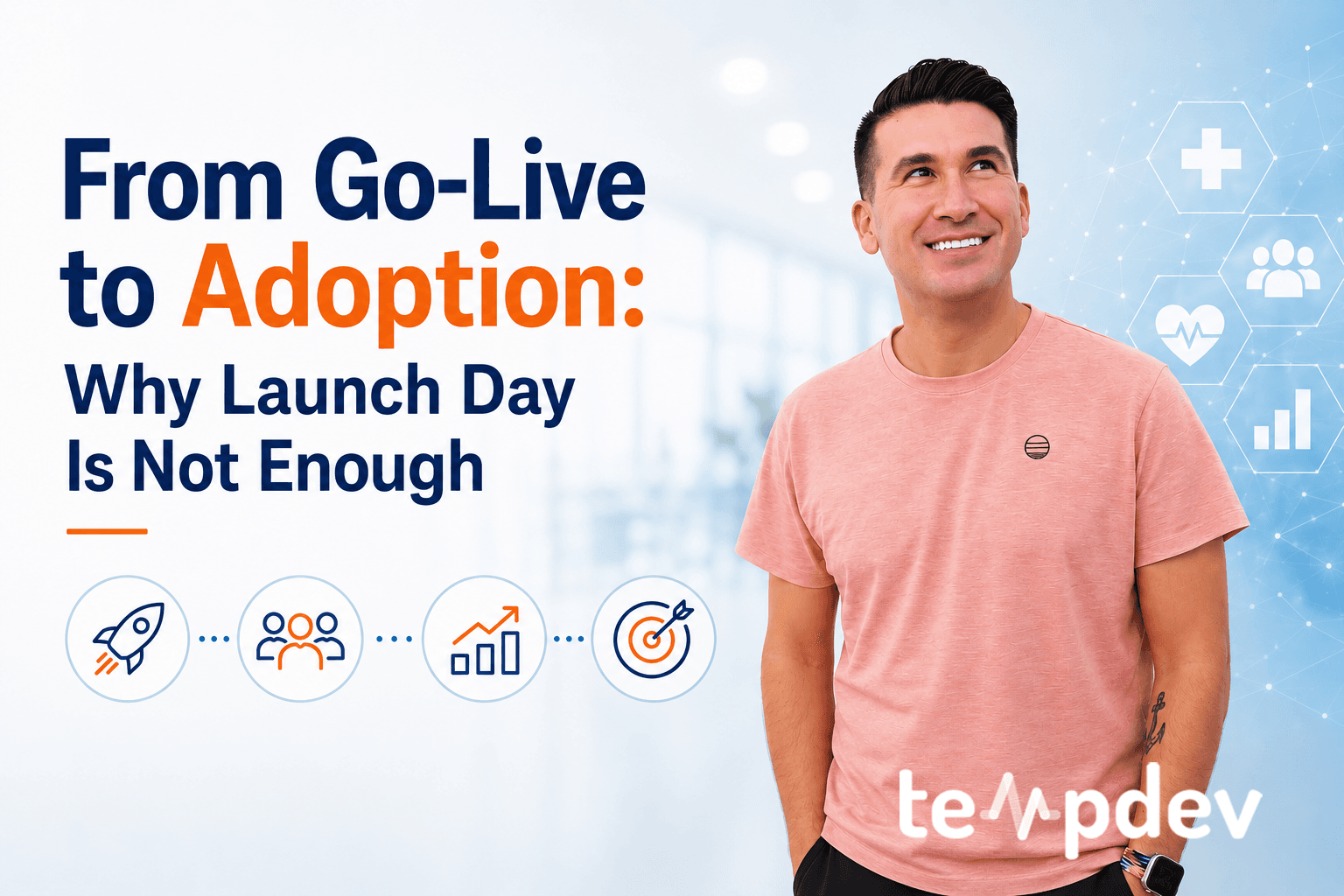
From Go-Live to Adoption: Why Launch Day Is Not Enough

Related articles:
6 Ways to Get NextGen Client Support with TempDev
Read ArticleBeyond Compliance: Maximizing the Strategic Value of Your NextGen Enterprise 8.3.1 Upgrade
Read ArticleFirst-90-Day Playbook: Accelerating Your NextGen Workflow Redesign
Read ArticleThe Hidden Cost of Scope Creep in NextGen Projects
Read ArticleChecklist for a Successful NextGen KBM Upgrade
Read Article
You had that date circled for months. The team pushed through late nights, went live, and everyone celebrated, maybe a little too soon. Then Monday hit.
Phones started ringing. Workflows that sailed through testing broke under real patients. Staff quietly went back to what they knew was faster. Leadership moved on because the launch was "done."
However, the truth that most people do not want to admit is that EHR adoption is harder than go-live. And go-live is not the finish line, but the starting line for real work.
Why Go-Live Is Not the Finish Line
Healthcare IT change management does not end when the system turns on. In fact, that is when the hardest part begins.
Users still need support. No amount of training prepares someone for their first live patient encounter with a new system. They will freeze, click the wrong thing, and get frustrated. Therefore, you need to be ready for support.
Workflow issues appear in real use. Testing environments are clean. The real world is messy, with patients showing up late, staff calling in sick, and insurance cards getting lost. Your perfect workflow will therefore break. That is normal, but ignoring it is not.
Adoption takes repetition. People do not learn a new system in one training session. They learn by doing it several times. EHR implementation success depends on giving users the space to practice, make mistakes, and try again.
Most importantly, the users who struggled most during training are rarely the ones who speak up after go-live. Go find them. Watch them work. That is where your real adoption gaps live.
Leadership needs visibility into what is working. If executives only watch go-live metrics, they miss the real story, which should answer the following questions: Are users actually using the system? Are they using it correctly? Are they bypassing it because it is faster? Those questions matter more than launch day.
The Difference Between Launching a Tool and Changing a Workflow
Here is where many projects go off track.
Technical completion is not operational success. You can install software perfectly and still fail. This is because EHR adoption is not just about the technology, but also whether people change how they work.
Why user behavior matters. A clinician who documents everything on paper and has a nurse enter it later is not using your new system. They are working around it. And they probably have good reasons. Find those reasons and address them.
Why training has to match real roles and responsibilities. General training does not work. A front desk receptionist needs different skills than a biller. A nurse needs different workflows than a physician. Role-based training is therefore critical.
Healthcare IT change management means understanding that a new system forces new behaviors. Those behaviors do not appear automatically. They must be taught, reinforced, and supported.
What PMs Should Watch After Go-Live
EHR implementation success requires active monitoring. Here is what project managers should watch after launch.
Support tickets. What questions keep coming up? If ten different people ask about the same thing, you have a training gap or a design problem. Fix the root cause, not just the tickets.
User confusion. Watch body language. Listen to how people talk about the system. Are they confident? Frustrated? Scared? These signals indicate where NextGen workflow optimization is most needed.
Missed workflow steps. Are people skipping required fields? Bypassing approval steps? Taking shortcuts? Sometimes the workflow is wrong, or even the training was unclear. Either way, you need to know.
Reporting gaps. Are managers getting the data they need to run their departments? If not, they will lose confidence in the system. And when leadership loses confidence, EHR adoption dies.
Feedback from clinical and administrative teams. Most importantly, ask the people doing the work. They know what is broken, what is slow, and what would make their jobs easier.
A good PM does not wait for problems to escalate. They watch for these signals daily and respond before small issues become big blockers.
The Budget Trap: Don't let your team spend 100% of the budget just to hit the go-live target. A good PM ensures the budget is reserved for post-implementation optimization. Once real workflows "stress-test" the system, you will need resources to fund the necessary technical and operational fixes.
How TempDev Helps Clients Move From Implementation to Real Adoption
Being in the NextGen ecosystem for over 15 years, I've learned what works after go-live and what doesn’t.
Role-based communication. We do not send the same message to everyone. Clinicians get clinical guidance. Front desk staff get front desk guidance. IT gets technical guidance. Everyone gets what they actually need.
Issue tracking. We log every problem, point of confusion, and request. Then we prioritize them. Not everything gets fixed immediately. But everything gets acknowledged; that builds trust.
Workflow adjustment. NextGen workflow optimization is continuous. We watch how users actually work. Then we adjust templates, permissions, and sequences to match reality.
Client accountability. We don’t do the work for you. We do it with you. Your team owns the workflows. We bring the expertise, and together, we drive EHR adoption forward.
Practical optimization after launch. The first month after go-live is messy. That is expected. Month two is about stabilization, month three is about optimization, and month four is about proving value. This is the rhythm of real EHR implementation success.
Most importantly, we stay involved. We are involved from implementation through post-go-live. Because healthcare IT change management is not a phase; it’s a commitment.
Final Thoughts
Go-live is a milestone. But it is not the finish line.
Real success comes after launch. EHR adoption takes training, repetition, visibility, and the willingness to keep improving.
If you are planning a NextGen implementation or struggling with adoption after go-live, you don't have to figure it out alone. TempDev helps clients move from launch to lasting adoption every day.
Want to learn more about our approach? Read about how Aaron leads complex NextGen implementations or check out our guide to the NextGen Enterprise 8.3.1 upgrade.
Ready to make your EHR investment actually work? Contact TempDev to learn how we support NextGen workflow optimization and drive real EHR implementation success.
Interested?
Agree with our point of view? Become our client!
Did you enjoy this read? Feel free to share it with your contacts.