
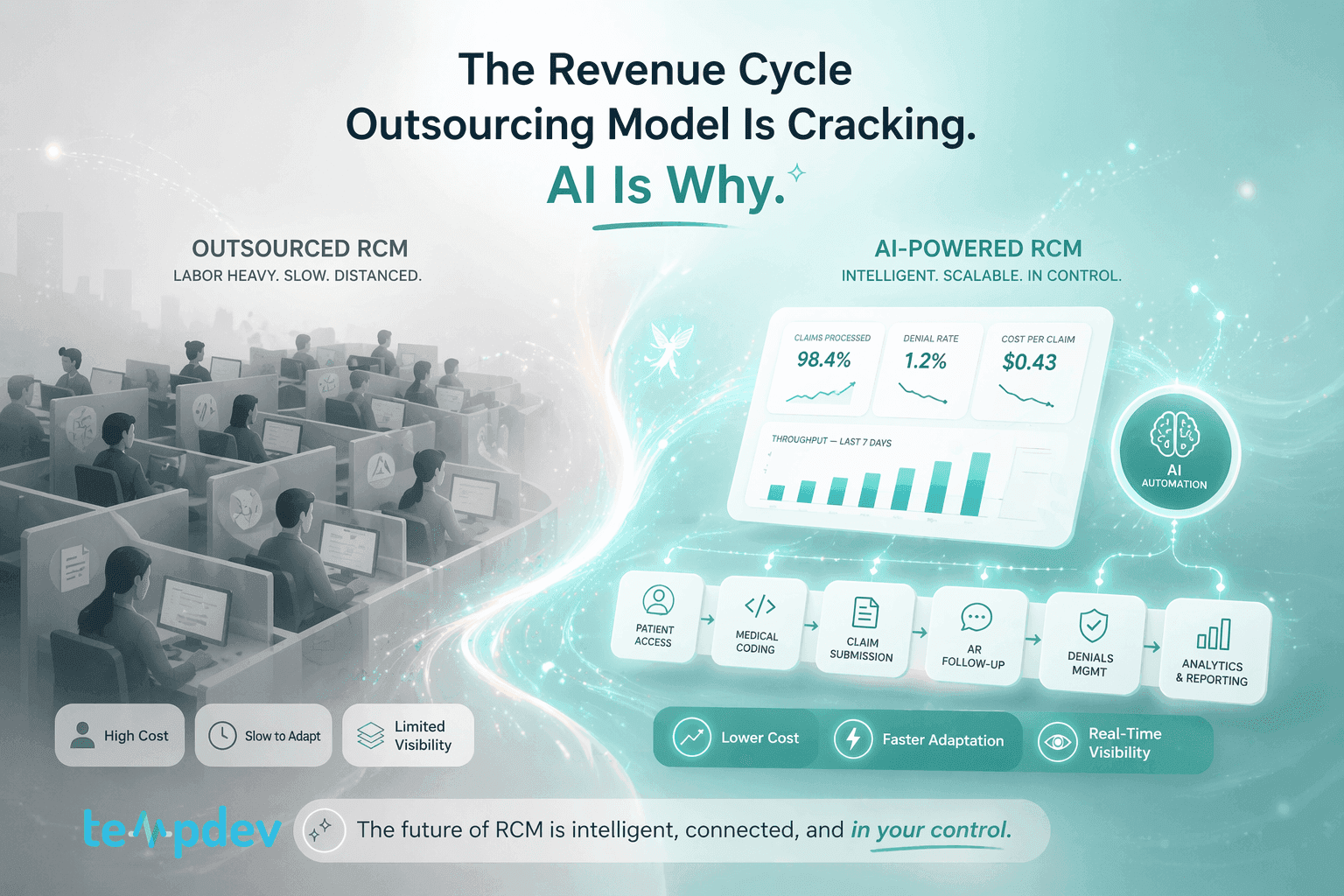
The Revenue Cycle Outsourcing Model Is Cracking. AI Is Why.

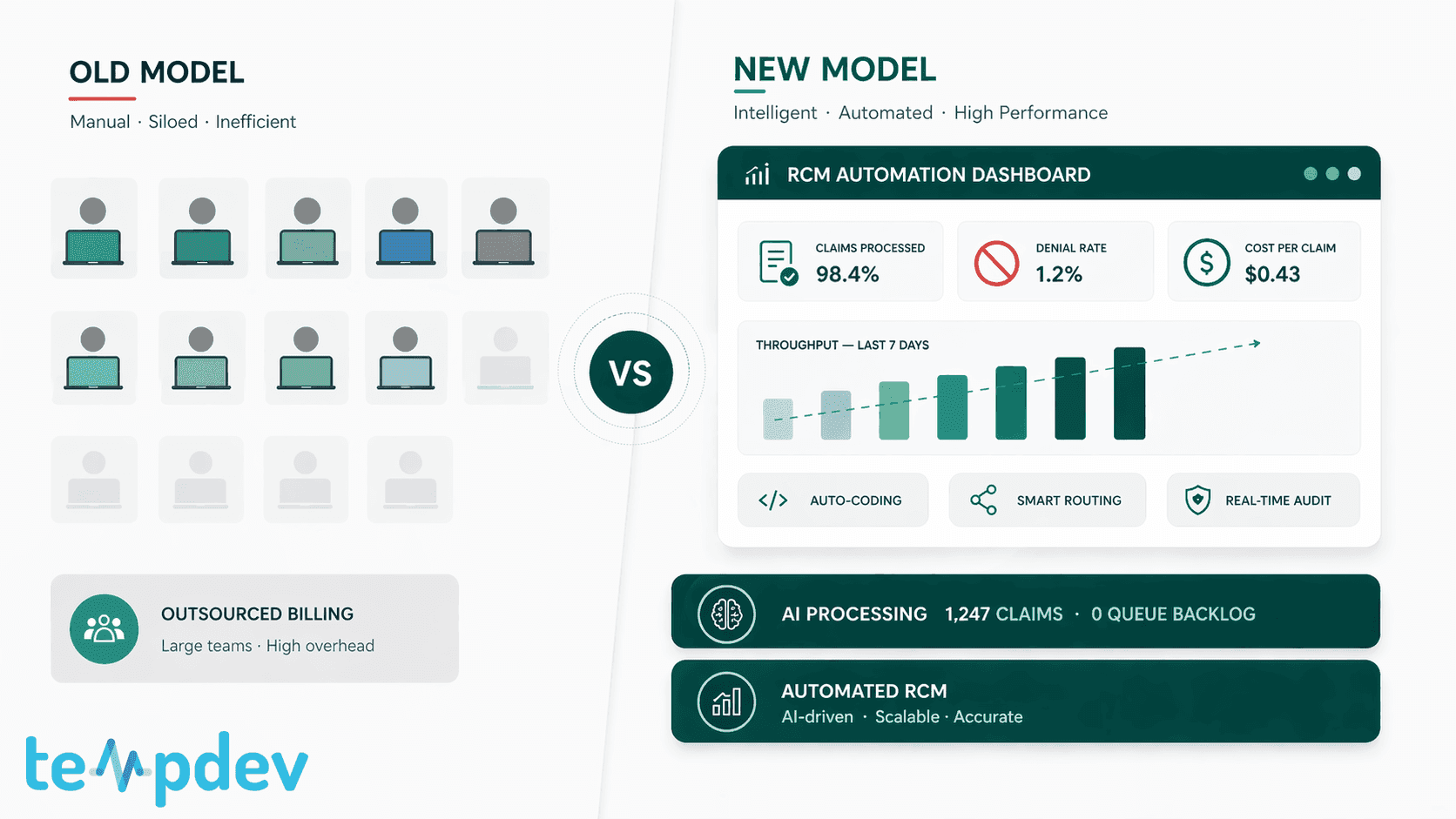
For years, the answer to revenue cycle complexity was to offload it; hand your billing over to a vendor with the infrastructure, the headcount, the payer expertise needed to take that heavy load off your operations. It was often outsource or bust. And in many cases, that still holds today.
But something is bubbling up on the ground. At TempDev, we are witnessing a slightly different move with clients: healthcare organizations are starting to bring revenue cycle operations back in-house, not because outsourcing has failed them, but because the reasons it was needed in the first place are changing. And AI is key in that.
The Original Case for Outsourcing RCM
Rarely was the decision to outsource revenue cycle management taken lightly - it was a sound solution to real constraints.
In healthcare, it's hard to bill. Payer contracts are all different. Coding rules change constantly. Denial management requires real specialization. Outsourcing provided a level of scale to most organizations that they'd never build on their own. For many, that meant offshoring: tapping into lower-cost labor markets abroad to manage billing, coding, and follow-up work at scale.
So nobody was having the revenue cycle outsourcing vs insourcing debate for most of the 00s and 10s. Outsourcing was simply the popular operational need of the day.
What's Changed: The Shift Toward Autonomous RCM
The most significant change in RCM AI automation is not just the fact that AI exists, but rather what it can do now. Activities that used to demand vast, dedicated teams, like coding backup, denial management, prior authorization workflows, and even appeal letters, are more and more being done through AI-powered platforms. An HFMA–AKASA joint survey of 530 healthcare finance leaders found that 80% of health systems are exploring or already implementing Generative AI in the revenue cycle. Autonomous RCM is reducing dependence on large external labor teams by carrying out end-to-end tasks with very little human involvement. AI isn't simplifying the payer environment nor making it any less complex, but it is changing the nature of the teams required to manage that complexity, one of the most profound changes occurring in revenue cycle management today.
Why Healthcare Organizations Are Re-Evaluating Outsourcing
When we talk to our clients, the issue isn't "our vendor failed us." It's mostly: "We're paying for a service built around labor, and we're watching AI reduce the cost of that labor. Why are we being charged more then?"
Fair enough. As AI in revenue cycle management progresses, the investment case for sprawling outsourcing deals has come under scrutiny. The common thread that justifies the move to in-house RCM is control. If your billing operations are working out of a vendor's system, you're not free to iterate, troubleshoot, or react to payer-specific issues. You're operating within someone else's workflow logic, reporting structure, and frequently a tech stack that does not interoperate cleanly with your EHR. This "technology friction" introduces real delays, and in the revenue cycle, delays directly mean cash flow impact.
The reassessment should be seen as a return, not a rejection of outsourcing. But it comes with a realization that the infrastructure environment is different now.
The Control Factor: Why In-House RCM Is Becoming More Viable than Ever
The historic weak point in the case for in-house RCM has been on one side: cost. That equation is changing. AI, machine learning, and deep learning together are expected to save $200 billion to $360 billion in healthcare expenses, with a sizeable share of that opportunity in the revenue cycle. As medium and large organizations leverage AI platforms against what previously needed large teams, the per-unit cost to run in-house RCM operations falls.
What organizations get in return is considerable: immediate access to operational data, the ability to customize workflow logic per payer contract, quicker adaptation when denial patterns shift, and seeing real-time performance rather than a vendor report once a month.
In-house RCM also brings revenue cycle operations under the org bundle—finance, IT, and operations. Feedback loops are shorter, accountability is clearer.
There's also the human side of the equation. Offshoring RCM operations, a common practice for decades, introduced language gaps, cultural distance, and institutional knowledge loss that are difficult to measure but very real in day-to-day operations.
Bringing the work back in-house closes those gaps, building a team with direct context for your payers, your patients, and your workflows. For organizations tired of the RCM technology strategy decisions being made by a third party, that alone can shift the calculus.
Where Most Organizations Miss
Simply, technology alone isn't the answer. We've seen organizations put money into capable platforms, only to hit a ceiling not because the technology failed, but because the workflow underneath it wasn't designed to support it. If your pre-authorization process is flawed, scaling it up with healthcare billing automation will deliver more intensified errors faster. The AI will mirror the given blueprint of structure.
The biggest oversight is underestimating the complexity of workflow design. Someone needs to own this from beginning to end in an in-house RCM setup: how claims move, what denotes a denial, and when an appeal gets launched. Tech that sits on top of organizations, skipping this design work, misses the mark.
Where accountability holes exist makes the problem worse: the revenue cycle touches clinical, administrative, finance, and IT teams. If there's no clear ownership at every handoff, the system breaks down even when the technology is sound.
What Has to Happen
For the organizations we're working with who are successfully shifting, we've started to identify a pattern.
Their processes are well-documented and clean prior to automating anything. Revenue cycle optimization in healthcare depends on structured data and meaningful dashboards, not static reports. RCM AI automation healthcare only performs at its potential when the foundation underneath it is sound.
They've identified owners for coding performance, denial trends, and EHR-to-billing workflow. And their systems: EHR, practice management, and billing, are properly aligned to smooth the flow of information between them.
On NextGen, where configuration decisions have cascading downstream effects, this system alignment is often the winning or losing investment that comes before you click "go."
It's Not In-House or Outsource
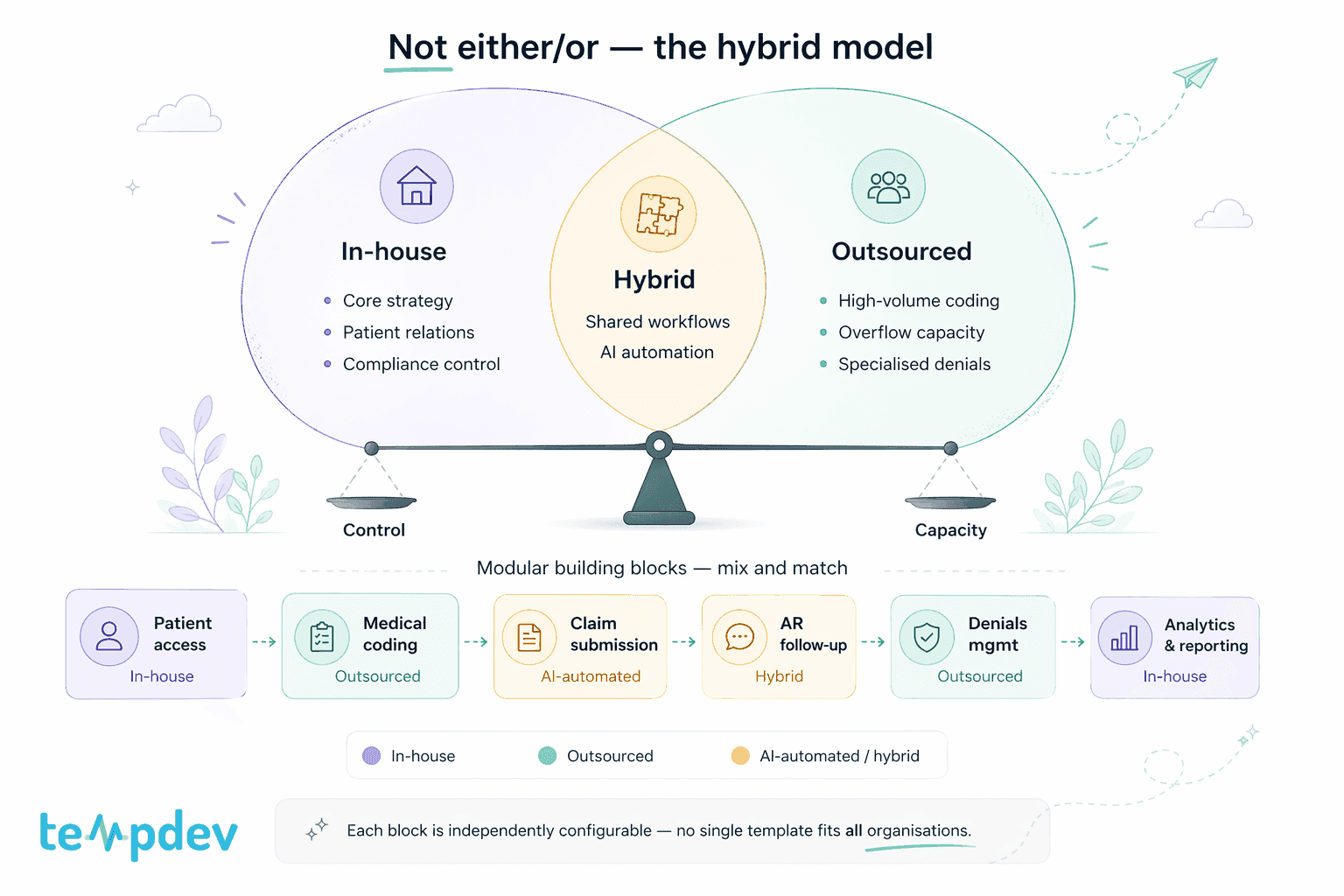
It's not an either/or argument when talking about revenue cycle outsourcing vs insourcing, though healthcare revenue cycle trends suggest the balance is shifting.
Many clients are choosing hybrid models: doing core billing in-house but maintaining targeted vendor relationships for focused coding specialists or specific payer categories. Healthcare RCM automation has made this kind of selective approach more practical than it used to be.
And the real switch isn't just moving around where the processing happens. It's about whose system you're owning: moving from a reliance on labor toward an infrastructure that offers visibility, chances for automation, and leverage for the future. That's the essence of a sound RCM technology strategy.
How Healthcare Leaders Change
In deciding on your own RCM model, don't only see it as a vendor choice. Understand it as an infrastructure choice. The question isn't just "outsource or insource?" It is: where do we need the revenue cycle to be in three years, and what do we need to install today in terms of systems, workflows, and team building?
At TempDev, we have been helping clients navigate this transition by finding infrastructure holes, creating workflows that allow for healthcare billing automation to perform effectively, and building the reports that leadership actually needs. Not every organization is ready to leap into in-house RCM. But for many, this option is more realistic and more strategic than ever.
If you're starting to ask these questions, we'd be glad to think through it with you.
Ready to get more of your NextGen system?
Help your organization achieve measurable improvements in efficiency, compliance, and performance.