


Why Quality Reporting Needs to Move Closer to Daily Operations


Related articles:
Unlock Growth with TempDev’s Appointment Analysis Power BI Dashboard
Read ArticleUse TempDev’s NextGen Order Management BI Dashboard to Drive Clinical Insights
Read ArticleUtilize NextGen EHR Operations BI Dashboard to Improve Clinical Workflows
Read Article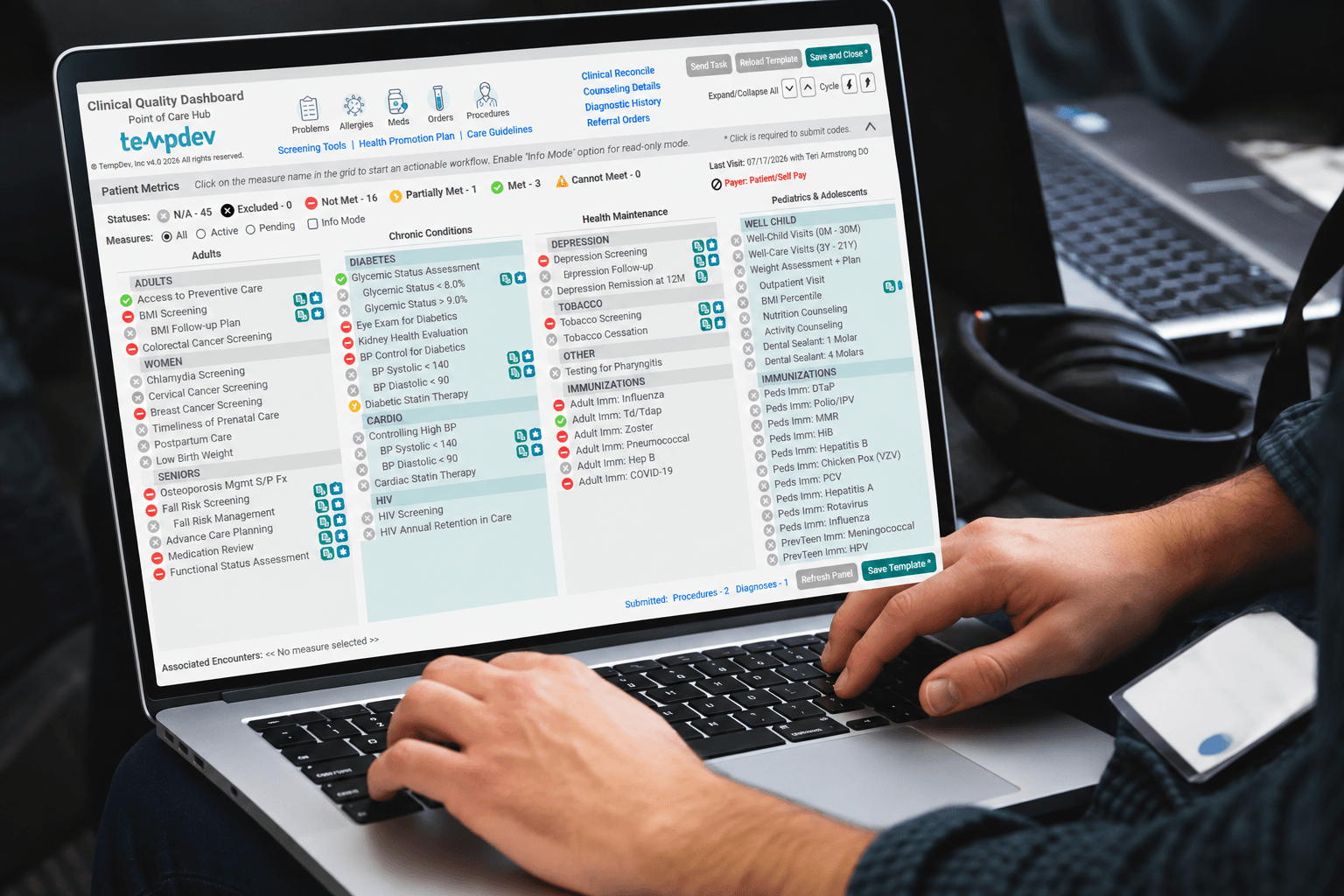
In healthcare administration, treating quality reporting as a cyclical, year-end event introduces substantial operational risk. Every reporting season, clinical and administrative teams face a predictable strain: scraping data, reconciling disparate charts, and attempting to retroactively validate data for value-based care programs like HEDIS, UDS, GPRA, or MIPS.
When quality reporting is treated like an annual audit, it ceases to be an indicator of clinical excellence and instead becomes a high-stakes administrative burden. Many practices utilize quality dashboard reports to see how they are doing or separate population health products to get patients in the door, but they severely lack actionable data at the exact point of care.
Forward-thinking healthcare organizations mitigate this risk by shifting their perspective. Instead of relying solely on retrospective reporting cycles or disconnected population health tools, they are embedding real-time insights directly into daily clinical workflows using dedicated tools like the TempDev Quality Measures Template. Integrating a single point-of-care view protects reimbursement revenue, reduces staff burnout, and allows for clinical intervention while the performance window is still open.
Take a look at the updated Quality Measures Dashboard:
The Problem With Retrospective Quality Reporting Data
The fundamental flaw in traditional quality measurement is latency. Analyzing data that is three, six, or twelve months old means leadership is operating on lagging indicators. By the time a report reveals a decline in diabetes screenings or depression metrics, the opportunity for proactive care coordination has passed, and care gaps remain unaddressed.
Relying solely on retrospective data places operational leadership in a permanently reactive stance. Discovering a systemic documentation gap late in the performance year forces a compressed, frantic reconciliation period.
This scramble is highly inefficient. Forcing providers to retroactively search historical records and modify charts to satisfy compliance parameters heavily contributes to clinician burnout. It transforms clinical metrics into administrative hurdles rather than reflections of patient outcomes.
Bridging the Gap at the Point of Care
While traditional dashboards show where a practice stands globally, they fail to assist the physician when a patient is sitting right in front of them. This is where a dedicated point-of-care tool completely transforms the workflow. Rather than forcing a physician to think through complex parameters or review separate retrospective reports, a unified quality measures template aggregates every program the practice participates in, including HEDIS, UDS, GPRA, and MIPS, into a single actionable view.
This setup removes the guesswork by presenting a clear checklist: here are all the things you need to do for the patient to be compliant. Furthermore, the system can automatically calculate and apply CPT II codes to ensure proper billing where appropriate. This turns standard encounters into the best possible opportunity to work with patients to close care gaps in real time, leveraging the valuable minutes when the patient is physically in the room.
Establishing Clinical Visibility within the Performance Window
To maintain financial stability and predictable performance, organizations require continuous data visibility throughout the performance period. Care teams and clinical coordinators must have access to accurate performance metrics during daily workflows, not merely when reporting deadlines approach.
Per guidelines from the Centers for Medicare & Medicaid Services (CMS) and regional payer programs, maximizing performance across electronic clinical quality measures (eCQMs) demands precise, concurrent documentation. Without real-time visibility, clinical teams lack the data necessary to self-correct operational drift.
When visibility is integrated into the active care cycle, operational efficiency increases. If a medical assistant receives a clear, point-of-care alert regarding an open care gap while the patient is in the clinic, the gap can be resolved during the encounter. This real-time resolution eliminates the need for resource-intensive, retrospective patient outreach campaigns, stabilizing your scores and optimizing resource allocation.
Leveraging Dashboards to Drive Targeted Action
Optimizing this workflow requires a structured quality reporting dashboard built into your electronic health record (EHR) system. Clinical staff lack the bandwidth to extract actionable insights from dense, raw data extracts. They require clear, synthesized data that identifies immediate operational priorities.
An engineered dashboard translates complex data sets into highly directed tasks. Rather than presenting abstract percentages, it provides care coordination teams with precise registries of attributed patients missing specific lab values, screenings, or clinical documentation.
Centralizing this data allows leadership to identify operational bottlenecks instantly. Administrators can compare cross-clinic data to isolate which sites require targeted workflow retraining. This shifts the executive strategy from retroactive error correction to proactive, daily resource management.
Operational Requirements for Healthcare Leadership
For healthcare executives, practice administrators, and revenue cycle leaders, operational control depends on data integrity. Revenue predictability in value-based reimbursement frameworks requires a clear view of your risk adjustment and compliance metrics.
Quality reporting integrated into daily operations allows leadership to analyze four core operational dimensions at a glance:
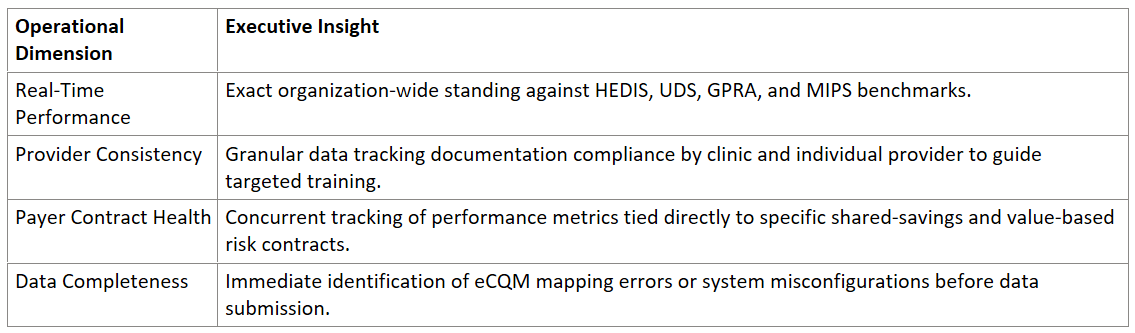
Possessing this level of operational transparency allows executives to make data-driven decisions early in the fiscal year, protecting the organization's bottom line from avoidable reimbursement penalties.
Building a Proactive Reporting Infrastructure
Transitioning away from reactive reporting does not necessitate complex third-party software additions. Instead, it requires system optimization and disciplined workflow design. Enterprise EHR systems, such as NextGen, contain the intrinsic capabilities required to track these metrics, but the system configuration must align with the operational realities of clinicians, nurses, and medical assistants.
Proactive quality reporting is achieved by lowering the technical barriers to compliance. This involves designing optimized templates like the TempDev Quality Measures Template that naturally guide providers through required documentation during the standard patient encounter. When the system architecture is properly aligned, quality tracking occurs seamlessly as a byproduct of care delivery, rather than as an administrative add-on at the end of the shift.
By optimizing your existing EHR infrastructure around your actual clinical workflows, quality reporting ceases to be an annual operational crisis. It becomes an integrated, predictable business function that secures revenue, minimizes administrative friction, and ensures consistent care delivery.
Interested?
Agree with our point of view? Become our client!
Did you enjoy this read? Feel free to share it with your contacts.